
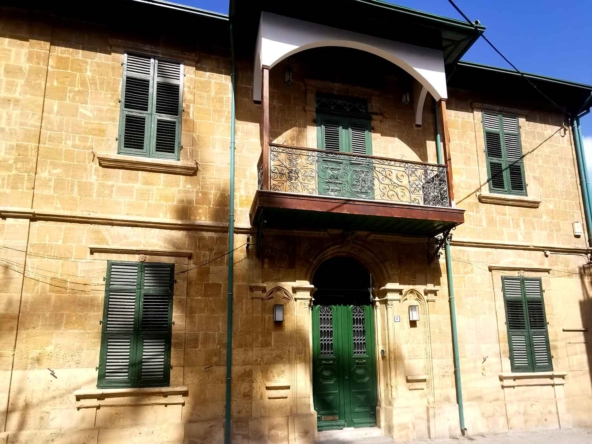
The scientific and technical chamber (Etek) urged the government on Wednesday to expediate newly announced measures aimed at protecting and restoring listed buildings across Cyprus, warning that delays could further endanger historic structures.
Chamber president Konstantinos Konstantis expressed strong support for the reforms promoted by the interior ministry, describing the island’s listed buildings as a core part of its historical identity and stressing the need for immediate action.
“Listed heritage is an integral part of the historical identity of the place and its preservation is a top priority,” he said.
His comments follow a recent collapse of a listed building in the old walls of Nicosia, an incident which has renewed concern over the condition of historic properties.
Konstantis warned that dangerous buildings remain a serious risk and called for systematic inspections to ensure structural problems are detected early.
He said regular monitoring of buildings was essential to “avoid dangerous situations” and to safeguard both public safety and architectural heritage.
The chamber welcomed a series of policy changes designed to make restoration projects more viable for property owners.
Among the most significant is a rise in the recognised restoration cost used to calculate support and incentives, a move intended to reflect rising construction prices which have discouraged conservation works.
Under the revised framework, the maximum recognised restoration cost for listed buildings of up to 300 square metres increases from €1,400 to €1,700 per square metre.
For buildings between 301 and 1,000 square metres the limit rises from €1,300 to €1,600 per square metre, while properties exceeding 1,000 square metres will see the ceiling increase from €1,000 to €1,300 per square metre.
Authorities are also advancing broader reforms aimed at simplifying procedures and encouraging the reuse of historic structures.
These include a fast-track licensing process for listed buildings, exemptions from permits for certain low risk works, and the creation of a unified repository for listed building development coefficients to allow faster transfers between properties.
Additional changes involve the establishment of a single licensing point for restoration applications, the creation of regional conservation offices, the digitisation of cultural heritage records and the publication of guidance for owners and restoration professionals.
Konstantis said the proposed repository for listed building coefficients could significantly improve the system by allowing quicker transfer and use of development rights associated with protected properties.
He called on the state to move forward without delay in implementing the announced measures and in establishing a framework for routine building inspections to ensure the preservation of historic structures.




Click here to change your cookie preferences