
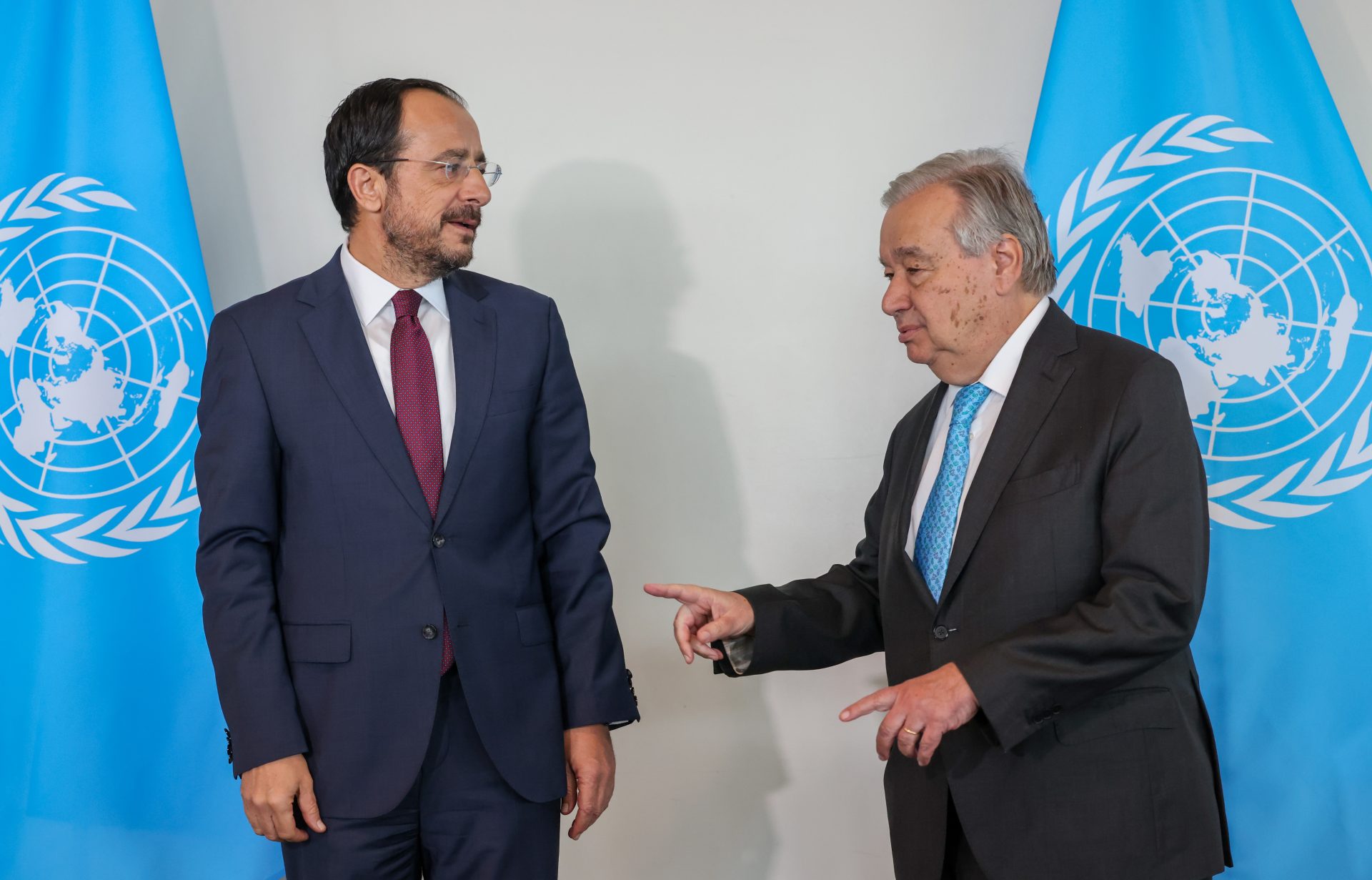
President Nikos Christodoulides will hold a meeting with United Nations Secretary-General Antonio Guterres next week, with that meeting most likely set to take place on the sidelines of next week’s European Council summit in Brussels, government spokesman Konstantinos Letymbiotis said on Thursday.
He said that the meeting will take place next Wednesday, and that its holding is “part of the clear and firm political will of President Christodoulides to resume negotiations on the Cyprus issue”.
At the same time, he added, the meeting “confirms the firm and continuous interest” of Guterres in the Cyprus problem “in a period of intense geopolitical developments”.
The Greek Cypriot side’s willingness to restart negotiations, he said, is “a given”. He then added that those negotiations should restart from the point at which they were cut off in the Swiss ski resort of Crans-Montana in 2017, and be geared towards a bizonal, bicommunal, federal solution.
He said that an enlarged meeting on the Cyprus problem, which would involve the island’s two sides, the UN, and its three guarantor powers, Greece, Turkey and the United Kingdom, “can act as a catalyst for achieving substantial progress”.
“We declare our readiness to attend such a meeting, so that all aspects of the Cyprus problem can be discussed and the conditions for the restart of the substantive negotiation process can be restarted,” he said.
He added that on this front, “the message is clear”, and that “on our part, there is clear political will and readiness”.
However, UN envoy Maria Angela Holguin had said in January that no enlarged meeting on the Cyprus problem could be held until more before “results on the confidence-building measures” between the island’s two sides are achieved.
Since then, Erhurman and Christodoulides met last month, with the pair meeting without the presence of the UN for the first time. However, while Christodoulides described that meeting as “open and honest”, and Erhurman was largely in agreement with him, describing it as “open, sincere and useful”, no concrete results were achieved.
Next week’s meeting comes a month after Turkish Cypriot leader Tufan Erhurman had met Guterres in New York, with Erhurman saying after that meeting that with regard to talks aimed at resolving the Cyprus problem, “this time it must be different”.
“I shared with the secretary-general face to face my view that, especially in light of previous experiences and the disappointments suffered by Turkish Cypriots, what is important to me is not that the meetings are for the sake of meetings, but that this time, they are for the sake of reaching a solution,” he said after the meeting.
To this end, he said he “had the opportunity to share with him that we have developed our four-point proposal, based on his own frequently used phrase, ‘this time it must be different’”.
Those four points, sometimes referred to as “preconditions” – a term Erhurman resents – foresee that the Greek Cypriot side accept political equality, time-limit negotiations, and preserve all past agreements, and that the UN guarantee that embargoes placed on the Turkish Cypriots be lifted if the Greek Cypriot side leaves the negotiating table again.
Guterres’ spokesman Stephane Dujarric, meanwhile, had in his most recent public intervention on the Cyprus problem elected to speak about crossing points between the island’s two sides, with no crossing points having opened for almost seven years.
He said the UN is hoping for new crossing points to open “as soon as possible”, with Erhurman later accusing Christodoulides of obstinance regarding plans to open a through road between Athienou and the Nicosia suburb of Aglandjia, which would route, at least in part, through the north.
He had said that various proposals had been made to Christodoulides so as to allow the road to open, but that Christodoulides had rejected all proposals. Christodoulides, meanwhile, had suggested a new idea for a crossing point to be opened in Nicosia’s old town.
When he took office in October last year, he said, he “found a map in front of me marking four new crossing points” – in Mia Milia, Louroujina, Athienou and Aglandjia – all of which had been discussed at the enlarged meeting on the Cyprus problem which was held in New York in July last year.
“While we have four crossing points in place, … constantly developing new proposals to resolve the issue of a few hundred metres, to now set this aside and propose discussing new crossing points in addition to these unresolved ones seems like nothing more than throwing a spanner in the works and pushing the matter towards an impossible outcome,” he said.


Click here to change your cookie preferences