
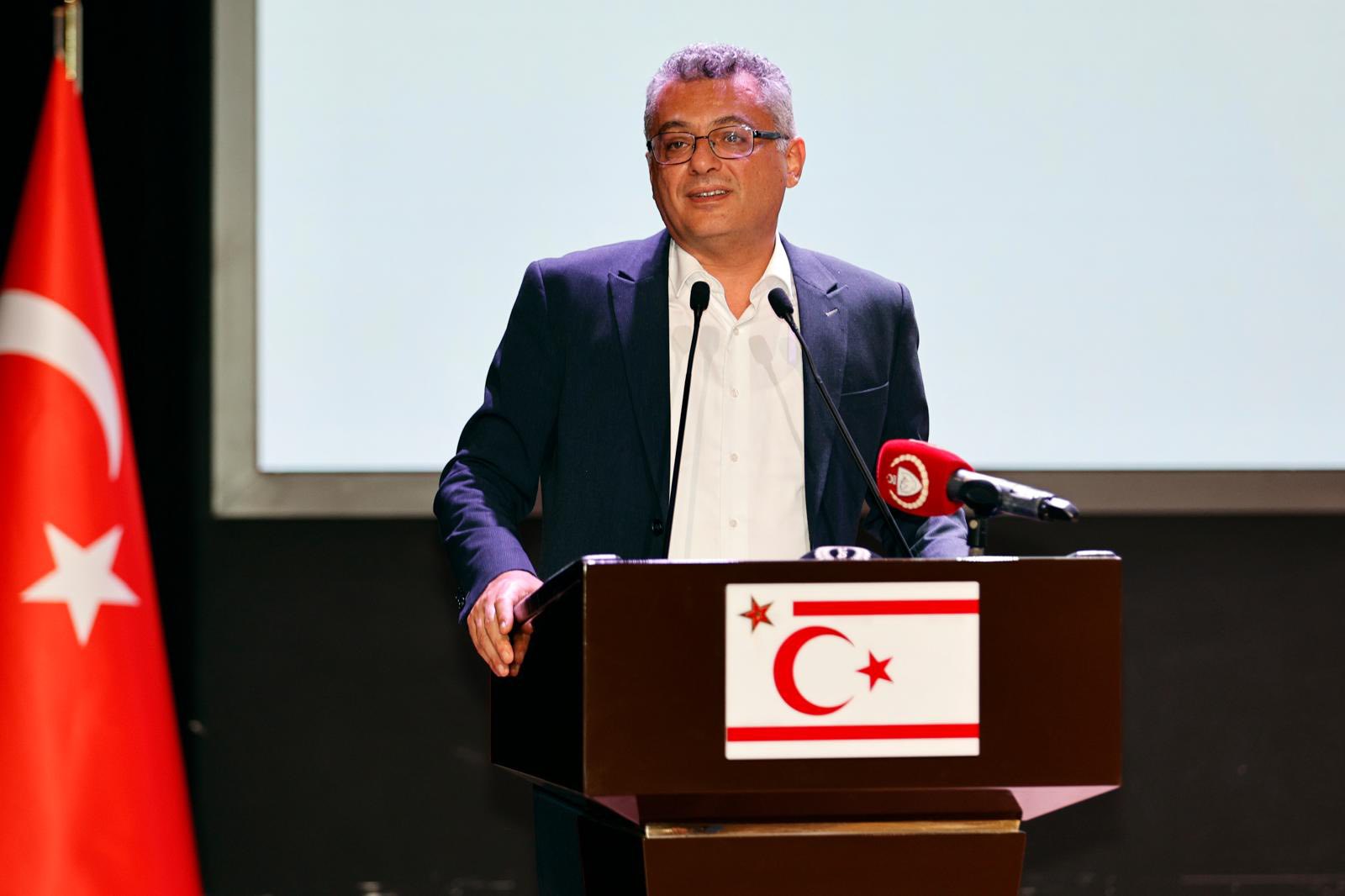
Turkish Cypriot leader Tufan Erhurman on Friday vowed not to “fall for the provocation” of recent comments made by both President Nikos Christodoulides and government spokesman Konstantinos Letymbiotis in relation to the Cyprus problem.
“Statements continue to pour in from the Greek Cypriot leadership. These include remarks made at meetings of civil society organisations, opening ceremonies, answers given to unrelated questions, official statements, and so on,” he began.
He said that he had told Christodoulides that “since we are continuing talks, we had warned against constantly bringing up the issue at every meeting and every opening ceremony, against trying to establish new positions in the absence of our counterpart, against poisoning the atmosphere, and against engaging in blame games”.
The Turkish Cypriot side, he said, “has taken the utmost care to avoid touching on this issue at opening ceremonies and at meetings of civil society organisations”, while when speaking to media outlets about the Cyprus problem, “we have not presented a new position unknown to our counterpart”.
“We have not shared with the public what our counterpart has said or stated unless they themselves had made it public. We have responded to only about a fifth of the statements which have come in, or even avoided responding to those,” he said.
However, he added, “it does not stop”.
“Claims and positions which have not been raised in bilateral meetings are being attempted to be introduced through the media,” he said.
Nonetheless, he said that “there is only one way for a provocation to succeed – for the person being provoked to fall for the provocation”.
“If you do not fall for the provocation, the provocation will hang in the air pointlessly. We are at the table. We are proceeding with patience, composure, seriousness, and determination,” he said.
That notwithstanding, he did pass comment on Letymbiotis’ insistence on Thursday that Christodoulides sits at the negotiating table not only as the leader of the Greek Cypriot community, but as the president of the Republic of Cyprus.
“Now, there is the issue of ‘status at the negotiating table’! … They said it once and I did not respond. Yesterday, they said it again! Everyone knows that there are currently no negotiations and that we are only at the ‘discussion table’. Regardless of what table it is, the whole knows that we are, and will be, at the table as two ‘leaders’,” he said.
He added that “all United Nations reports and records regarding these processes are public”, before pondering why such statements are being made.
“When everything is so clear, why do they keep repeating this position, which nobody, including us, accepts, and not repeat it to my face, but to the public? Of course, this claim, this ‘position’, has no value or meaning whatsoever when the facts are clear, and everyone knows this. So, what is the aim? To help towards a solution?”
The word “president” was not used in either of United Nations Secretary-General Antonio Guterres’ two reports on Cyprus which were published in January, with those reports referring to Christodoulides exclusively as “the Greek Cypriot leader”.
Previously, Christodoulides had in his own update in last July’s report on the UN good offices in Cyprus outlined his view regarding the position he holds in Cyprus talks.
“As per the longstanding practice in meetings with broader format that include the contractual parties to the 1960 treaties, I represented the Republic of Cyprus – through my capacity as president – as a contracting party to the said treaties, whilst also representing the Greek Cypriot community for the intercommunal aspects of the discussions,” he wrote.
This stance had irked Turkish Cypriot leader of the day Ersin Tatar, who wrote in his own update in the same report that “Christodoulides presented himself both as the ‘president of the republic of Cyprus’ and as the ‘representative of the Greek Cypriot community’ – thereby complicating the tone and dynamics” of talks.
Tatar also referred to himself as “the fifth president of the Turkish Republic of Northern Cyprus”.
At the same time, the UN does recognise Christodoulides as the president of the Republic of Cyprus and has recognised Greek Cypriot-led governments as governments of the Republic of Cyprus in the aftermath of the collapse of the constitutionally foreseen bicommunal Cypriot governments since 1964.
UN resolution 168, passed in March 1964, recognised the government of the day as the government of Cyprus, notwithstanding the ejection of its constitutionally mandated Turkish Cypriot members.
Additionally, the creation of the UN peacekeeping force in Cyprus (Unficyp) in 1964 was pursuant to a status of forces agreement forged upon letters sent between UN secretary-general of the day U Thant and foreign minister of the day Polycarpos Yiorkadjis.

Click here to change your cookie preferences