
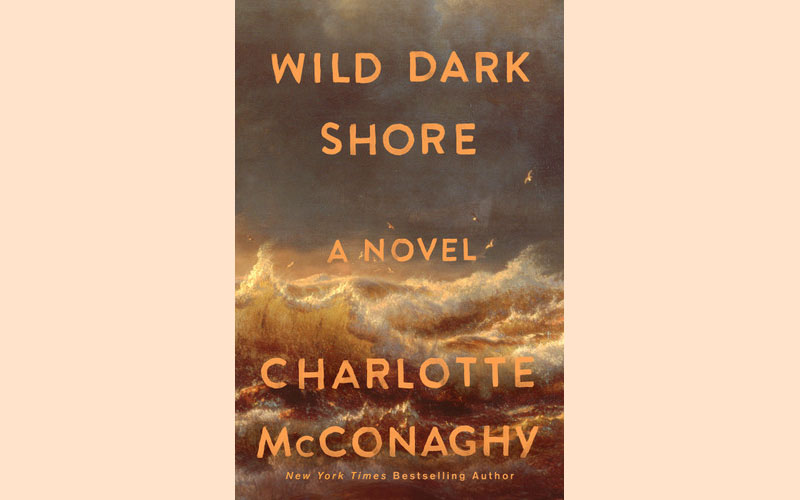
Wild Dark Shore by Charlotte McConaghy
By Philippa Tracy
Dominic Salt is struggling to deal with the death of his wife, Claire, nine years earlier. She died when her youngest child, Orly, was born. Since then, Dominic and his three children, Orly, Raff and Fen, have been living on a remote, fictional island, called Shearwater, about 1,500km from Antartica. They are there to manage a huge seed vault, of over three million seed varieties. But rising sea levels mean that the island is slowly disappearing into the sea. A naval ship is due to collect the family, and the seeds, in less than two months. Before then, they must sort and pack the seeds that will eventually fit into a much smaller vault, off island. They can save only the seeds essential to feed the population when inevitable future disasters befall humanity.
Recent events on the island are shrouded in mystery. There is a sense of impending danger. It is not just the increasingly extreme weather shifts; everyone in the Salt family seems to be harbouring secrets. The research centre at the heart of the biodiversity conservation work has been abandoned and it is unclear where the senior botanist, Hank, has gone. Or why? All lines of communication on the island have been cut.
When a woman washes ashore from a shipwreck, it is also not clear whether or not she will survive or what brought her there. She has her own secrets, which are slowly revealed through her first-person narrative. The story is told in short chapters with alternating character voices.
Current concerns about climate change run throughout the novel. Nine-year-old Orly tries to get close to Rowan, the stranger, initially nursing her back to health, perhaps looking for a mother figure. His precious knowledge of the seed bank, and the great botanical discoveries of the 20th century, underpin his love of nature. He is already grieving the seeds that will be lost.
Rowan gets close to the family but takes every opportunity to talk about why she does not want children herself. While she expresses popular concerns linking population growth and climate change, she may not be telling the whole story. She says that to bring children “into this apocalypse is selfish and unethical”. But she also seems to be scarred by painful memories and resents the “unfathomable pressure on women to have babies.”
Grief is the main theme in the novel. The whole Salt family is grieving the death of Claire in different ways. Raff loses himself in his fascination with the whales; he is also dealing with another death on the island. Fen sleeps on the beach, among the seals and is stealing her mother’s items from her father, one by one. Dominic lives for his children but is unable to really connect with them or express his emotions. Rowan, who is good at identifying emotional vulnerabilities in others, sees him as coming from a generation of men who never learnt to express their feelings. She is, in some ways, equally cautious with her own emotions. But she has learnt that nature is unpredictable and uncontrollable, and that the nature of life is that we must love things “knowing they will die.”


Click here to change your cookie preferences