
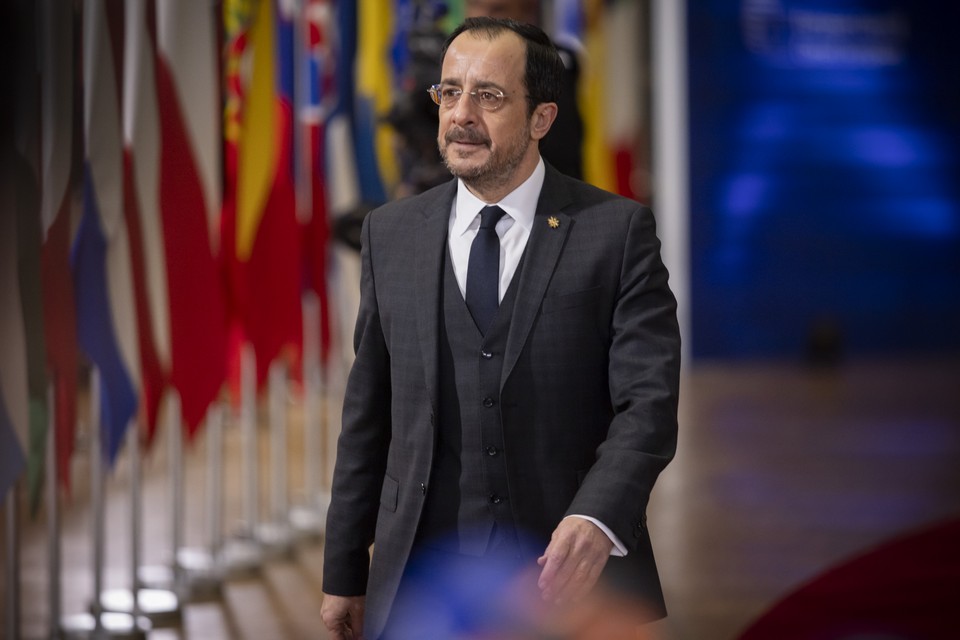
President Nikos Christodoulides on Thursday said that countries in the Middle East expect there to be “some initiative” to end the ongoing conflict in the region, and suggested that the European Union can contribute to that initiative.
“I believe we should exchange some views … as the European Union, to have a role in an initiative, because if there is no initiative, the continuation of this situation will have a negative effect on all of us,” he said upon his arrival at the day’s European Council summit in Brussels.
He then added to this end that the EU must offer “support for Lebanon”, pointing out that Lebanese President Joseph Aoun had made an “official and public proposal” to hold direct negotiations with Israel after Israel unleashed heavy missile fire both on the south of Lebanon and on its capital, Beirut.
He added that Aoun had asked him to put the matter forward at the day’s summit, and said that “beyond that, if there is a positive response from the other side, we are ready, within the framework of the excellent relations we have with everyone, for the Republic of Cyprus to help in this direction”.
Aoun had said earlier in the week that he hoped to achieve a “breakthrough” in his efforts to hold direct talks with Israel.
“No one expected that the war of others would once again take place on our land, a war with which we have nothing to do, neither directly nor indirectly,” he said, before lamenting that “some are seeking support from abroad against others at home”.
He had added that there is “no possible military horizon” to the ongoing conflict between Israel and Hezbollah, and that as such, “the longer we delay [negotiations], the greater the damage will be”.
Christodoulides’ support for direct talks between Israel and Lebanon comes after French President Emmanuel Macron had said that “Israel must seize this opportunity to initiate talks and declare a ceasefire, find a lasting solution, and allow the Lebanese authorities to fulfil their commitments to Lebanon’s sovereignty”.
He had also said that Israel “must refrain from launching a large-scale offensive and cease its massive airstrikes, especially since hundreds of thousands of people have already fled the bombings”.
Israel and Lebanon have not engaged in direct negotiations of this nature since Israel invaded southern Lebanon in 1982.
Relations between Cyprus and Lebanon have strengthened since Aoun was elected as Lebanon’s president in January last year, with Cypriot President Nikos Christodoulides visiting Lebanon the following day, becoming the first foreign leader to meet Aoun after the election.
Aoun then visited Cyprus in July last year, saying at the time that “Cyprus has always been by Lebanon’s side” and highlighting the “proximity of the two countries, not only geographically, but also in common interests and challenges”.
“Cyprus has always been supportive of Lebanon,” he said, adding that his country “relies” on Cyprus and will continue to do so.
Christodoulides, meanwhile, said that the two countries had been “like twins” historically, and that the Mediterranean “unites, rather than divides” them.



Click here to change your cookie preferences