
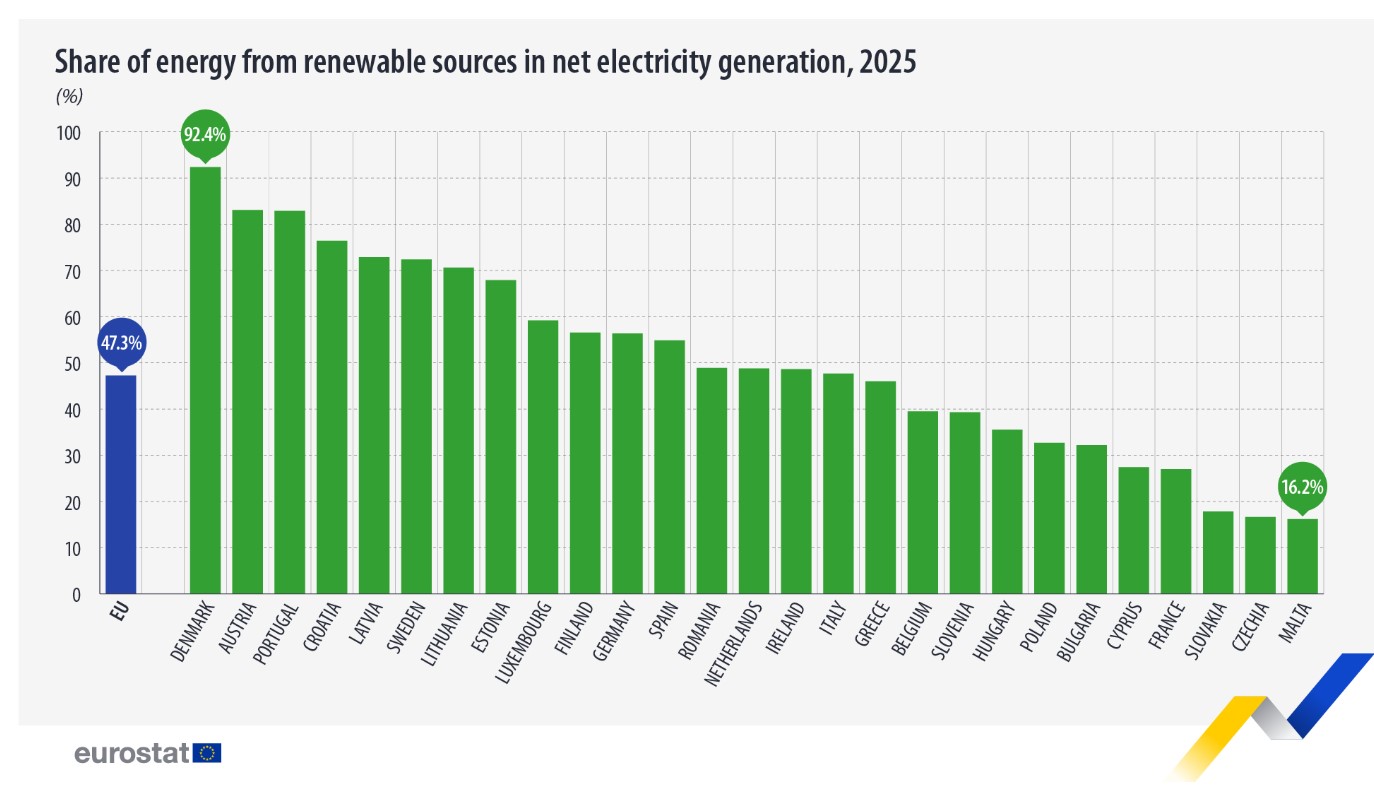
Cyprus recorded the fifth lowest share of electricity generated from renewable sources in the European Union in 2025, according to a report released on Thursday by Eurostat.
The figures showed that 47.3 per cent of electricity in the EU came from renewable energy sources in 2025, marking a slight increase from 47.2 per cent in 2024.
The data highlights Cyprus’ position among the lowest-performing countries in renewable electricity generation, underscoring ongoing challenges in expanding green energy capacity.
While the country’s overall renewable share was not specified, it generated 88.767 gigawatt-hours of electricity from renewable sources in December 2025, compared with 1,836.866 gigawatt-hours in Greece over the same period.
The EU total for December 2025 stood at 101,635.436 gigawatt-hours, Eurostat reported.
Across the EU, wind energy remained the primary source of renewable electricity, accounting for 37.5 per cent of the total.
Solar energy ranked second, contributing 27.5 per cent, followed by hydropower at 25.9 per cent.
Combustible renewable fuels made up 8.5 per cent, with geothermal and other sources contributing 0.5 per cent.
Solar energy recorded the fastest growth, increasing by 24.6 per cent in 2025, while hydropower declined by 11.8 per cent, reflecting broader shifts in Europe’s energy mix.
At country level, Denmark recorded the highest share of renewable electricity at 92.4 per cent, driven mainly by wind energy.
Austria followed with 83.1 per cent, largely supported by hydropower, and Portugal reached 82.9 per cent, relying on both hydro and wind sources.
At the lower end of the scale, Malta recorded 16.2 per cent, followed by the Czech Republic at 16.6 per cent and Slovakia at 17.8 per cent.





Click here to change your cookie preferences