
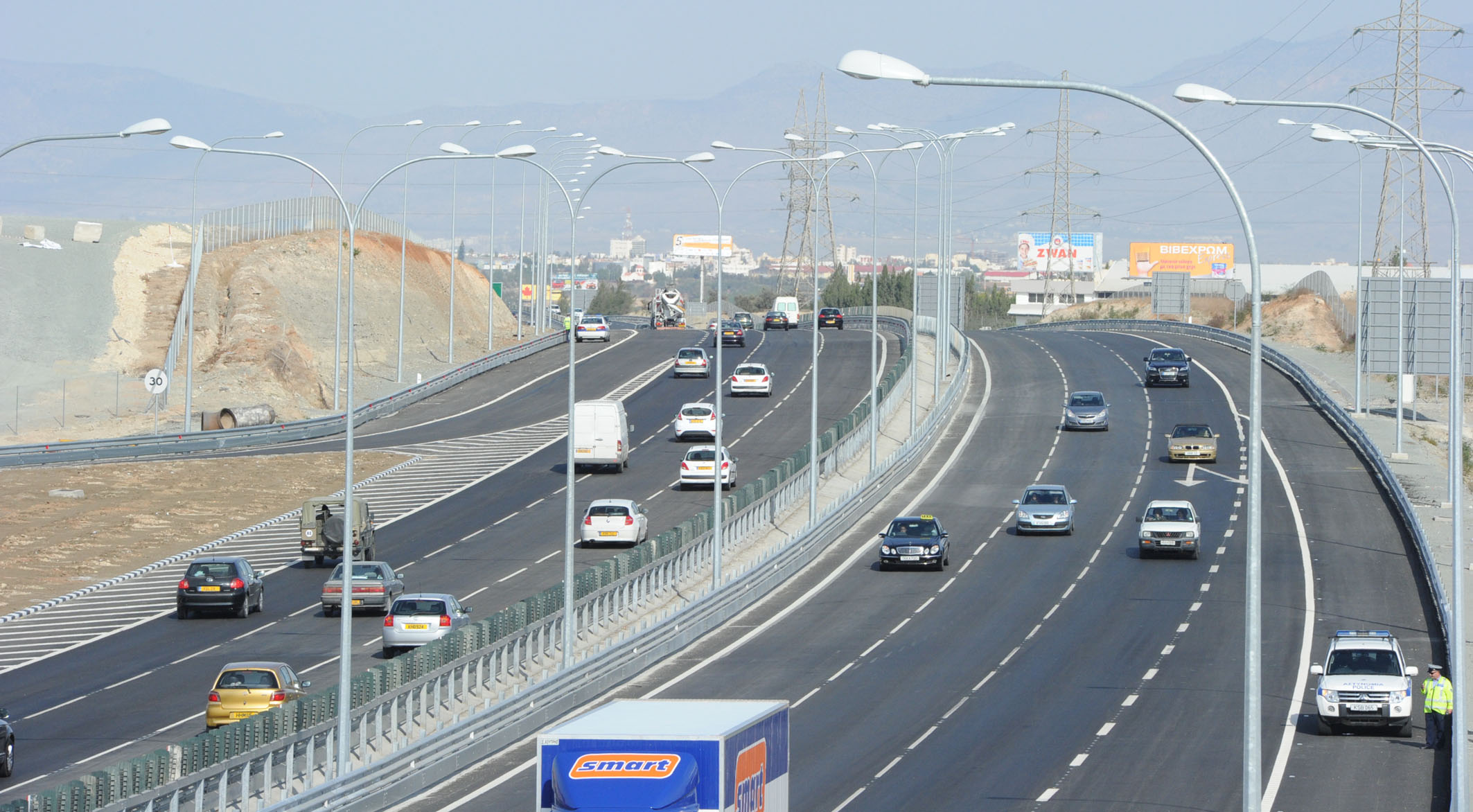
Cyprus motorway density reached 29.41 kilometres per 1,000 square kilometres in 2024, according to a Eurostat report on EU transport infrastructure, placing it below major EU urban hubs but broadly in line with several southern European regions
The findings highlighted how motorway networks tend to concentrate in urban areas, industrial zones and major seaports, where population density and transport demand are highest.
In comparative terms, Cyprus’ motorway density stood significantly higher than several Greek regions, including Central Greece at 17.64 kilometres per 1,000 square kilometres and Peloponnisos at 19.14 kilometres.
It was also far above Crete, which recorded just 1.08 kilometres per 1,000 square kilometres, reflecting the infrastructure constraints typical of island regions.
However, Cyprus remained below Attica, the wider Athens region, which posted 47.78 kilometres per 1,000 square kilometres.
When compared with other southern European regions, Cyprus’ figure was close to Emilia-Romagna in Italy, which recorded 30.56 kilometres per 1,000 square kilometres.
At the higher end of the scale, major metropolitan regions such as Comunidad de Madrid and Ile-de-France reported much denser motorway networks, at 92.45 kilometres and 51.87 kilometres per 1,000 square kilometres respectively.
Across the European Union, the densest motorway networks in 2024 were recorded in Bremen in Germany, with 169 kilometres per 1,000 square kilometres.
This was followed by Zuid-Holland and Utrecht in the Netherlands, with 134 kilometres and 124 kilometres per 1,000 square kilometres respectively.
Other leading regions included the capital regions of Budapest, Wien and Noord-Holland, which reported motorway densities of 120 kilometres, 109 kilometres and 108 kilometres per 1,000 square kilometres respectively.
In contrast, 20 EU regions recorded no motorway infrastructure, underlining significant disparities in connectivity.
Most of these were island regions, including six in France, comprising five outermost regions and one island region.
Further regions without motorways were identified in Greece, Portugal and Finland, with three, two and one regions respectively.
In addition, four regions in Poland, two Spanish autonomous cities on the North African coast, as well as one region each in Bulgaria and Romania, also reported no motorway networks.
Looking at long-term developments, the most significant motorway expansion between 2014 and 2024 took place in Andalucía in Spain, where 242 kilometres of new motorways were constructed.
The second largest increase was recorded in Stredné Slovensko in Slovakia, with 214 kilometres added over the same period.
The third largest expansion occurred in Castilla y León in Spain, where 191 kilometres of new motorways were built.
In the rail sector, the highest railway density in 2024 was observed in Berlin, with 764 kilometres of railway lines per 1,000 square kilometres.
Hamburg followed with 639 kilometres per 1,000 square kilometres, reflecting the importance of freight connections linked to major seaports.
Other leading regions included Budapest in Hungary with 484 kilometres, Praha in the Czech Republic with 433 kilometres, and Bremen in Germany with 389 kilometres per 1,000 square kilometres.
Hamburg and Bremen stood out as regions where extensive freight rail lines to and from seaports significantly boosted overall railway density.
At the lower end of the scale, three Greek regions recorded the lowest railway density, each with less than 10 kilometres per 1,000 square kilometres.
These regions were Peloponnisos, Dytiki Makedonia and Thessalia.
Across Europe, 13 regions had no railway network at all, including five outermost regions in France.
A further five regions in Greece, mostly islands, and three regions in Spain, including two autonomous cities on the North African coast and one outermost region, also lacked rail infrastructure.
Cyprus was not included in the railway section of the report, and therefore does not count as one of the 13 regions without rail mentioned earlier, as the country has no rail services at all.





Click here to change your cookie preferences