
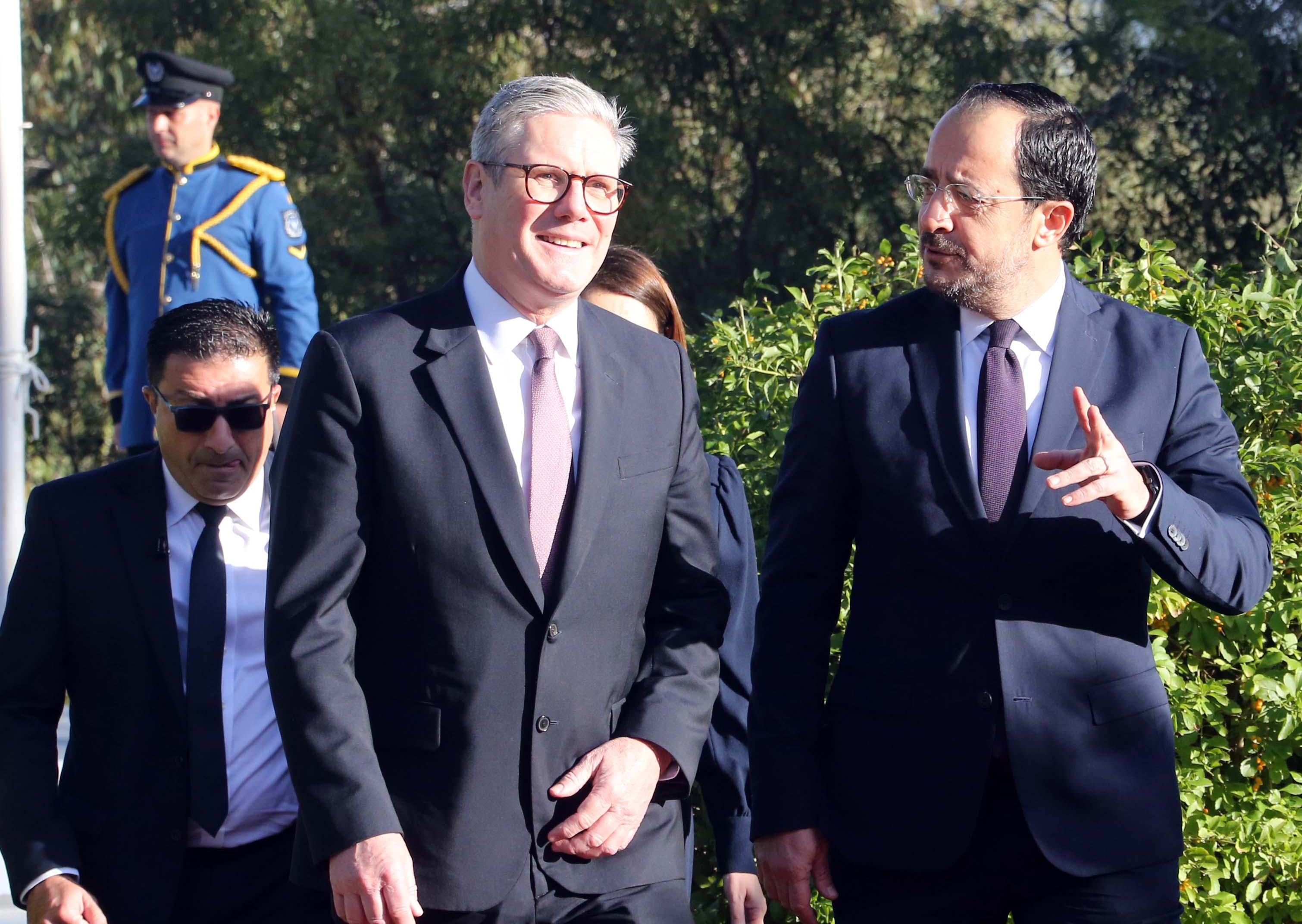
British Prime Minister Sir Keir Starmer on Saturday told President Nikos Christodoulides that Cyprus’ security is “fundamental” to the United Kingdom and reiterated that the country’s bases in Cyprus “will not be used for any offensive military operations”, government spokesman Konstantinos Letymbiotis said.
He said the pair had held a telephone conversation “at [Starmer’s] initiative” and discussed the ongoing conflict in the Middle East, as well as other, related developments.
Starmer, Letymbiotis said, told Christodoulides that “the security of the Republic of Cyprus is fundamental to the United Kingdom and, to that end, a decision has been taken to enhance the means contributing to the preventative measures already in place”.
This comes after the British defence ministry had on Friday evening announced that 500 “additional personnel” would be deployed to Cyprus, in addition to the various elements of military hardware which have arrived both before and after the start of the conflict at the beginning of this month.
Letymbiotis also said that Christodoulides had “underlined … the importance of further strengthening coordination and cooperation with the United Kingdom”, and added that relations between the two countries are “grounded in close and sincere cooperation, on the basis of mutual respect and a longstanding partnership”.
He said Christodoulides had also briefed Starmer on “the approach he had presented” at this week’s European Council summit in Brussels, “regarding the need to undertake a coordinated initiative, in cooperation partners, with a view to de-escalating the crisis”.
Christodoulides, he said, had “stressed that leveraging multilateralism constitutes the primary diplomatic avenue for strengthening these efforts and for making a meaningful contribution to safeguarding stability”.
He added that Starmer had “concurred”, and at this point referred to the joint statement issued by 22 countries, including the UK, regarding the Strait of Hormuz on Thursday.
That statement had declared that all 22 countries “condemn in the strongest terms recent attacks by Iran on unarmed commercial vessels in the Gulf, attacks on civilian infrastructure including oil and gas installations, and the de facto closure of the Strait of Hormuz by Iranian forces”.
It called on the Iranian government to “cease immediately its threats, laying of mines, drone and missile attacks, and other attempts to block the strait to commercial shipping”, stressing that “the effects of Iran’s actions will be felt by people in all parts of the world, especially the most vulnerable”.
As such, all 22 countries said they are ready to “contribute to appropriate efforts to ensure safe passage through the strait”.
Letymbiotis on Saturday said Starmer had told Christodoulides that the statement “confirms the shared approach towards strengthening multilateralism and focusing on de-escalation”.
He also said that in addition to Starmer’s reiteration of the British government’s position that its bases in Cyprus are being used for purely defensive purposes, the pair had a wider discussion on the matter of the bases, with the Cypriot government of late having emboldened its rhetoric regarding their future.
“President Christodoulides referred both to challenges that have arisen and to lessons learned from the management of the crisis thus far. In this context, he presented a proposal for the initiation of relevant discussions,” he said.
Christodoulides had said ahead of this week’s European Council summit that “we are going to have an open and frank discussion with the British government” about the bases, before describing them as a “colonial consequence”.
“We have more than 10,000 Cypriot citizens within the British bases. We have a responsibility to those people, and when the situation in the Middle East dies down, we are going to have an open and frank discussion with the British government,” he said.
Asked whether he wishes for the bases to be “gone”, he said that “we have a clear approach with regard to the future of the British bases”, before adding, “I am sure that you understand that I am not going to negotiate in public”.
Later in the day, he won the support of the European Council itself in this endeavour, with the council’s conclusions saying that it “stands ready to assist” the Cypriot government, and that it “acknowledges the intention” for such a discussion to be held.
The emboldening of rhetoric on Christodoulides’ part notwithstanding, the British government has thus far appeared to be in no mood to discuss any change to their future, with the UK’s parliamentary undersecretary of state for the armed forces Al Carns said on Tuesday that the bases’ future is “not in question”.



Click here to change your cookie preferences