
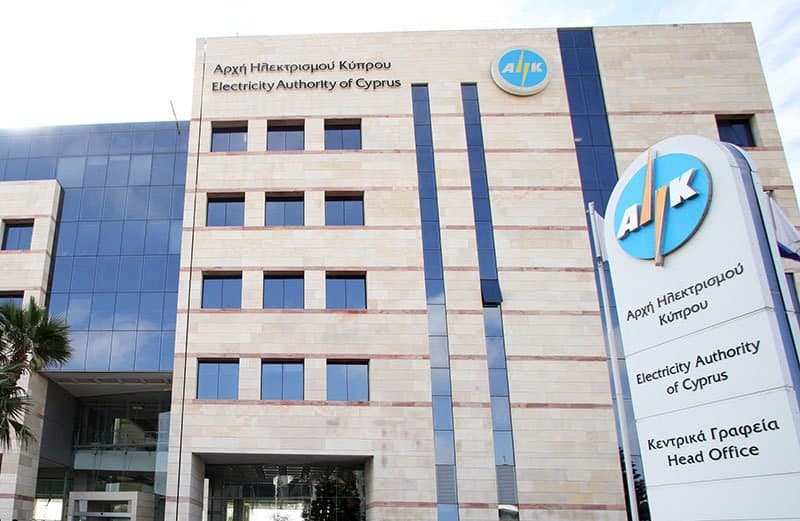
Workers at the Electricity Authority (EAC) on Tuesday threatened escalating strike action, demanding that independent authorities investigate a series of suspicious activities that they say point to an undermining of the state-run power utility but also higher prices for consumers.
In a joint statement, the trade unions Epopai, Sidikek, Sepaik and Syvaik said they would convene in the next few days to decide further industrial action.
They had previously held ‘warning strikes’ on February 27 and March 18 – each lasting a few hours.
The unions want independent authorities to look into various matters that have caught the public eye and come up with answers.
They demand to know who hamstrung the EAC regarding a tender it had launched for leasing land planned to house solar parks.
They also want an investigation into “which former state officials secured a bevy of renewables permits for private interests, with whom they are working together today, who secured renewables and conventional production permits, and by which processes they currently engage in selling renewables permits seeking exorbitant amounts”.
It’s understood they were referring to recent allegations heard in parliament that roughly two-thirds of renewables permits did not result in solar parks, with the bearers holding onto them and then selling them at vastly inflated prices.
Further, the unions demand answers as to why the state is intent on allowing the Cyprus Telecommunications Authority (CyTA) to get a foothold in the energy sector.
“Is it perhaps that CyTA’s involvement in energy is so that certain people can sell it the RES permits at lucrative prices?”
Another matter warranting investigation is “who forced the EAC to pay Etyfa €43 million overnight, given that the EAC technocrats were split on this matter”.
Here, the unions were alluding to the EAC investing €43 million into the capital of Etyfa, the state-run natural gas infrastructure company tasked with building the – now stalled – LNG terminal at Vasiliko.
Also, the unions asked who authorised the former head of the energy regulatory authority to agree to “the lopsided distribution of the costs for the electricity interconnector, with Cypriot consumers bearing 63 per cent of the charges, not to mention the 8.33 per cent return on investment”.
In addition, they want answers as to who decided that the sixth turbine at the Vasiliko power plant should be powered by natural gas, and whether this decision was imposed “to favour the illegal private production plant in the Vasiliko area”.
The turbine in question is idle, as the EAC’s Vasiliko station does not currently use natural gas for energy generation.
Regarding the “illegal private production plant”, this refers to a power station in Vasiliko owned by PEC – part of the Cyfield Group. In February last year, the Audit Office said the facility cannot legally operate because significant supporting infrastructure was built on land not owned by the company and without the required permits. The plant has not commenced commercial operations.
The unions also referenced the infamous ‘Videogate’ affair, where it appeared that associates of President Nikos Christodoulides engaged in pay-to-play practices to sell access to the presidential palace and the first lady.
The eight-minute clip, posted on X, featured Cyfield boss Giorgos Chrysochos, being recorded apparently without his knowledge, with the person speaking to him offering to invest €150 million in a project.
Media later speculated that the investment mentioned in the video might be Cyfield’s power plant at Vasiliko.
Lastly, the unions asked why the energy ministry decided to reset to zero surplus electricity credits for rooftop photovoltaics. In many cases, credits built up over months or years were zeroed, meaning households lost previously earned offsets that would normally reduce future electricity charges.
“For all the above, inertia, filibustering, and perhaps even expediency, have resulted in consumers bearing a high cost of electricity, while the risk of a total blackout becomes more likely,” the unions concluded.





Click here to change your cookie preferences