

‘Our goal is to help promising companies evolve into global technology exporters that contribute meaningfully to Cyprus’ economic future’
We had an interesting interview with the Chief Scientist of the Republic of Cyprus and Chairman of the Research and Innovation Foundation, Demetris Skourides, who also chairs the National AI Strategy currently under preparation. It explores the key findings of the GAIA report and what they mean for the future of Cyprus’ artificial intelligence ecosystem. Commissioned by the Office of the Chief Scientist, and supported by AIA Lab, the report provides the first comprehensive survey across 300 stakeholders, mapping 116 companies, startups, and research organisations building AI solutions and products in Cyprus.
The Report leveraged well known strategy management tools such as Magic Quadrant and Horizon 3 model and adjusted them to reflect necessary parameters for the National ecosystem. Two tools were created to benchmark Cyprus ecosystem GAIA-like quadrant , and GAIA-like Horizon3 model.
Its findings offered important perspectives and insights to the chief scientist on how Cyprus can strengthen innovation, accelerate the commercialisation of AI technologies and position itself as a competitive technology and innovation hub within Europe and beyond.
The GAIA report shows that most AI companies in Cyprus fall into the ‘visionary’ category rather than the ‘leader’ category. What specific steps should Cyprus take to help these companies turn strong ideas into scalable global businesses?
The most important message of the GAIA report is actually a very positive one: Cyprus does not have an ideas problem. We are witnessing success in the government’s initiatives in attracting companies from abroad, and in a growing community of ambitious companies developing innovative technologies and building products with global potential.
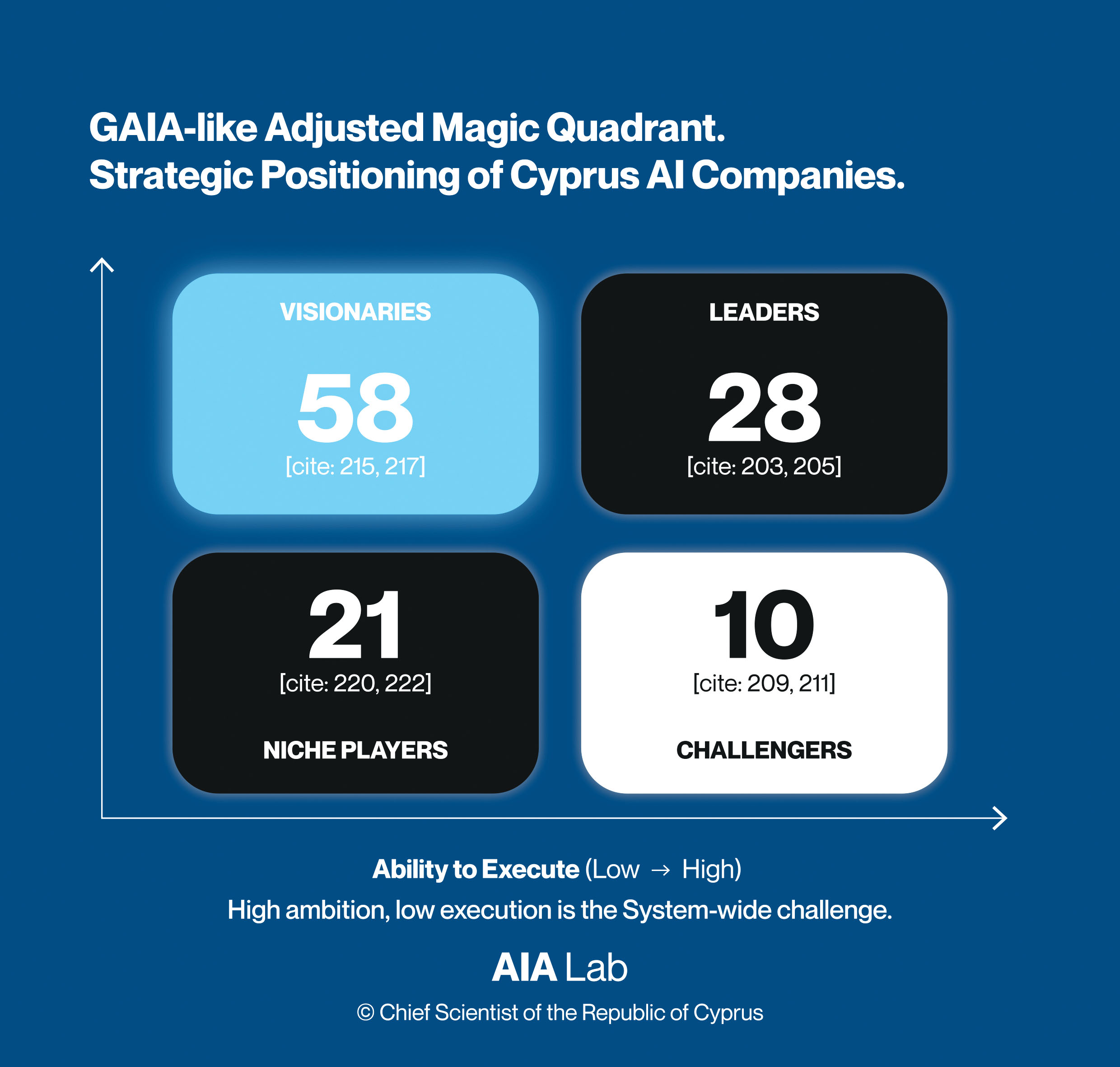
AI Is new. In 2023, the level of adoption of AI technologies in Cyprus was at 3.2 per cent. Since then, the rate of adoption across industry has accelerated. However, we are still in the early phases of forming an AI innovation ecosystem. As per the GAIA-like quadrant model, there exist 58 companies in the ‘visionary’ category, 28 in the ‘leaders’ quadrant, 21 identified as ‘niche player’s, and 10 identified as ‘challengers’.
The fact that a large portion of our ecosystem falls into the ‘visionary’ category reflects a healthy level of technological ambition and creativity.
However, the challenge for any innovation ecosystem, and Cyprus is no exception, is the transition from vision to execution at scale. Innovation alone does not automatically translate into economic impact. The real test is whether promising companies can scale into global businesses that generate exports, create high-value employment, and anchor economic activity within the country.
The GAIA report gives us a clear roadmap. First, we need to accelerate the rate at which entrepreneurs and startups build new world class solutions that leverage AI technologies. Second, we need to strengthen the mechanisms that support companies in the scale-up phase, particularly those that have already developed a product and are beginning to reach the market. These companies often face a very specific set of challenges: expanding internationally, building solutions complaint to AI regulatory guidance that can scale globally, building strong go-to-market strategies, securing growth financing and developing the operational capacity to serve large customers.
Third, we must leverage the experience of the companies that have already succeeded. Cyprus already hosts several internationally recognised technology firms operating at scale. These companies can act as anchors for the ecosystem by mentoring emerging companies, partnering with startups and helping build supply chains that strengthen the entire technology sector.
Fourth, we must ensure that innovation policy increasingly focuses on execution and global competitiveness, not just invention. Research and development remain essential, but the next phase for Cyprus requires a stronger emphasis on commercialisation, export readiness and deployment of technology in real markets.
Fifth, through the work we have undertaken in developing memoranda of understanding (MOU’s) with strategic partners. In parallel, we are actively strengthening Cyprus’ connections with international innovation ecosystems. Through collaborations and dialogue with technology hubs across Europe, the Middle East and Asia, we are helping position Cyprus as a gateway for companies that wish to build globally relevant AI solutions while operating within a trusted European regulatory environment.
Sixth, in collaboration with the deputy ministry of digital policy, research and innovation, we need to revisit incentives and programmes, and design new instruments to help accelerate the transition of ‘visionaries’ into ‘leaders’, ‘niche’ players into market leaders and shorten the time to market.
In short, our goal is not simply to produce more startups. Our goal is to help promising companies evolve into global technology exporters that contribute meaningfully to Cyprus’ economic future.
The analysis suggests the ecosystem is ‘product-rich but marketing-poor’, with many startups investing less than €10,000 in sales and go-to-market capabilities. How should national innovation policy change to support commercialisation and go to market strategies, not just research and development?
This is one of the most important findings of the GAIA report.
For many years, innovation policy in most countries, including Cyprus, has understandably focused on supporting research, technological development, and early-stage innovation. These are critical foundations for any knowledge economy. However, the GAIA report highlights that building great technology is only part of the journey.
In practice, companies scale only when they develop strong commercialisation capabilities and can capture the value they create. That means investing in sales, international partnerships, customer acquisition, regulatory readiness and product deployment. Without these elements, even the most promising technologies can remain confined to small pilot projects or limited markets, particularly in markets where the rate of technology and AI model refresh cycles changes on a monthly basis.
The report clearly shows that companies generating significant revenue tend to invest substantially more in sales and marketing capabilities. In other words, scaling a technology company requires building a professional commercial and go to market engine around the technology.
This insight is helping us rethink the next phase of innovation policy in Cyprus. We need to think of tools and instruments that help complement research funding with stronger support for commercialisation pathways. This includes helping companies access international markets, supporting export managers and sales teams, facilitating participation in global technology ecosystems and enabling companies to build the operational capacity required to deliver solutions at scale.
At the same time, we are encouraging and enabling companies to connect with global markets from the outset. Cyprus’ strategic position between Europe, the Middle East and Asia allows our technology companies to operate internationally from an early stage and strengthening those global connections is an important part of our innovation strategy.
As part of the identified challenges in the report, we are also working to strengthen the connections between research institutions, startups and industry, bridging the journey from lab to market. Cyprus has strong academic research capabilities, however we must ensure that research results increasingly translate into commercial products and services.
Ultimately, innovation policy must support the entire lifecycle of a technology company: from idea to product, offering enablers to support the establishment of global market presence.
According to the Horizon model in the report, many companies are stuck between early innovation and real market scale. What incentives or infrastructure could help Horizon 2 companies transition into established Horizon 1 exporters?
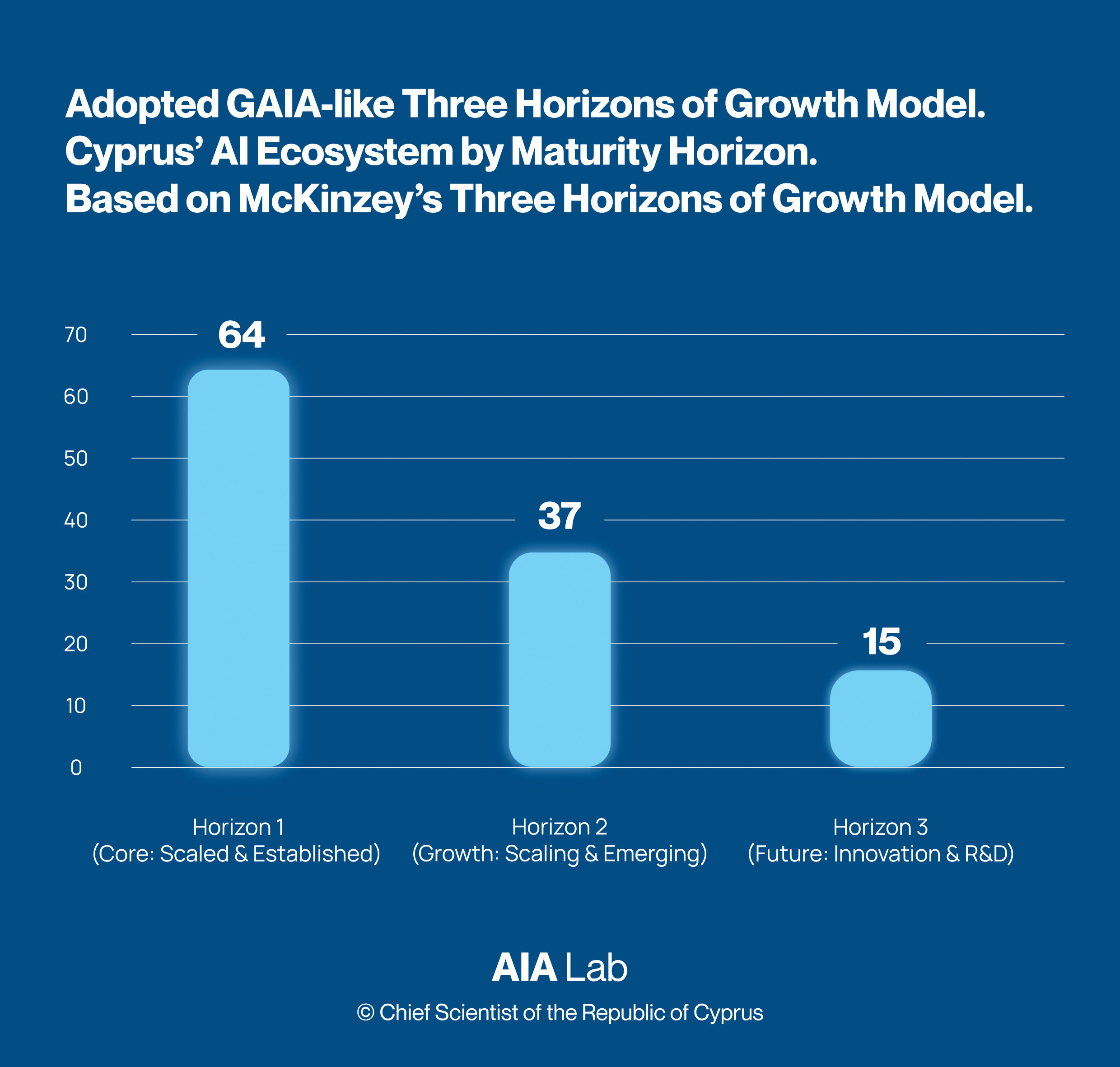
The Horizon framework presented in the GAIA report is an adjusted model and refers to the GAIA-like horizon model tailored particularly to assess the ecosystem growth. It is useful because it shows where the greatest economic potential lies within the ecosystem.
Horizon 1 companies are already operating at scale. Horizon 3 companies represent the early research pipeline. But the most strategically important group is Horizon 2: companies that have already demonstrated technological capability but have not yet reached stable market scale.
These companies represent the growth engine of the ecosystem. If they succeed, they become major employers and exporters. If they struggle to scale, the ecosystem risks remaining fragmented.
Several factors are important for helping Horizon 2 companies transition into established global businesses.
One is access to growth capital. Scaling internationally often requires resources for sales teams, regulatory compliance, infrastructure and customer support. Another is access to global networks, partnerships and markets. This finding re-enforces earlier programmes introduced by the Research and Innovation Foundation that are based on blended-finance.
Talent is also a crucial factor. The GAIA report highlights that the ecosystem does not suffer from a shortage of graduates, but rather from a shortage of experienced senior talent: engineers, architects and product leaders who have built and scaled complex technology systems before.
This is why initiatives such as Minds in Cyprus are so important. Through this initiative, we are actively working to reconnect Cyprus with its global diaspora of scientists, engineers and entrepreneurs. Many highly experienced Cypriot professionals are currently working in major technology hubs around the world.
By encouraging them to return or collaborate with the local ecosystem, we can significantly strengthen the leadership and expertise available to scaling companies.
At the same time, we are strengthening international partnerships that allow Cypriot companies and researchers to collaborate with global technology ecosystems. These connections help local firms gain access to knowledge, markets and investment networks that are essential for scaling advanced technologies such as artificial intelligence.
In addition to the above, the GAIA report indicates a moderately low number of ecosystem stakeholders in Horizon 3, confirming that relatively limited funding and a relatively small number of research projects are currently underway, which may pose a risk to long-term competitiveness from a research perspective. For Cyprus to remain relevant as a research and technology hub in artificial intelligence, significant and sustained investment in AI research will be required.
Finally, infrastructure also plays an important role. As AI systems become more sophisticated, companies increasingly need access to advanced computational resources, data infrastructure and secure digital environments. Strengthening these capabilities is part of our broader strategy to develop sovereign AI capabilities and ensure that companies operating in Cyprus can build and deploy advanced technologies efficiently.
The GAIA report shows that many AI startups remain trapped in pilots, with only a portion reaching full production deployments. From a policy perspective how can Cyprus help these startups move from experimentation to large-scale adoption?
One of the most insightful observations of the GAIA report is what it calls the “pilot trap.” Many companies successfully develop prototypes or minimum viable products, but struggle to transition from experimentation to full production deployments.
This is not unique to Cyprus; it is a common challenge in innovation ecosystems around the world. But addressing it requires deliberate policy interventions.
One of the most effective mechanisms is for the public sector itself to act as an early adopter of technology. Governments can play an important role as reference customers for emerging technologies, particularly in areas such as digital public services, healthcare systems, regulatory technology and environmental monitoring.
When governments adopt innovative solutions, they not only improve public services but also help technology companies validate their products and demonstrate their value in real operational environments.
To this end, the deputy ministry of digital policy, research and innovation, the Research and Innovation Foundation (RIF), and the chief scientist are already piloting the AI for Government programme. This two-pronged strategy both accelerates the introduction of innovation within the public sector and enables the deputy ministry of digital policy, research and innovation, and RIF to better understand how procurement bottlenecks that inhibit innovation can be identified and addressed.
This opportunity is particularly important in light of the ongoing policy discussions surrounding the forthcoming Cloud and AI Development Act, which aims to simplify procurement processes for digital technologies across Europe.
Another important element is strengthening the ecosystem’s ability to deploy solutions at scale. Building a prototype and operating a production-grade system are very different challenges. Companies must develop capabilities in implementation, cybersecurity, compliance and operational resilience.
Stakeholders, including startups, must leverage the opportunity and available resources to ensure compliance with the EU AI Act, redesigning their approach so that compliance becomes a strategic strength as the company scales while reducing the overall cost of compliance.
At the same time, we must recognise that artificial intelligence is rapidly becoming a foundational technology for every sector of the economy. As I often say, AI is becoming the new energy of the digital economy, while data is the fuel that powers it.
The countries that succeed will be those that embed AI into real economic activity: into financial services, logistics, healthcare, energy systems and many other industries. While preparing Cyprus’s new AI strategy, particular focus was placed on establishing the foundational elements and core infrastructure that will accelerate AI adoption across both the private and public sectors, while consistently prioritising trustworthy and human-centred AI adoption.
The focus now must be on moving from experimentation to real deployment across the economy.
Looking at the broader picture, what would a successful AI ecosystem in Cyprus look like five years from now in terms of exports, talent, and international competitiveness?
The vision for Cyprus over the next five years is closely aligned with the broader objectives of Cyprus Vision 2035, which aims to transform the country into a knowledge-driven and innovation-led economy.
A successful AI ecosystem in Cyprus will be characterised by several key outcomes.
First, we should see a growing number of companies generating substantial export revenues from AI-driven products and services while serving customers. We want to see our ecosystem to move from pilots and proof-of concepts to offering solutions that customers enjoy, solutions that create financial value, productivity and improve customer experience.
Cyprus is a relatively small domestic market, which means that successful technology companies must be globally oriented from the beginning. The companies that reach scale will be those that design their solutions for international markets.
Second, we expect to see a stronger talent ecosystem, combining locally trained professionals with international expertise and returning members of the Cypriot diaspora. Through initiatives such as Minds in Cyprus and through collaboration with universities and industry, we aim to strengthen the leadership layer of the technology ecosystem and ensure that companies have access to world-class expertise.
Third, Cyprus has the opportunity to position itself as a trusted innovation hub within the European Union. As AI becomes more central to economic activity, issues such as transparency, security and responsible AI governance will become increasingly important.
Cyprus can play a significant role as a jurisdiction that combines technological innovation with strong regulatory credibility and alignment with European standards.
Artificial intelligence is transforming how knowledge, expertise and productivity are created. It is lowering barriers to entry and allowing smaller countries to compete in areas that were once dominated by large technology powers.
Over the next five years, success will also be measured through concrete outcomes. We expect to see a significant increase in AI companies, AI adoption across public sector and private sector, AI-driven exports from Cyprus, a growing number of companies operating internationally and thousands of new high-skill jobs created in areas such as artificial intelligence, data science and advanced digital services.
Our ambition is to see more Cypriot companies moving from promising innovation to globally recognised technology providers.
If we succeed in converting the innovation we already have into scalable companies, strong exports and internationally competitive products, Cyprus can become a dynamic hub for AI innovation connecting Europe, the Middle East and beyond.
The GAIA report shows that the foundations are already in place. The task ahead is to think big, invest strategically and execute relentlessly to drive growth.





Click here to change your cookie preferences