
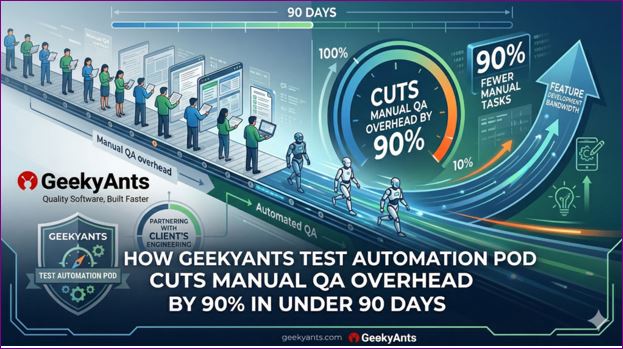
GeekyAnts has completed a test automation engagement that reduced manual QA workload by 90% across a large software platform within a 90-day period. The project was delivered through the company’s Test Automation Pod model, in which a dedicated team works alongside a client’s engineering organization to build and deploy automation systems.
The engagement reflects a broader challenge facing enterprise software teams as manual quality assurance processes struggle to keep pace with faster release cycles and increasingly complex product environments.
Manual QA remains a persistent bottleneck
In many large software organizations, manual QA does not typically emerge as a single visible failure point. Instead, its impact tends to build over time through longer sprint cycles, growing regression backlogs, reduced release confidence, and increased engineering time spent on repetitive testing work.
For teams managing web, mobile, API, and backend systems simultaneously, manual testing can become difficult to sustain at the speed required by modern product roadmaps. The effects often appear in delayed releases, production regressions, and reduced bandwidth for feature development.
The challenge for many engineering teams is not simply adopting automation tools, but implementing automation in a way that improves test coverage without disrupting ongoing delivery.
A structured automation rollout
According to GeekyAnts, the Test Automation Pod was embedded within the client’s engineering workflow and began the engagement with a review of the existing manual testing process. The team mapped current test cases against release risk, execution frequency, and feasibility for automation.
That assessment was used to prioritize the rollout. High-risk and frequently repeated manual test cases were automated first, with broader regression coverage added in subsequent sprints.
The automation framework was built largely on the client’s existing toolchain, limiting the need for a separate testing infrastructure. Where additional tools were introduced, the company said they were selected with long-term maintainability in mind and documented for internal adoption.
Parallel execution was also built into the framework, allowing tests that had previously been run sequentially to be executed concurrently across environments. The automation suite was then integrated into the CI/CD pipeline so that tests could run on code commits rather than during isolated QA phases.
What the reduction means in practice
A 90% reduction in manual QA workload can affect more than staffing or cost. In practice, it changes how engineering teams allocate time during a release cycle. Work that had previously been dedicated to repetitive verification can shift toward product development, while broader regression coverage can improve consistency in testing.
The 90-day timeline is also notable because enterprise automation initiatives often face delays tied to framework selection, changing scope, or incomplete implementation. In this case, the engagement was structured around a fixed delivery window with a team focused specifically on automation deployment.
That model may help explain how the implementation moved from audit to operational rollout within a relatively short period.
Handoff and long-term ownership
GeekyAnts said the engagement included documentation, automation assets, and maintenance runbooks intended to support a transition to the client’s internal QA team after the 90-day period.
That handoff process remains a key factor in whether automation initiatives continue to deliver value after initial deployment. In many organizations, automated test suites lose effectiveness over time if documentation is incomplete or ownership is not clearly transferred.
By producing handoff materials during the engagement rather than after it, the project was designed to support longer-term internal use and extension.
Broader relevance for engineering teams
Test automation is widely established as a core part of modern software delivery, but implementation at scale continues to be uneven across organizations. Many teams understand the value of automation in principle, yet face operational challenges in execution, including prioritization, ownership, integration with delivery pipelines, and post-launch maintenance.
The outcome reported in this engagement offers one example of how organizations are approaching those challenges through dedicated embedded teams, phased coverage expansion, and closer alignment with internal engineering workflows.
As release cycles continue to shorten and software platforms grow more complex, automation is increasingly being treated as an engineering function rather than a secondary QA initiative.
About GeekyAnts
GeekyAnts is a technology consulting and product development company focused on digital transformation, app development, product design, and custom software services. Its U.S. office is located at 315 Montgomery Street, 9th & 10th Floors, San Francisco, CA 94104, USA. Learn more at geekyants.com/en-us or reach the GeekyAnts team directly at [email protected] or phone at +1 845 534 6825.
DISCLAIMER – “Views Expressed Disclaimer – The information provided in this content is intended for general informational purposes only and should not be considered financial, investment, legal, tax, or health advice, nor relied upon as a substitute for professional guidance tailored to your personal circumstances. The opinions expressed are solely those of the author and do not necessarily represent the views of any other individual, organization, agency, employer, or company, including NEO CYMED PUBLISHING LIMITED (operating under the name Cyprus-Mail).





Click here to change your cookie preferences