
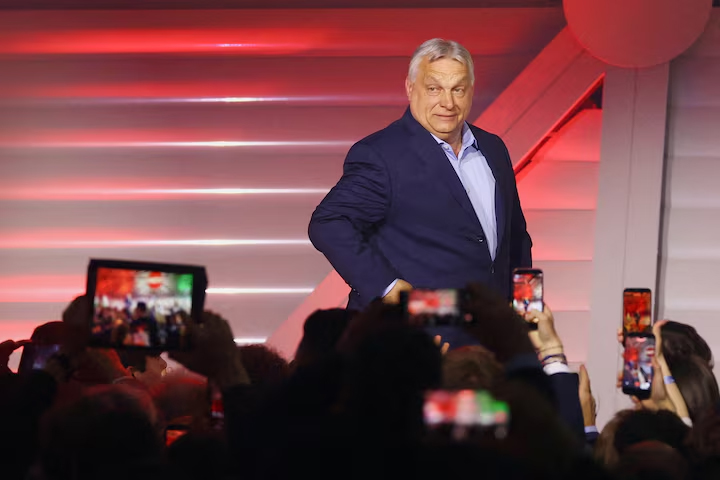
Polish Prime Minister Donald Tusk sent a message congratulating Hungary’s newly elected prime minister, Peter Magyar, for having evicted long-serving populist leader Viktor Orban (aka ‘The Viktator’) from power. All the usual welcoming words, but Tusk’s message ended with two slightly mysterious words in Hungarian: “Ruszkik Haza” – Russians Go Home.
There are no Russians in Hungary, apart from occasional visitors, so what was that about? It dates back to 1989, when a then-youthful student leader called Viktor Orban became an overnight national hero by giving a speech telling the Russians to end their 45-year-old military occupation and go home.
They did go home then, but their influence returned with Orban’s return to the prime ministership. He had previously occupied the office as a conventional conservative in 1998-2002, but he practically invented modern populism – ‘illiberalism’, as he called it –for his comeback in 2010. And this time the Russians were with him all the way.
Hungary’s value to Moscow was its membership in the European Union and Nato, which enabled it to pass on all the information that its representatives had access to as members. Orban also blocked various EU decisions that Russia disapproved of, like his recent veto of a $105 billion EU loan to Ukraine to replace the US aid that Trump cancelled.
That loan will now go through. Repairing the huge damage done by sixteen years of Orban will take a lot longer: the judiciary has been packed, the government is a kleptocracy, the media are 80 per cent-owned by Orban’s cronies, and the electoral map has been gerrymandered. But the main interest for non-Hungarians is the possibility that this is a communicable disease.
Populists all over the place clearly fear that it might be. Orban rose to power when Donald Trump was a property developer, Italy’s Prime Minister Giorgia Meloni was a junior minister, France’s Marine Le Pen and Britain’s Nigel Farage were fringe figures, and Germany’s Alice Weidel was a financial consultant.
They all found time in their busy schedules to offer their support to Viktor Orban, and now they are strangely silent. It’s like when your parents die: you realise that it’s now you on the front line.
Last week, with Orban trailing badly, they pulled all the stops out. Trump, in his fifth intervention in support of Orban in six months, posted “I AM WITH HIM ALL THE WAY”, and Vice President JD Vance showed up in Budapest in person on the way to his equally unsuccessful performance in the ‘peace talks’ in Islamabad.
This is an unusual amount of attention to lavish on an election in a country of nine million people located in the unfashionable end of Europe. You only have to compare it to the attention that the world media gave to the 2023 election that brought Orban clone Robert Fico back to power in Slovakia.
That event got almost zero attention, whereas Sunday’s election in Hungary got front-page coverage almost everywhere. The difference is entirely due to the fact that Orban’s loss was seen as a defeat for the founding father of the populist strategy, at least in its current incarnation – and possibly a harbinger of the future.
The anxiety of some and the hopes of others have been stoked by the growing likelihood that the populist formula is failing in its natural homeland, the United States.
Trump’s own erratic behaviour is part of the problem, but the economic dislocation caused by his war against Iran is an even bigger reason for them to fear defeat in the midterm elections next November.
The governing party losing control of one House of Congress in the midterms, or even of both, is a frequent feature of national politics in the United States, and it normally doesn’t cause despair. It’s a protest vote, and it’s not even a reliable predictor of what will happen in the general election.
Yet Trump & Co in the United States, and even more so their fellow travellers in Europe and far-flung outposts like Argentina, seem concerned that the wind has changed, even though nobody else has noticed it yet.
Maybe they are wrong, and this is only a minor setback in their inevitable march to power everywhere in the West. But protest-based mass movements have an average lifetime of 10-15 years, so a steep decline in the health and longevity of populist governments starting about now would not be untypical.
On the other hand, Trump’s desperate antics as he seeks a face-saving way out of his war on Iran are prolonging an economic downturn that could end in a major recession.
Voters punish whichever government is in power when the recession arrives with complete disregard for the actual causes, so we could see old populist regimes go down even as new ones emerge elsewhere.
Gwynne Dyer’s new book is Intervention Earth: Life‑Saving Ideas from the World’s Climate Engineers. The previous book, The Shortest History of War, is also still available



Click here to change your cookie preferences