
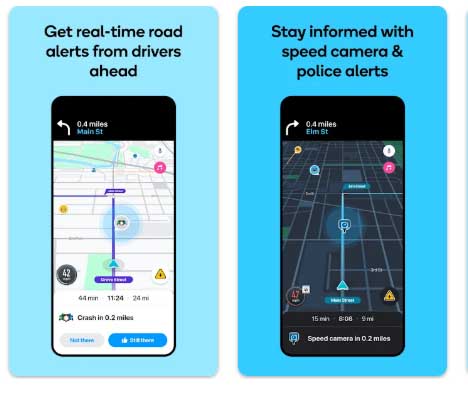
Police have reiterated their opposition to navigation apps that alert motorists to the location of speed cameras and police checkpoints, although officials say they have received no formal notification of any European move to restrict such services.
The comments came on Wednesday following recent reports about a European Court of Justice ruling permitting member states to impose targeted restrictions on certain navigation app features.
Speaking on Sigma, deputy traffic department chief Tasos Asikis said police first became aware of the issue through media reports and had not received any official communication outlining the contents of any European decision or directive.
“We have not been officially informed about the existence of this decision and, therefore, we do not know its content,” Asikis said.
“We will seek to study it in order to obtain a clear picture and assess whether there is a need to take any measures on our part.”
Despite the absence of formal guidance, Asikis reaffirmed the force’s position that applications which identify the locations of speed enforcement cameras and police checkpoints undermine road safety.
“When drivers know the checkpoints in advance, they reduce their speed only at those specific locations and not throughout their journey,” he said, arguing this weakens enforcement efforts and contributes to speeding offences elsewhere on the road.
He said effective traffic policing depends on drivers being unable to predict where checks will take place, referring to international practices that favour mobile and less visible enforcement measures.
Asikis cited the Australian state of Victoria, where authorities increased the use of mobile speed cameras, and referred to European Commission guidance suggesting speed enforcement is more effective when checks are difficult to anticipate.
“The uncertainty created among drivers about where a check may be carried out contributes to them maintaining a consistently safe speed throughout their journey and not just at the points where they know there are cameras or checks,” he said.
The comments follow a European Court of Justice ruling confirming that EU member states may, under certain legal conditions, restrict applications such as Waze and Coyote from sharing the locations of particular police operations and traffic checks.
The judgement does not introduce an EU wide ban but establishes that individual countries may adopt proportionate restrictions after following the required legal procedures.
Asikis stressed that Cyprus currently has no obligation to block such applications and said police continue to publish the locations of fixed speed cameras through their official website.





Click here to change your cookie preferences