
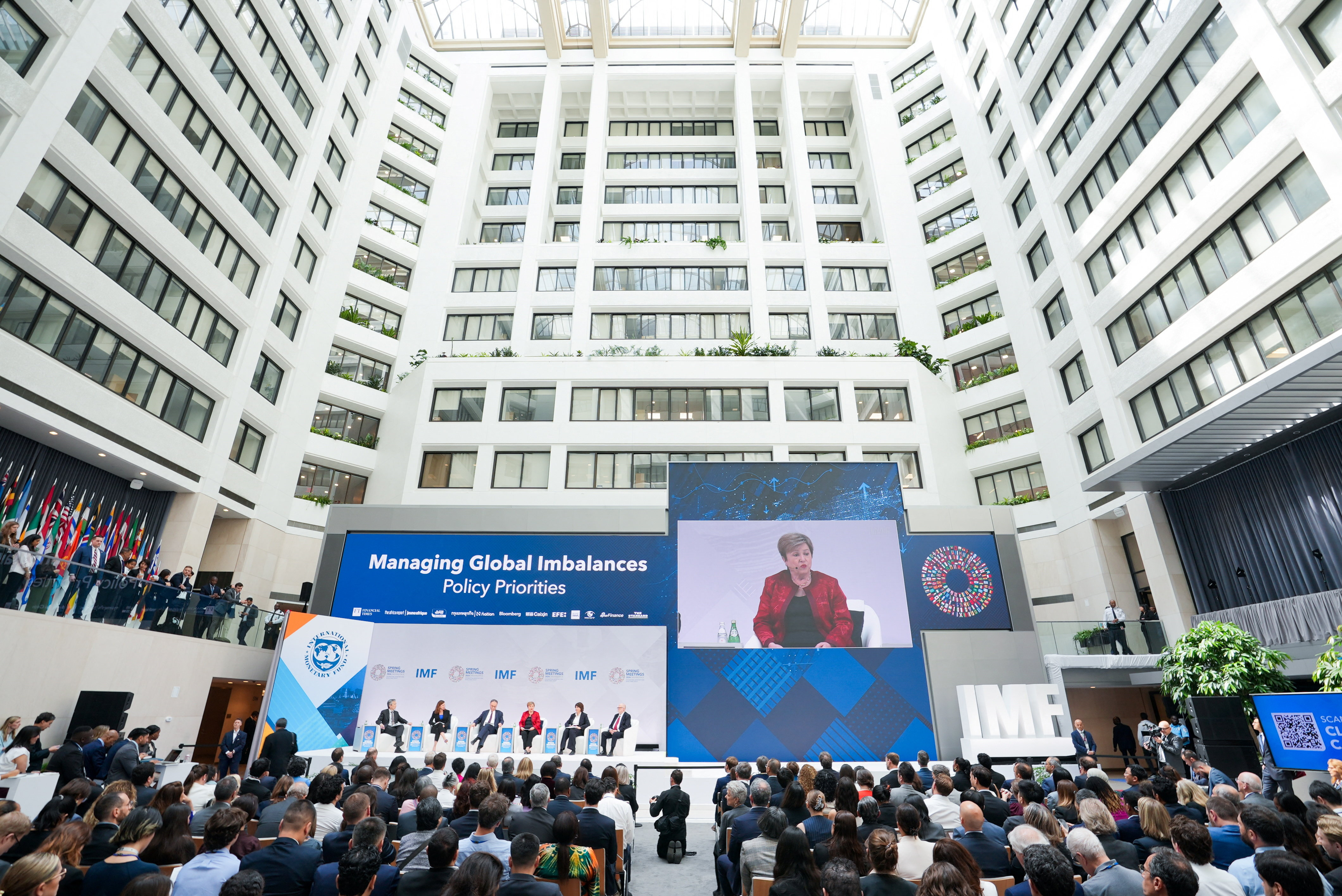
The International Monetary Fund expects at least a dozen countries to seek new loan programs to cope with surging energy prices and supply chain disruptions caused by the Middle East war, with several sub-Saharan African nations seeking help, the head of the global crisis lender said on Wednesday.
IMF Managing Director Kristalina Georgieva also warned of deepening supply disruptions from the closure of the Strait of Hormuz even if the conflict ends quickly and urged countries to take measures to reduce their fuel usage.
Speaking at a press conference during the IMF and World Bank spring meetings in Washington, Georgieva repeated her estimate that disruptions from the war could trigger new demand for $20 billion to $50 billion in financial support that could include new loans and augmentation of some of the global lender’s 39 existing country financing programs.
She did not name specific countries that have requested aid, although she said the IMF was not currently discussing an augmentation of Egypt’s $8 billion loan program despite the war’s impact on its economy.
IMF strategy chief Christian Mummsen said the needs estimate was developed before the start of the meetings and could be expanded after bilateral meetings with finance officials from the IMF’s member countries.
“This is preliminary. We’re still taking stock,” Mummsen said, adding that the list of countries seeking help would likely expand beyond a dozen.
SUPPLY SHOCKS, SLOW TANKERS
Georgieva said she was concerned about the physical breakdown of supply chains, especially for Asian countries dependent on oil, natural gas, naphtha, helium, fertilizer and other inputs from Gulf countries.
She said such disruptions are “not going to evaporate overnight, even if the war ends tomorrow. Why? Because a tanker is a slow-moving vessel, it would take 40 days to get all the way to Fiji. So we need to be prepared that the impact of the supply disruptions in the weeks ahead is going to be deeper.”
The IMF already has said global economic conditions are worsening beyond those that informed the relatively mild cut in growth it projected on Tuesday in its updated World Economic Outlook. The global lender’s 3.1% forecast for 2026 was based on a swift end to the conflict and drop in oil prices.
Instead, the IMF’s chief economist, Pierre-Olivier Gourinchas, said the global economy was now “drifting” past that forecast towards a more adverse scenario in the IMF’s World Economic Outlook, with 2026 growth falling to 2.5% and oil prices averaging about $100 a barrel for the year.
In its worst-case, “severe scenario” of a deeper and longer conflict, global growth falls to 2% to the brink of global recession.
With more shortages looming, Georgieva said countries should take measures to conserve energy use and create incentives to reduce the oil intensity of their economies, such as temporarily making public transport free.
She repeated the IMF’s warnings against countries taking untargeted actions such as broad energy subsidies to offset the impact of higher prices, saying they would only “prolong the pain of high prices.”
The IMF’s Fiscal Monitor, released on Tuesday, also urged countries to refrain from subsidies and, instead, aid their citizens with targeted, temporary cash transfers for the most vulnerable that do not obscure higher fuel prices and do not stoke demand.
IMF Fiscal Affairs Director Rodrigo Valdes said broad fuel subsidies would do that and shift supplies away from poorer countries, telling a press conference: “If you try to undo a supply shock by trying to prop up demand, you will end up with more inflation.”
CENTRAL BANKERS, STAY VIGILANT
To prevent the war-driven energy shock from morphing into a 1970s-style runaway inflation problem, the IMF has been urging central banks this week to stay vigilant for signs of wage-price spirals but not move right away to tighten monetary policy and cool demand.
“What we tell central banks is, if you have high credibility, signal that your objective is to protect price stability, but don’t rush,” Georgieva said. “Wait to see how conditions would evolve.”
Central banks with less credibility on controlling inflation may need to take stronger measures, she added, without naming specific countries.
Mummsen said financial markets had remained orderly, but some tightening had occurred for emerging markets and developing countries, where borrowing costs are already high.
“In a world where uncertainty is high, and shocks keep coming, our message is basically A, economic fundamentals matter and B, policy agility is key,” he said.
Mummsen said delays or cancellation of fertilizer shipments were hitting developing countries particularly hard, with some estimates predicting that 45 million more people will now face food insecurity. He said higher food costs hit low-income countries harder since they spent about 36% of their consumption on food, while the rate was about 20% for emerging markets and just 9% for advanced economies.




Click here to change your cookie preferences