
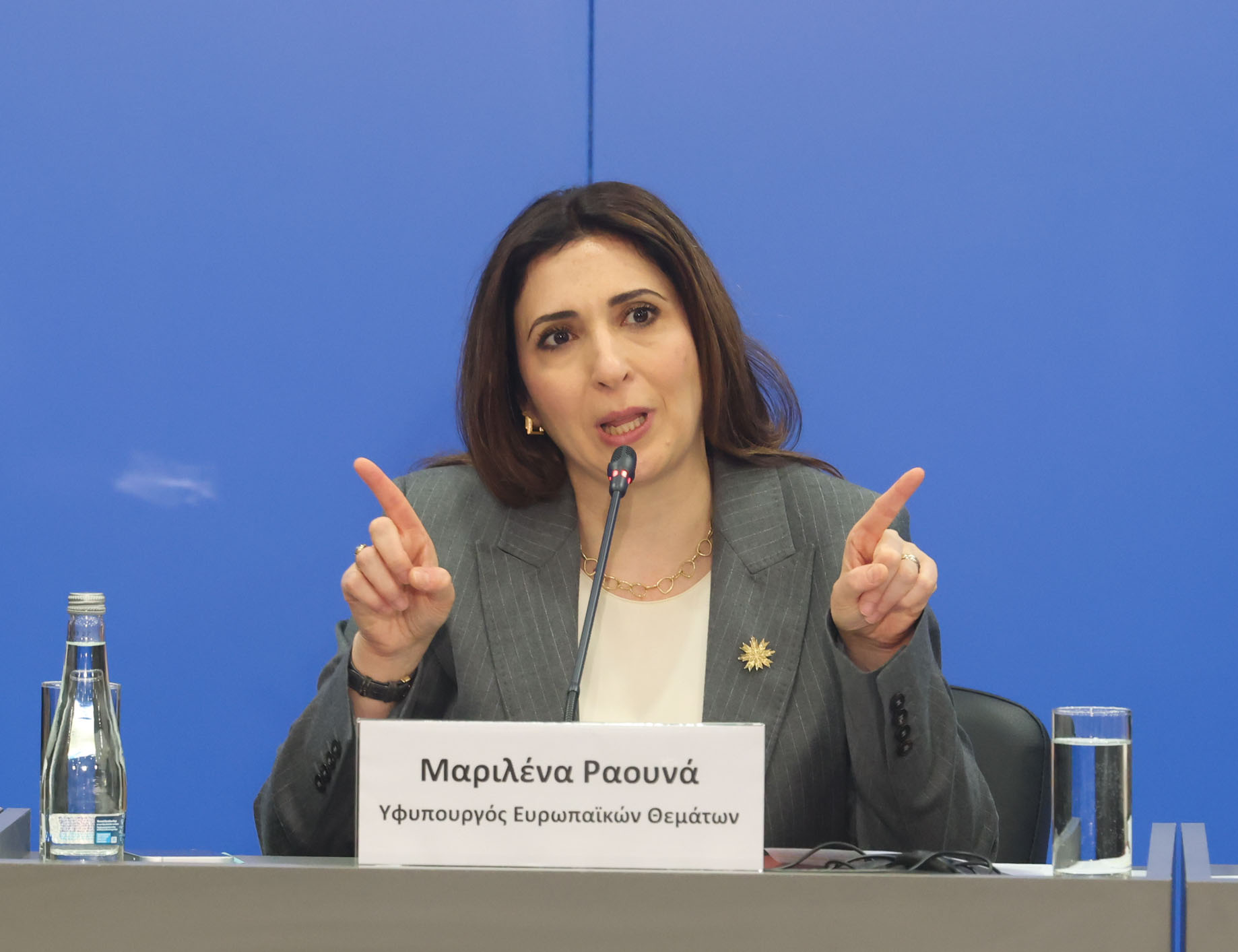
The leaders of Egypt, Jordan, Lebanon, and Syria have all been invited to attend next week’s European Council summit in Cyprus, European Affairs Deputy Minister Marilena Raouna said on Friday.
She told a press conference that those of the four – Egyptian President Abdel Fattah al-Sisi, Jordanian King Abdullah II, Lebanese President Joseph Aoun, and Syrian President Ahmed al-Sharaa – who “respond positively” and will therefore attend next week’s summit will be announced on Monday.
“Initially, the plan was to invite the 10 countries participating in the Pact for the Mediterranean, so as to specifically discuss its implementation. However, due to developments in the region, the decision was made to maintain this limited format of guests,” she said.
The 10 Mediterranean pact countries are Algeria, Egypt, Israel, Jordan, Lebanon, Libya, Morocco, Palestine, Syria, and Tunisia.
Raouna also confirmed that Ukrainian President Volodymyr Zelenskiy will contribute to the summit via a videocall, and that he will as such not travel to Cyprus.
Asked why other leaders of other countries in the region and further afield who had previously been mentioned by President Nikos Christodoulides and other members of the government as possible attendees of the summit, she said that “geopolitical developments were taken into account”.
Christodoulides had previously suggested that Indian Prime Minister Narendra Modi and Turkish President Recep Tayyip Erdogan may be invited to the summit, while Israeli Prime Minister Benjamin Netanyahu had also been viewed as a possible attendee.
However, Raouna said on Friday that the current geopolitical state of the region had “guided the creation of this composition of guests from third countries, in collaboration with the office of the European Council president,” Antonio Costa.
She then said that the Middle East is “the EU’s neighbourhood” and that the region’s security is “inextricably linked to that of the EU itself”.
“Through these adverse circumstances, they have proven in practice that they are reliable, predictable partners,” she said, in reference to the conflict in the Middle East, before being asked whether the Cypriot government or Costa had considered inviting Netanyahu.
To this, she reiterated that the choice of who would be invited was taken “in close coordination” with Costa’s office, and said that “it is important for the EU to support de-escalation in the region and send a message of respect for the territorial integrity, independence, and sovereignty of Lebanon”.
On this front, she made reference to United Nations security council resolution 1701, which stipulates that there be no armed forces in southern Lebanon south of the Litani river other than Unifil and the Lebanese military.
It also calls for the withdrawal of all Israeli forces from Lebanon and the withdrawal of Hezbollah from all areas south of the Litani.

Click here to change your cookie preferences