
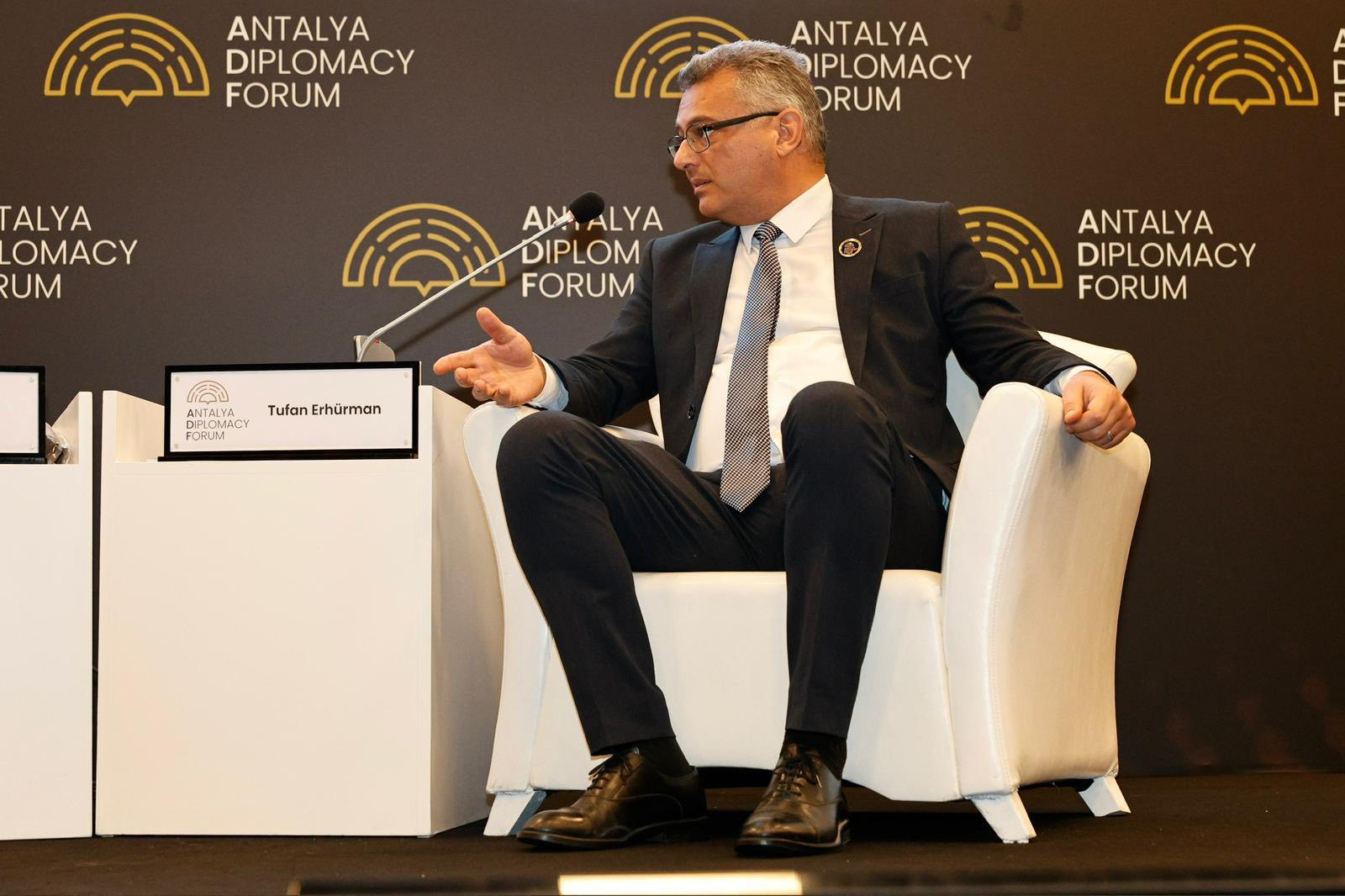
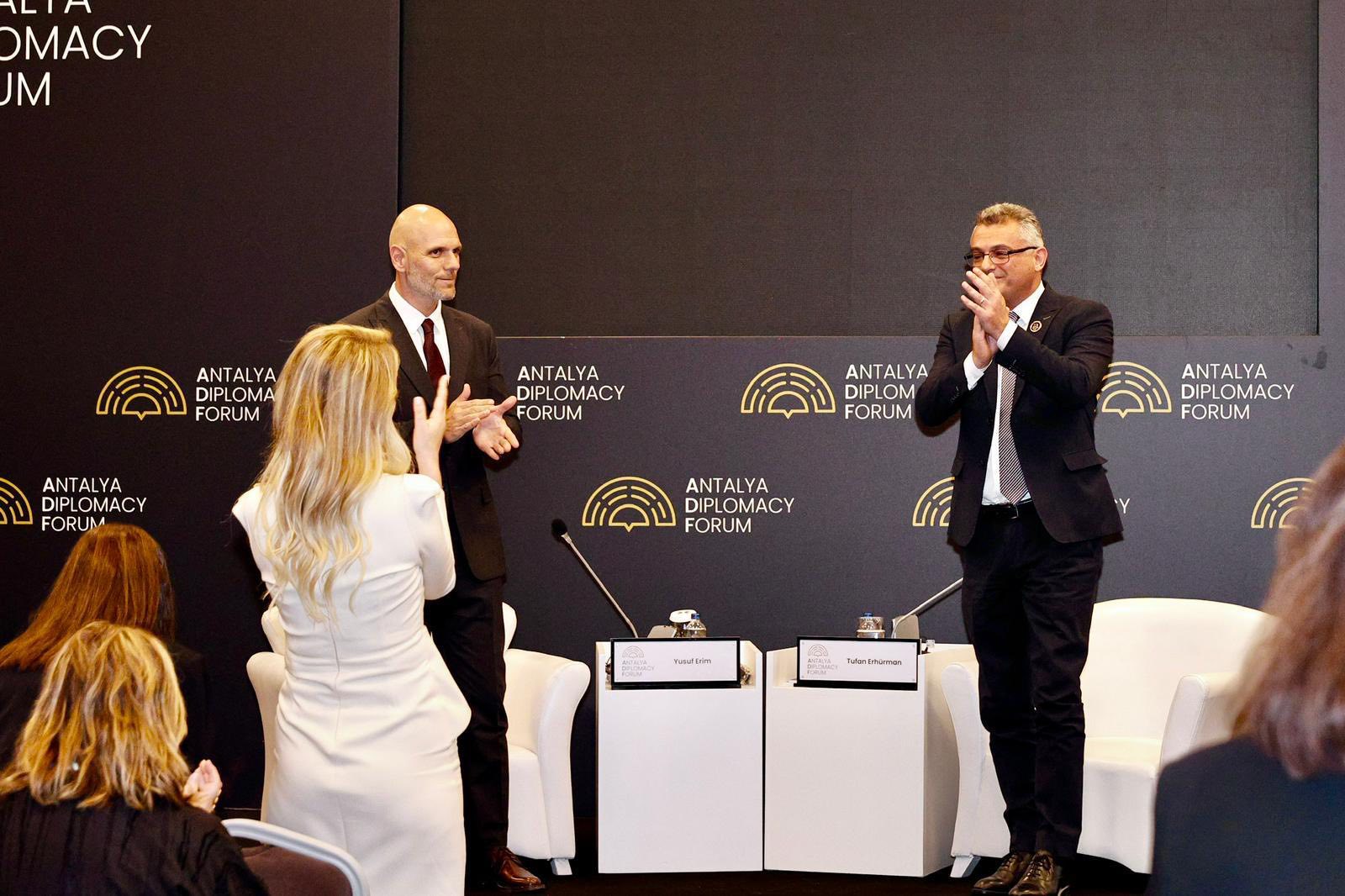
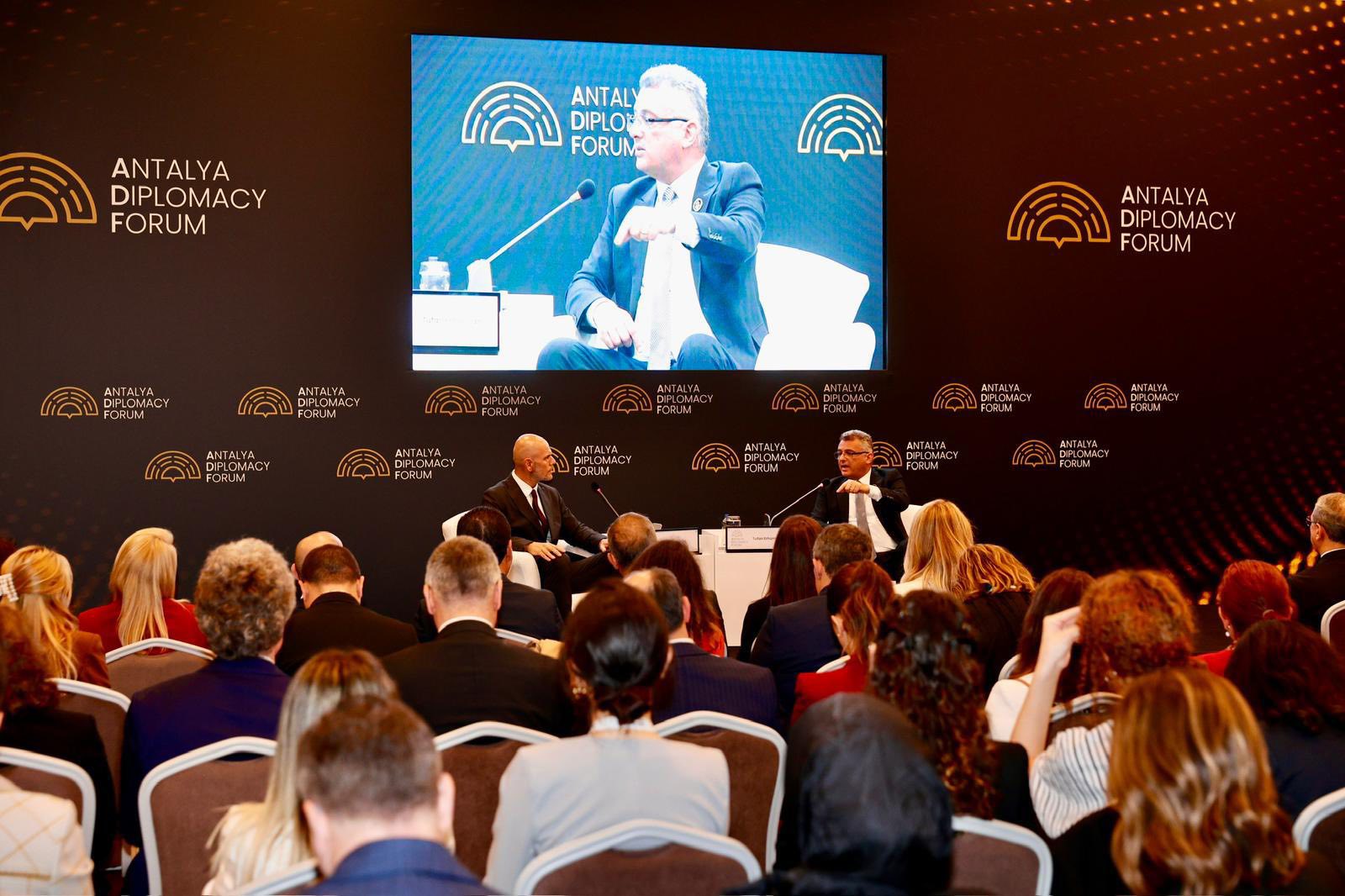
The Turkish Cypriots are “one of two equal founding partners in Cyprus”, Turkish Cypriot leader Tufan Erhurman stressed on Saturday, as he took to the stage at the Antalya diplomacy forum.
He was interviewed by Turkish public broadcaster TRT’s Yusuf Erim, who asked him whether he, like his predecessor Ersin Tatar, supports a two-state solution to the Cyprus problem.
“I am a lawyer. I have spent a significant part of my life working with the law and teaching law courses. Concepts are very important in law, but there is something even more important than concepts. All lawyers know this, legal character. In other words, the matter of content,” he said.
In this, he was referring to the legal status already obtained by the Turkish Cypriot people upon the signing of the Republic of Cyprus’ foundational documents in 1959, before adding that he intends to forge a negotiating process where the Turkish Cypriots are at the table as equal partners.
“Therefore, I said this before I took this, and I have followed this since taking office. I am saying the same thing in the negotiation process we are currently conducting under the auspices of the United Nations. The Turkish Cypriot people are one of two equal founding partners on the island. This is a legal status that no one can change,” he said.
As such, he said, “as one of the two equal founding partners on this island, the Turkish Cypriot people have sovereign rights just like the Greek Cypriot people”.
“The Turkish Cypriot people have sovereign rights in the same areas as the Greek Cypriots, and these are equal sovereign rights. Therefore, what I, as the president of the Turkish Republic of Northern Cyprus, and throughout my previous life, can never accept, is the disregarding of the Turkish Cypriots on this island,” he said.
To this end, he said that “no one can make decisions, establish international relations, or sign international agreements as if the Turkish Cypriots do not exist”, and added that “my aim is very clear” regarding his next steps.
He then listed the matters of energy, security, and maritime jurisdiction as areas in which the Turkish Cypriots must be consulted before the Republic of Cyprus takes decisions.
“If there is such an issue, if there is the issue of maritime jurisdiction, the Greek Cypriot side does not have the right to sign agreements or to enter into international alliances in these fields without the will of the Turkish Cypriots,” he said.
He stressed that “I am not presenting this as a political argument”, before outlining the legal case for his position.
“Even in the 1960 constitution of the Republic of Cyprus, when a decision regarding security on the island was to be made, our vice president, the late Dr Fazil Kucuk, had the right to veto,” he said.
He added, “in other words, even if the Greek Cypriots had a numerical majority in the cabinet of the day, what and even if the president’s seat was held by the Greek Cypriots, our vice president had the power to veto any security-related decision simply by raising his hand”.
Then, he turned his attention to current events, pointing out that the Republic of Cyprus has signed “a number of agreements with the United States and France concerning security, energy, natural gas, and maritime jurisdiction”.
“The will of the Turkish Cypriot people is not reflected in any of these agreements. This needs to be understood by the international community, and action must be taken accordingly,” he said.
However, he said, “the Greek Cypriot side is trying to reduce us to the status of being absent from the island”.
“What we are trying to do is ensure that the argument that there are areas of shared jurisdiction on the island is accepted … Therefore, in any solution found on the island, our goal is to ensure that a structure in which the Turkish Cypriot people’s rights in areas of sovereignty I have mentioned are not violated,” he said.
Returning to the question of the type of solution he may seek, he pointed out that the concepts of a federation, a unitary state, and a two-state solution differ in various existing cases.
“For example, there is a federation in Bosnia and Herzegovina, and there is a federation in the United States. No one who knows about this can look at them and say the two are the same,” he said.
He then added that as such, “rather than focusing on these names, I am pursuing my people’s rights”.
“What are the Turkish Cypriot people’s rights? Is the Turkish Republic of Northern Cyprus currently a state with its own judiciary, parliament, executive branch, and presidency? Yes. Does the fact that it is not recognised besides by the Republic of Turkey negate its statehood? No,” he said.
However, he added, “the sovereign rights of the Turkish Cypriot people, who constitute the population of the Turkish Republic of Northern Cyprus, are currently be violated”.
“We are determined to win these rights. Let us achieve this and then let the academics sit down and write books about it,” he said.
He then stressed that the Turkish Cypriots’ rights are not limited to the island’s northern third, saying, “wherever hydrocarbons are discovered in Cyprus, whether in the south or in the north, I am an equal partner to it”, before turning his attention to the Republic of Cyprus’ recent political gravitation towards the State of Israel.
“If an alliance is formed with a state which kills children, and this is done by violating the will and sovereignty of the Turkish Cypriot people, I will explain this to the entire international community. This is a violation of my sovereign rights, my equal sovereign rights,” he said.
He went on to say of the Cyprus problem that “the Turkish Cypriot people absolutely do not accept the status of being a ‘minority’ on the island”, before highlighting that “the Turkish Cypriot people demonstrated their will for a solution” at both the 2004 Annan plan referendum and during negotiations which almost produced a solution at the Swiss ski resort of Crans-Montana in 2017.
Later, he spoke of how it is “very important” that “we will be given a commitment from the outset that if negotiations collapse again due to the Greek Cypriot side’s stalling, the Turkish Cypriot people will not return to their current status”.
He said that “even though [late United Nations secretary-general Kofi] Annan, in the report he published after the 2004 referendum, stated that after the Turkish Cypriots’ ‘yes’ vote, there was no longer any legitimate justification for their isolation”, the Turkish Cypriots’ international isolation persists 22 years on.
“The isolations were to be lifted. That is something Annan said,” he said, before pointing out that in this vein, the European Union’s “direct trade regulation”, designed to facilitate trade between the Turkish Cypriot community and the bloc, remains unimplemented almost 22 years after the Republic of Cyprus joined the EU.
“The direct trade regulation was one of the three regulations that the European Union had committed to us. Two of them have been implemented, but the direct trade regulation was blocked in European Union bodies by the Greek Cypriot side, together with Greece,” he said.
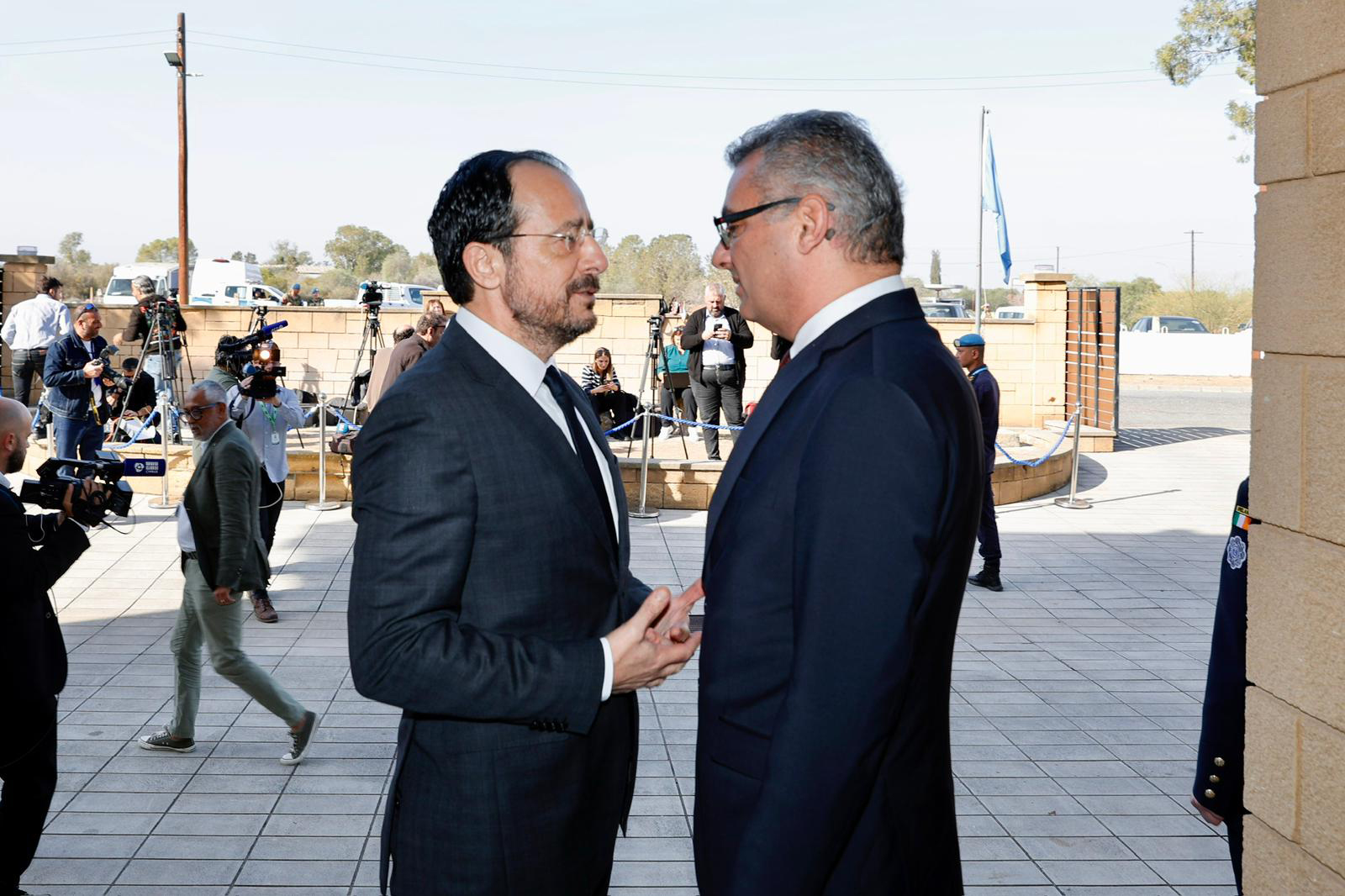
Moving onto the matter of the prospect of an enlarged meeting on the Cyprus problem, which would involve the island’s two sides, its three guarantor powers, Greece, Turkey, and the United Kingdom, and the UN, he said it is his preference to discuss matters directly with the Greek Cypriot side.
“What I said was, ‘let us meet face-to-face in Nicosia, and let us both make decisions on confidence-building measures which will make life easier for both the Turkish Cypriot and Greek Cypriot people,” he said.
He said that despite this, President Nikos Christodoulides has been eager to convene an enlarged meeting, and raised doubts over the purity of those intentions.
“I want to emphasise this. What they actually understand by an enlarged meeting is this, I am sorry, but the Greek Cypriot leadership has always tried to address the Republic of Turkey, not the Turkish Cypriot side. This is being repeated,” he said.
Towards the end of his appearance, he also spoke about the buildup of military assets in and around Cyprus after the island was hit by an Iranian-made drone last month, as well as the wider efforts made by the Republic of Cyprus in recent years to bolster its defence capabilities.
He said that a few years ago, he had “sent a message to the Greek Cypriot leadership saying, ‘frankly, I understand what you are trying to do; you think that by arming yourselves and enlisting the support of some major powers, you will create a military balance against the Republic of Turkey’”.
However, he said, such an effort would be “futile” and “impossible to achieve”, while he also warned of “another consequence”.
“If you are dreaming of having your ‘big brothers’ behind you so that you can feel safe, know that in no place will these ‘big brothers’ actually stand behind you. They will get in front of you, and you will be seriously damaged,” he said.
He also warned that “the issue of these ‘big brothers’ coming here risks the entire island, because Cyprus is a tiny island”, before saying that “the decisions they make without the will of my people risk not only their people but also my people”
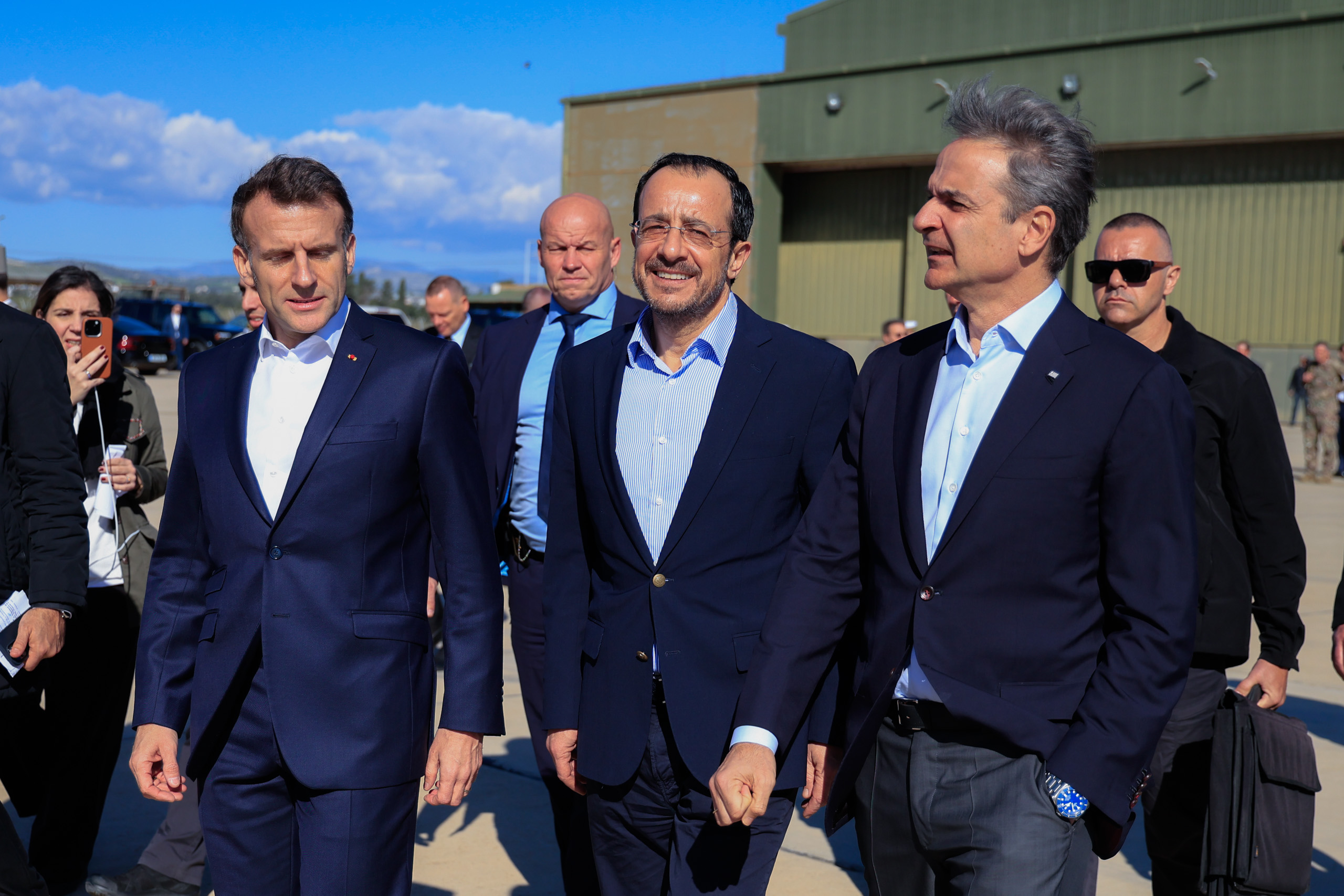
On this matter, he made reference to the visit of French President Emmanuel Macron and Greek Prime Minister Kyriakos Mitsotakis to the island in the aftermath of last month’s drone strike on the British Akrotiri air force base, saying, “they did not visit the areas where the British bases are located, but they visited Paphos”.
“Where is Paphos? It is where the Andreas Papandreou airbase is located. And where is that airbase located? I am talking about the airport of which Israel has been granted privileged use,” he said.
He then listed the countries which deployed assets to the island in the aftermath of the drone strike, before adding, “six F-16 fighter jets came from the Republic of Turkey and Christodoulides made a statement saying they did not ask for his permission, so that is a joke”.
Looking ahead, he said that “we are a people who want a solution and a people who have the will to find a solution” to the Cyprus problem, and added that while he is willing to engage in negotiations, “there is also a world outside the negotiating table”.
“We have absolutely no intention of remaining trapped at the negotiating table. We have been an observer member of the Organisation of Islamic Cooperation since 2010. More recently, we have become an observer member of the Organisation of Turkic States,” he said.
He added to this end that “we will continue to strive to develop our other bilateral relations as well”.
“Let everyone know that the Turkish Cypriot people have maintained their presence in Cyprus under the most difficult conditions. They have always been here, and they will continue to be here.”

Click here to change your cookie preferences