
KPMG Cyprus partner Christophoros Anayiotos said Cyprus’ technology sector has moved from the margins of the economy to one of its strongest engines of growth, contributing €5.9 billion, 16.2 per cent of GDP, in 2025.
Speaking during his keynote address at the TechIsland Summit on Thursday, titled ‘The Impact of Tech and Innovation in Cyprus’, Anayiotos presented KPMG’s 2025 economic impact assessment of the sector, setting out its contribution to GDP, employment, investment and Cyprus’ wider competitiveness.
The figures, he said, show a sector that is no longer emerging, but already central to the country’s economic model.
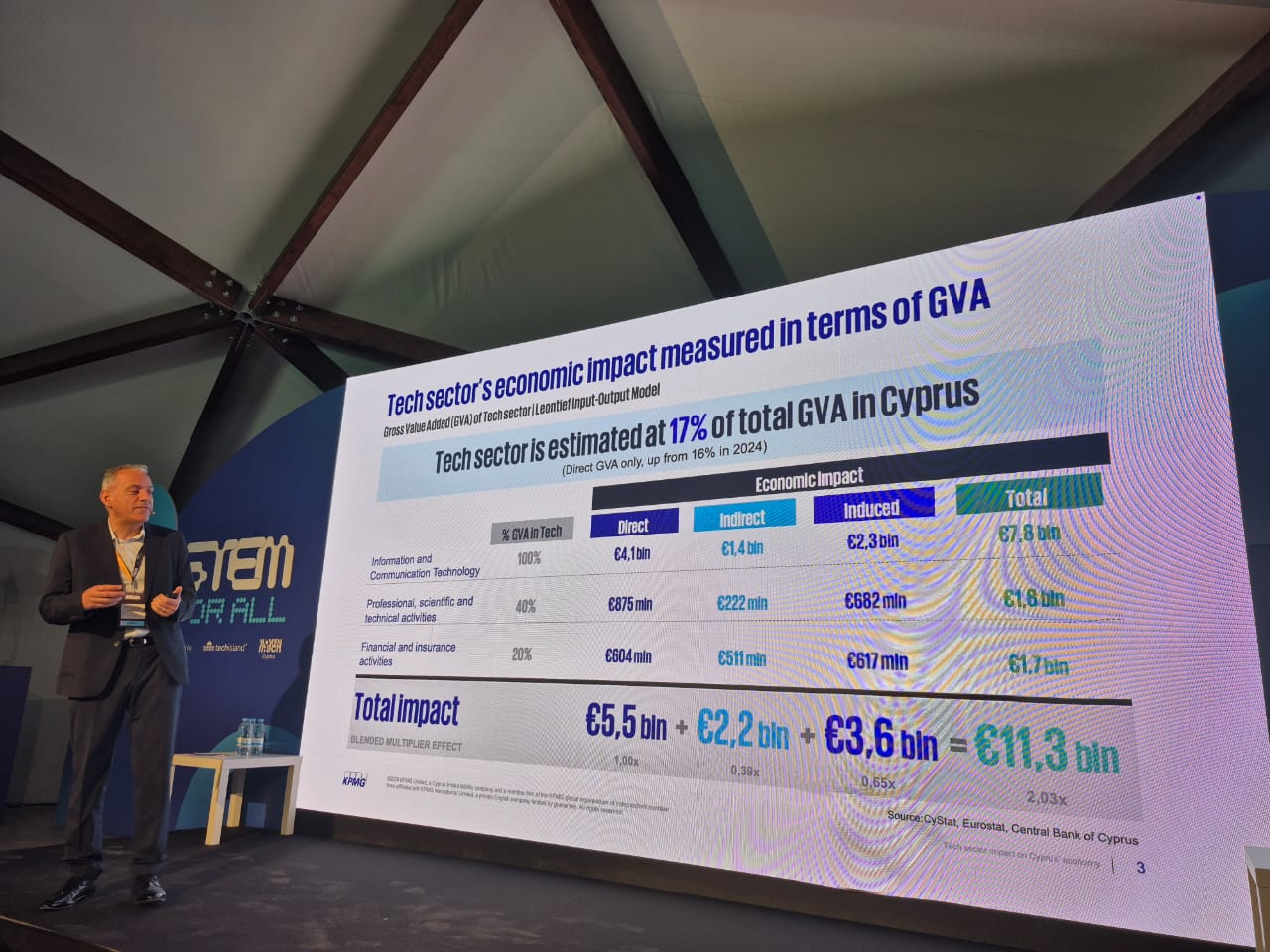
According to the assessment, “The Tech sector’s total Gross Value Added (GVA) in Cyprus for 2025 was €5.5 bln, representing 17 per cent of country’s total GVA.”
That contribution was driven mainly by Information and Communication Technology, which accounted for €4.1bn, followed by professional, scientific and technical activities at €875m, and financial and insurance activities at €604m.
Anayiotos said the tech sector’s direct GVA rose to 17 per cent of total GVA in 2025, from 16 per cent in 2024, confirming its growing weight in the Cypriot economy.
Yet its wider impact is considerably larger once the sector’s spillover effects are taken into account. When indirect and induced effects are included, he said, the sector’s total economic impact doubles to €11.9bn.
The same picture appears in GDP terms. The sector contributed €5.9bn directly in 2025, equivalent to 16.2 per cent of Cyprus’ GDP, up from 15.5 per cent in 2024. Including the wider knock-on effects across the economy, the total GDP impact reached €11.9bn.
This expansion is also reshaping the labour market, turning technology into one of the country’s most dynamic sources of employment.
Anayiotos said total employment in the technology sector has increased at a compound annual growth rate of 9.7 per cent between 2016 and 2025, reaching 48,200 employees last year. Of these, 31,700 were Cypriot nationals, 4,100 came from other EU countries, and 12,400 were non-EU nationals.
The data also shows how quickly the sector’s workforce is changing. Cypriot employees in tech grew by 6.2 per cent per year, while non-EU employees increased by 30.1 per cent per year. For Anayiotos, this makes talent one of the sector’s most urgent challenges.
He said “Local talent upskilling and reskilling are necessary to meet the increasing demand”, as technology-related roles continue to spread across the wider economy while the local talent pool becomes more limited.
Including direct and indirect employment, he said, the tech sector supports around 79,000 jobs in the national economy, made up of 48,200 direct jobs and 30,800 indirect jobs. The stronger labour market footprint is closely linked to the performance of ICT, which has continued to outpace the wider economy.
According to the data presented by Anayiotos, ICT recorded a ten-year compound growth rate of 18.9 per cent, compared with 7.9 per cent for Cyprus’ total GVA. Its resilience was also evident during the pandemic. In 2020, ICT GVA rose by 21 per cent, while Cyprus’ overall GVA fell by 3 per cent.
Anayiotos said ICT GVA had demonstrated “strong resilience and sustained growth”, including during recent periods of regional conflict and heightened uncertainty. This performance has also strengthened Cyprus’ position within the EU.
Anayiotos said Cyprus ranked third among EU27 countries in terms of ICT contribution to GVA, with the sector accounting for 12.5 per cent of total GVA in 2025, up from 11.4 per cent in 2024. This compares with an EU27 average of 5.6 per cent.
Cyprus also ranked first in the EU for ICT growth. “Cyprus ranks 1st among the EU27 in terms of ICT growth,” Anayiotos said, with ICT GVA increasing by 435 per cent between 2016 and 2025, compared with an EU27 average of 86 per cent.
He said Cyprus also ranks first among EU27 countries for growth in ICT employees. ICT employment in Cyprus grew at an annual rate of 10.7 per cent over the ten-year period, compared with 4.7 per cent across the EU27.
Productivity indicators point in the same direction. Anayiotos said the GVA contribution per ICT employee in Cyprus is around 36 per cent higher than the EU27 average, reaching €158,000 in 2025, compared with €116,000 in the EU27 in 2024.
However, he also noted that ICT employees accounted for 5 per cent of total employment in Cyprus in 2025, broadly in line with the EU average. This means that further growth will depend not only on attracting companies, but also on whether Cyprus can train, attract and retain enough talent to support them.
The investment figures reinforce the same trend. Anayiotos said ICT has become one of Cyprus’ leading destinations for inward foreign direct investment. “ICT ranks as the 3rd most attractive sector in terms of inwards FDI,” he said.
The sector accounted for 17 per cent of total inward FDI stock in 2025, behind financial and insurance activities at 45 per cent and real estate activities at 25 per cent. He said ICT’s contribution to FDI has been steadily gaining momentum, reflecting its growing role as a driver of investment activity.
At the same time, Anayiotos said Cyprus’ innovation performance presents both strengths and weaknesses. Cyprus ranked 25th among 139 economies in the Global Innovation Index 2025, 17th among the EU27 in the European Innovation Index, and second among 18 economies in the region.
He pointed to several strengths, including trademark applications, international scientific public-private co-publications, a high-skilled workforce, high-speed internet access and cloud computing.
However, he also identified weaknesses that could limit the country’s next stage of growth, including high dependence on high-tech imports and services, low R&D expenditure in the business sector, limited access to financing for R&D and IP development, and low patent and design applications compared with the EU.
Taken together, the findings show a sector that has already become a major part of Cyprus’ economy, but one that will require deeper investment in skills, infrastructure and innovation capacity to keep expanding.
Summing up the findings, Anayiotos said the tech sector directly contributed around 16 per cent of Cyprus’ GDP in 2025, equivalent to €5.9bn.
Its total economic impact reached €11.9bn, while the sector supported around 79,000 jobs, placed Cyprus first in the EU27 for ICT sector growth and ICT employee growth, and made ICT the third-largest contributor to inward FDI in Cyprus, with 17 per cent of total FDI stock in 2025.
Looking ahead, Anayiotos said Cyprus has several opportunities to build on this momentum. These include further promoting the country’s economic stability, marketing Cyprus as an ICT hub, improving airport connectivity, joining the Schengen Area to increase mobility and talent acquisition, and attracting more international banks.
He also said the country needs to increase the number and capacity of private schools, develop digital skills, promote STEM career paths, upskill teachers and students, digitally transform schools and government services, and improve the effectiveness of the legal system.
The message, in effect, was that Cyprus has already built a sizeable technology sector. The next challenge is whether it can create the skills, infrastructure and institutional capacity needed to sustain it.





Click here to change your cookie preferences