
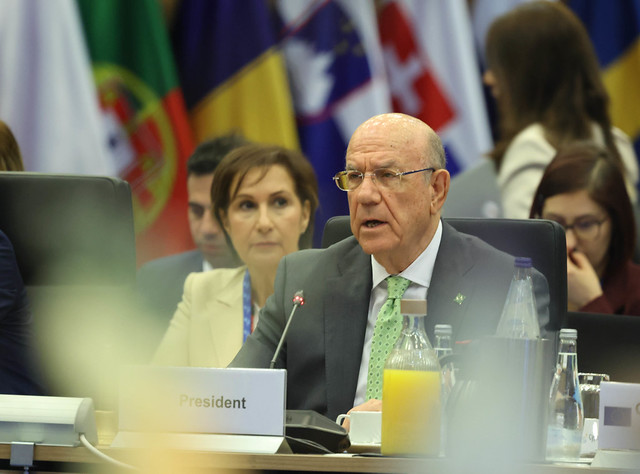
Geopolitical instability, rising defence needs and strengthening Europe’s competitiveness and resilience dominated discussions at the informal Economic and Financial Affairs Council (Ecofin) meeting in Nicosia on Saturday.
Speaking after the meeting, Finance Minister Makis Keravnos said the gathering took place against a backdrop of increasing geopolitical uncertainty, underlining the need for strategic autonomy, resilience and coordinated investment across the European Union.
“The prolonged instability in the Middle East, which affects energy markets, transport routes, trade flows and ultimately the day-to-day functioning of our economies, reminds us that Europe cannot afford complacency,” Keravnos said.
He stressed that Europe’s ambitions were growing in areas such as defence, the green transition, digital transformation, energy security and competitiveness, while fiscal space remained limited.
“For this reason, better coordination, smarter policies and stronger mobilisation of private capital are essential,” he said, adding that member states agreed fiscal sustainability must remain a central objective of EU economic and fiscal policy coordination despite growing investment pressures.
Asked whether the effects of the Middle East crisis and the disproportionate burden faced by certain member states had been discussed, Keravnos said the EU seeks to take into account national particularities and vulnerabilities when designing investment measures.
“All issues are on the table,” he said, adding that measures must remain targeted and temporary while avoiding problems linked to fiscal discipline.
According to Keravnos, discussions also reaffirmed a commitment to accelerating reforms at both national and EU level “to ensure investment needs are met without jeopardising fiscal sustainability”.
“In a time of global uncertainty, Europe must demonstrate unity, determination and the ability to act decisively,” he said.
European Commissioner for Economy and Productivity Valdis Dombrovskis said strengthening Europe’s competitiveness remained one of the European Commission’s central priorities.
Speaking at a joint press conference with Keravnos, Dombrovskis outlined four key pillars of the Commission’s competitiveness agenda: removing barriers in the single market, simplifying regulations, directing savings into productive investments and reducing energy costs.
He said the Commission had already presented more than 45 major policy proposals aimed at strengthening competitiveness and productivity across the bloc.
“We are making progress in implementing our competitiveness agenda, but we must remain focused,” he said.
He said the EU’s new fiscal framework had been designed to balance urgent investment priorities with debt sustainability, while the upcoming European Semester spring package would reflect the need to combine fiscal discipline with future-oriented spending.
On cryptocurrencies and stablecoins, Dombrovskis said the Commission’s priority was to maintain a strong regulatory framework while remaining open to innovation and new technologies.
He said the EU already has a robust framework through the Markets in Crypto-Assets Regulation (MiCA), but said it was important to ensure it remains “innovation-friendly, proportionate and globally competitive”.
He also announced that a consultation had been launched this week on revising the MiCA framework to address emerging issues in the sector.





Click here to change your cookie preferences