
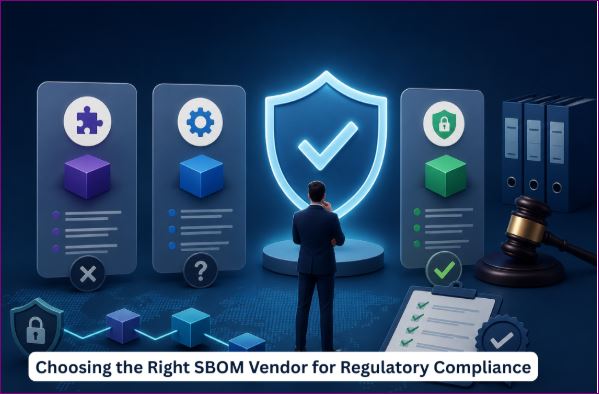
Software supply chain scrutiny has changed the way organisations buy security tooling. A few years ago, SBOMs sat quietly inside procurement conversations or niche DevSecOps discussions. Now they are tied directly to procurement reviews, cyber insurance expectations, software attestations, and sector-specific compliance obligations.
That shift created a crowded market. Every platform claims to generate accurate Software Bills of Materials. Every vendor promises visibility, automation, and compliance readiness. The problem is that many organisations end up paying for features they never use while still missing the controls regulators actually care about.
Choosing the right SBOM Vendor for Regulatory Compliance is less about buying the most advanced platform and more about understanding how compliance pressure intersects with operational reality.
Compliance pressure is no longer theoretical
Regulators are increasingly treating software transparency as a measurable security control rather than an optional best practice. Requirements around software provenance, dependency tracking, vulnerability disclosure, and third-party risk are tightening across industries.
Frameworks and mandates such as:
- Executive Order 14028 in the United States
- NIS2 in Europe
- FDA cybersecurity guidance for medical devices
- Secure software development requirements under government procurement standards
all push organisations towards maintaining accurate SBOMs.
What often gets missed is that regulators rarely ask whether an organisation owns an SBOM tool. They ask whether the organisation can demonstrate visibility into software components, identify vulnerable dependencies quickly, and maintain traceable records during audits.
That distinction matters.
A poorly chosen SBOM Vendor for Regulatory Compliance may generate massive inventories but still fail during an audit because the data is incomplete, outdated, or impossible to operationalise.
The budget trap most security teams walk into
There is a predictable pattern in many SBOM purchases. A vendor demonstrates a polished dashboard. The sales process focuses heavily on automation and AI-driven analysis. Procurement sees compliance language and assumes the requirement has been solved.
Six months later, teams discover:
| Common Issue | Operational Impact |
| Excessive false positives | Engineers ignore alerts |
| Weak ecosystem integrations | Manual workflows increase |
| Incomplete package visibility | Audit gaps remain |
| Licensing based on scan volume | Costs escalate unexpectedly |
| Limited support for modern build environments | Coverage becomes inconsistent |
This is where budget waste begins. Not through one large purchase, but through ongoing operational friction.
An effective SBOM Vendor for Regulatory Compliance should reduce workload, not create another layer of administration.
Start with regulatory alignment, not feature lists
Many buying decisions begin with product comparison spreadsheets. That usually leads to overbuying.
A better starting point is identifying which regulatory obligations actually apply to the organisation. Different industries have different expectations around SBOM depth, retention, reporting, and vulnerability response timelines.
For example:
- A healthcare software provider may prioritise FDA-aligned traceability
- A government contractor may need strong attestations and supply chain provenance
- A SaaS provider handling enterprise clients may focus on contractual compliance demands
The vendor should fit the compliance environment rather than forcing the organisation to adapt its processes around the platform.
This changes the evaluation criteria significantly.
What to evaluate before signing anything
The following areas tend to separate mature vendors from platforms that mainly exist for marketing demonstrations.
Data accuracy
SBOM quality depends entirely on visibility. If the platform cannot reliably identify dependencies across languages, containers, binaries, and build pipelines, the output quickly becomes unreliable.
False confidence is worse than limited visibility.
Ask vendors how they validate component identification. Request examples involving complex dependency chains rather than simple open-source packages.
Format support
A strong SBOM Vendor for Regulatory Compliance should support recognised formats such as:
- SPDX
- CycloneDX
- SWID
This matters because compliance environments evolve. Locking into proprietary formats creates future migration problems.
Integration capability
Most organisations already use CI/CD pipelines, ticketing systems, vulnerability scanners, and cloud security tooling.
An SBOM platform should fit into those workflows naturally.
If engineers need separate portals or manual exports for routine tasks, adoption usually collapses within months.
Vulnerability correlation
Generating inventories alone is not enough anymore.
The platform should correlate components against vulnerability databases and prioritise exploitable risks sensibly. Basic CVE matching without contextual analysis creates alert fatigue very quickly.
Audit readiness
Compliance teams often need evidence quickly during assessments.
A capable SBOM Vendor for Regulatory Compliance should make it easy to produce:
- Historical SBOM records
- Change tracking
- Vulnerability remediation timelines
- Software provenance reports
Without extensive manual preparation.
A practical way to compare vendors
Security leaders often struggle because every vendor presentation sounds nearly identical. Creating a simple evaluation framework helps separate operational value from sales language.
Below is a useful structure for internal reviews.
Core Checks
Before comparing pricing or dashboards, assess these areas consistently:
- Coverage Depth: Can the platform identify dependencies across all major environments used internally?
- Compliance Mapping: Does the tool align with the organisation’s actual regulatory requirements?
- Workflow Fit: Will engineering teams realistically use it without friction?
- Reporting Quality: Can compliance evidence be exported clearly during audits?
- Pricing Stability: Does the licensing model remain predictable as environments grow?
This section works well visually because it mirrors the real evaluation flow many security teams already follow.
Cheap platforms often become expensive later
There is pressure in many organisations to minimise tooling spend. Understandably so. Security budgets rarely expand at the same pace as compliance requirements.
Still, choosing the lowest-cost vendor can create hidden operational costs that become difficult to justify later.
A low-cost platform with poor integration support may require additional engineering effort. Weak vulnerability prioritisation increases analyst workload. Incomplete SBOM generation can eventually trigger external audit findings or procurement delays.
The total cost rarely stays low for long.
At the same time, the most expensive platform is not automatically the best fit either.
The right SBOM Vendor for Regulatory Compliance is usually the one that aligns with the organisation’s software complexity, regulatory exposure, and operational maturity without overwhelming internal teams.
Vendor transparency matters more than polished marketing
A noticeable shift is happening in the SBOM market. Buyers are becoming more sceptical of broad claims around “complete visibility” and “full compliance automation”.
Experienced security teams now ask harder questions:
- How frequently is component intelligence updated?
- What happens when packages cannot be identified?
- How are transitive dependencies handled?
- Which vulnerability feeds are used?
- How are false positives reduced?
Vendors willing to answer these directly tend to be more operationally mature.
Those relying heavily on abstract language usually expose gaps once deployment begins.
SBOM maturity is operational, not cosmetic
One of the biggest misconceptions around SBOM adoption is that generating inventories alone equals maturity.
It does not.
A mature programme connects SBOM data to broader risk management activities:
- Vulnerability response
- Third-party software reviews
- Procurement assessments
- Incident response
- Software lifecycle governance
That requires the vendor platform to operate reliably beyond simple inventory generation.
An effective SBOM Vendor for Regulatory Compliance should support long-term governance rather than short-term audit preparation.
Conclusion
Choosing an SBOM Vendor for Regulatory Compliance should not become a race towards the platform with the longest feature list or the loudest marketing claims. The better approach is slower and more practical.
Focus on visibility quality, integration capability, reporting reliability, and operational fit. A platform that works consistently across engineering, security, and compliance teams will deliver far more value than one overloaded with features nobody realistically uses.
Regulatory pressure around software supply chain security is unlikely to ease anytime soon. Organisations that treat SBOM adoption as a genuine governance capability rather than a procurement checkbox will be in a much stronger position during audits, incident investigations, and third-party assessments.
CyberNX can help organisations evaluate, implement, and operationalise SBOM strategies without creating unnecessary tooling complexity or budget waste. From compliance alignment to software supply chain visibility, the focus remains on building practical security processes that hold up under real operational pressure.
DISCLAIMER – “Views Expressed Disclaimer – The information provided in this content is intended for general informational purposes only and should not be considered financial, investment, legal, tax, or health advice, nor relied upon as a substitute for professional guidance tailored to your personal circumstances. The opinions expressed are solely those of the author and do not necessarily represent the views of any other individual, organization, agency, employer, or company, including NEO CYMED PUBLISHING LIMITED (operating under the name Cyprus-Mail).





Click here to change your cookie preferences