
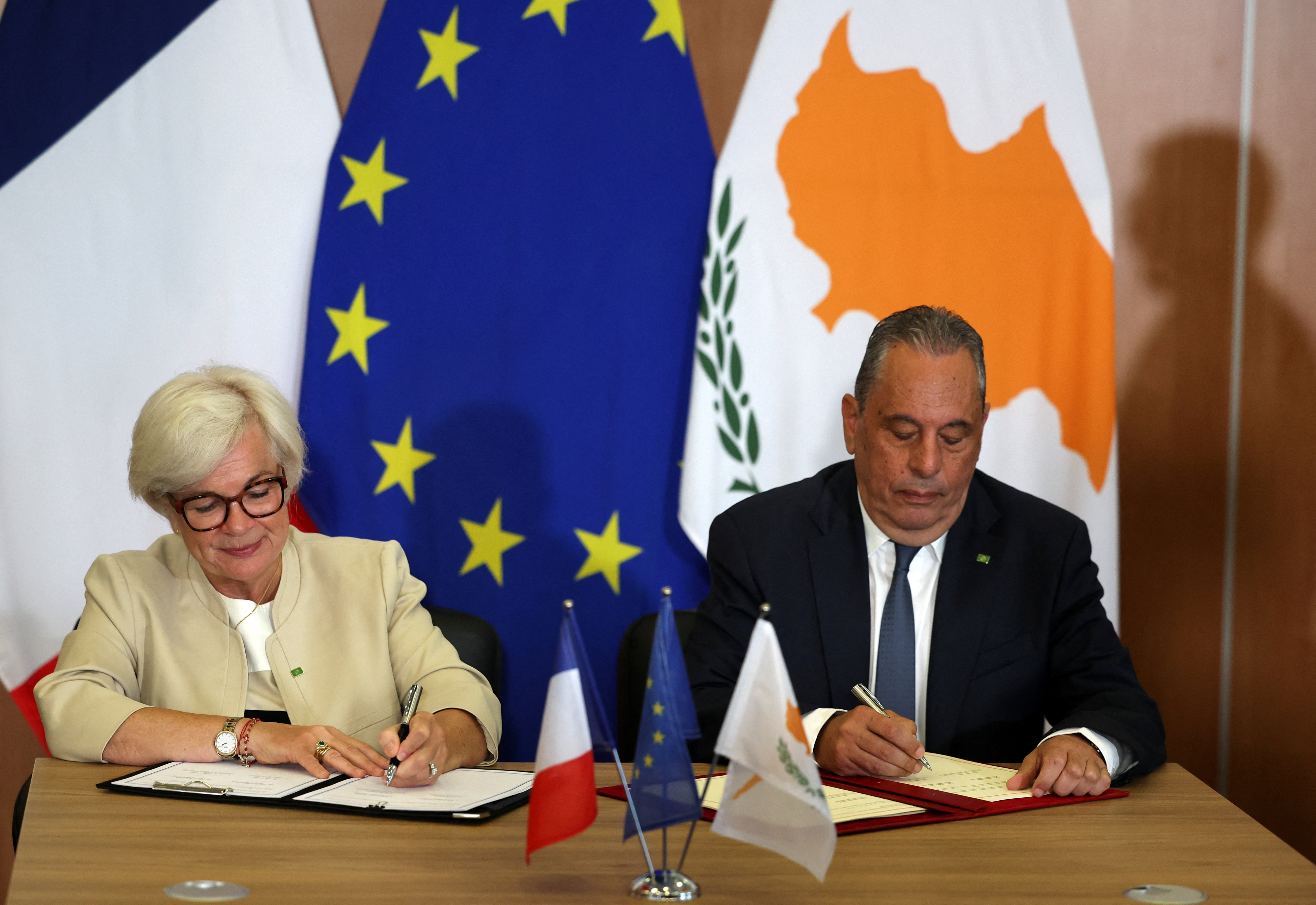
Cyprus and France took another step towards closer defence cooperation on Monday, signing an agreement aimed at making it easier for their armed forces to operate together and French troops to be positioned on Cyprus soil.
The agreement was signed in Nicosia by Defence Minister Vasilis Palmas and his French counterpart Catherine Vautrin on the sidelines of the informal meeting of EU defence ministers hosted by Cyprus.
The deal, known as a Status of Forces Agreement (SOFA), establishes the legal framework governing the presence and activities of French military personnel in Cyprus and Cypriot personnel in France.
Palmas described the signing as the culmination of an already close and expanding defence relationship built on mutual trust and shared strategic interests.
“The agreement establishes a modern and comprehensive framework for cooperation in the fields of defence and security, regulating the rights and obligations of the forces of both countries when present on each other’s territory,” he said.
The signing follows the strategic partnership agreement concluded by Presidents Nikos Christodoulides and Emmanuel Macron in Paris last December, which both sides described as a milestone in the steadily deepening relationship between the two countries.
Palmas said Cyprus and France cooperate closely on regional security issues, defence procurement and military partnerships across all sectors of defence and security. He also highlighted the two countries’ participation alongside Greece and Italy in a quadrilateral cooperation mechanism.
He said cooperation between the two countries was evident both operationally, through the regular presence and facilitation of French military forces in the region, and institutionally through joint initiatives within the European Union and other international frameworks.
The minister also referred to developments in the Eastern Mediterranean and the Middle East, thanking France for its rapid response during the regional crisis earlier this year when a drone struck Akrotiri.
“I had the opportunity to once again thank Minister Vautrin for France’s immediate response and the deployment of forces within the territorial waters of the Republic of Cyprus during the recent crisis in the region,” Palmas said.
He added that strengthening ties with France reinforced Cyprus’ role as a pillar of stability in the Eastern Mediterranean and reflected the Republic’s commitment to partnerships based on common values, respect for international law and the promotion of regional security.
Vautrin described Cyprus as a key strategic partner for France and an essential hub for French military operations in the Eastern Mediterranean and the Middle East.
“Cyprus is an essential support point for the conduct of our military operations in the Eastern Mediterranean and the Near East,” she said.
She noted that the ports of Larnaca and Limassol host around 30 French naval visits annually, with 21 already recorded since the beginning of this year.
The French minister highlighted the extensive cooperation between the two countries’ armed forces, pointing to joint naval exercises, including Argonaut and Eunomia, aimed at strengthening maritime security, freedom of navigation and crisis response capabilities.
She said cooperation had also expanded in recent years to include land and air operations, military mobility, air defence, operational readiness and logistical support.
“In the air domain, Cypriot infrastructure provides an ideal framework for our logistical support, as well as surveillance and air defence capabilities that are invaluable to our deployed forces,” she said.
Vautrin also emphasised France’s support for the modernisation of Cyprus’ armed forces, describing defence cooperation as a central pillar of the bilateral relationship.
The minister reiterated France’s support for Cyprus, recalling that during the regional security crisis in March a French frigate participated in the island’s air defence while the French carrier strike group was repositioned in the Mediterranean.
“This is our illustration of what European defence is,” she said.
Vautrin said the newly signed SOFA would facilitate cooperation between the two countries’ armed forces but stressed that it should be viewed as another step rather than the final destination.
“This agreement is not an end in itself. It is a stage in the strengthening of military cooperation between our two countries,” she said.
Both ministers said the agreement would help deepen defence cooperation at a time of growing instability in the Eastern Mediterranean and wider region, while supporting broader European efforts to strengthen security and defence capabilities.

Click here to change your cookie preferences