
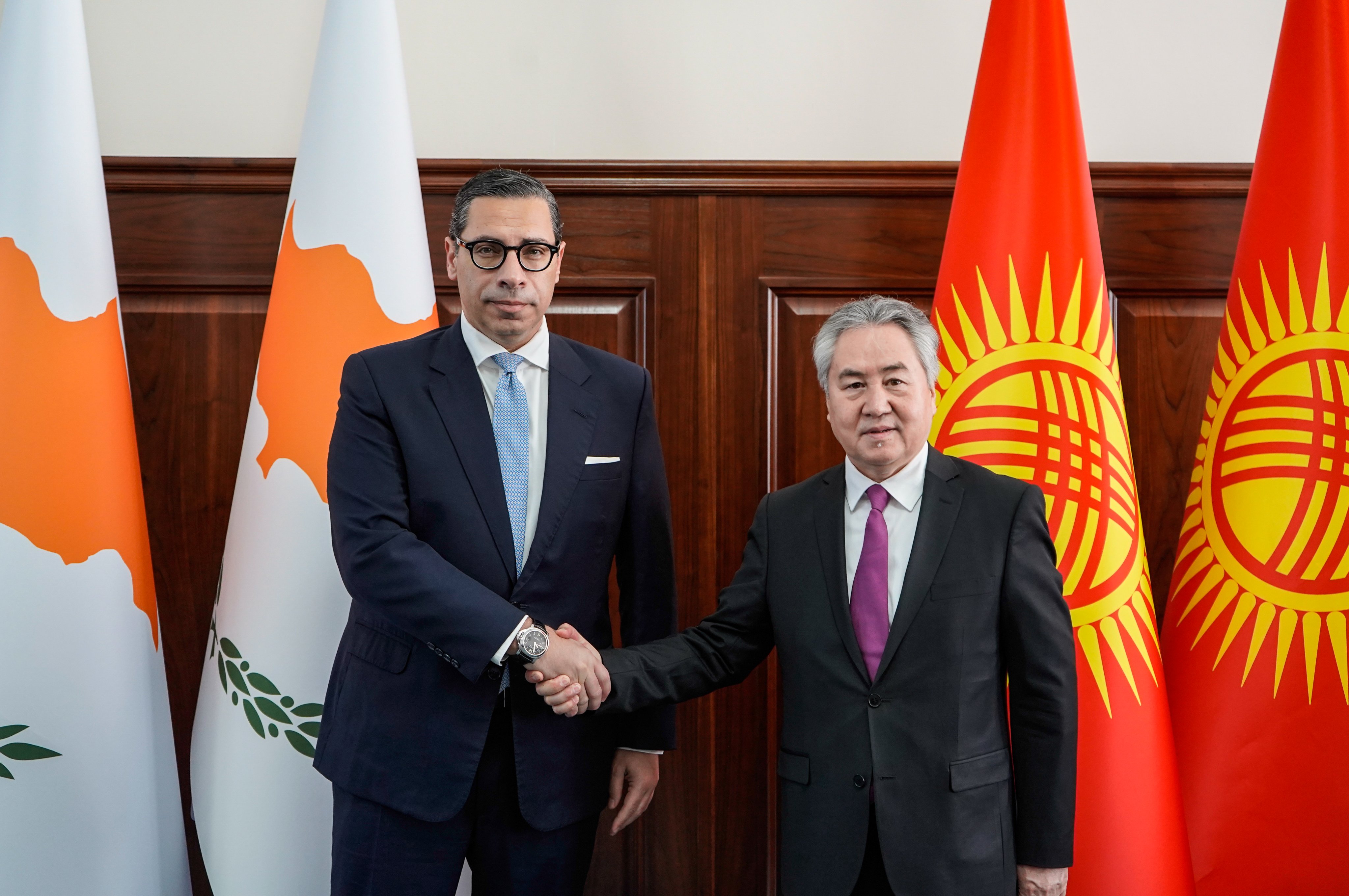
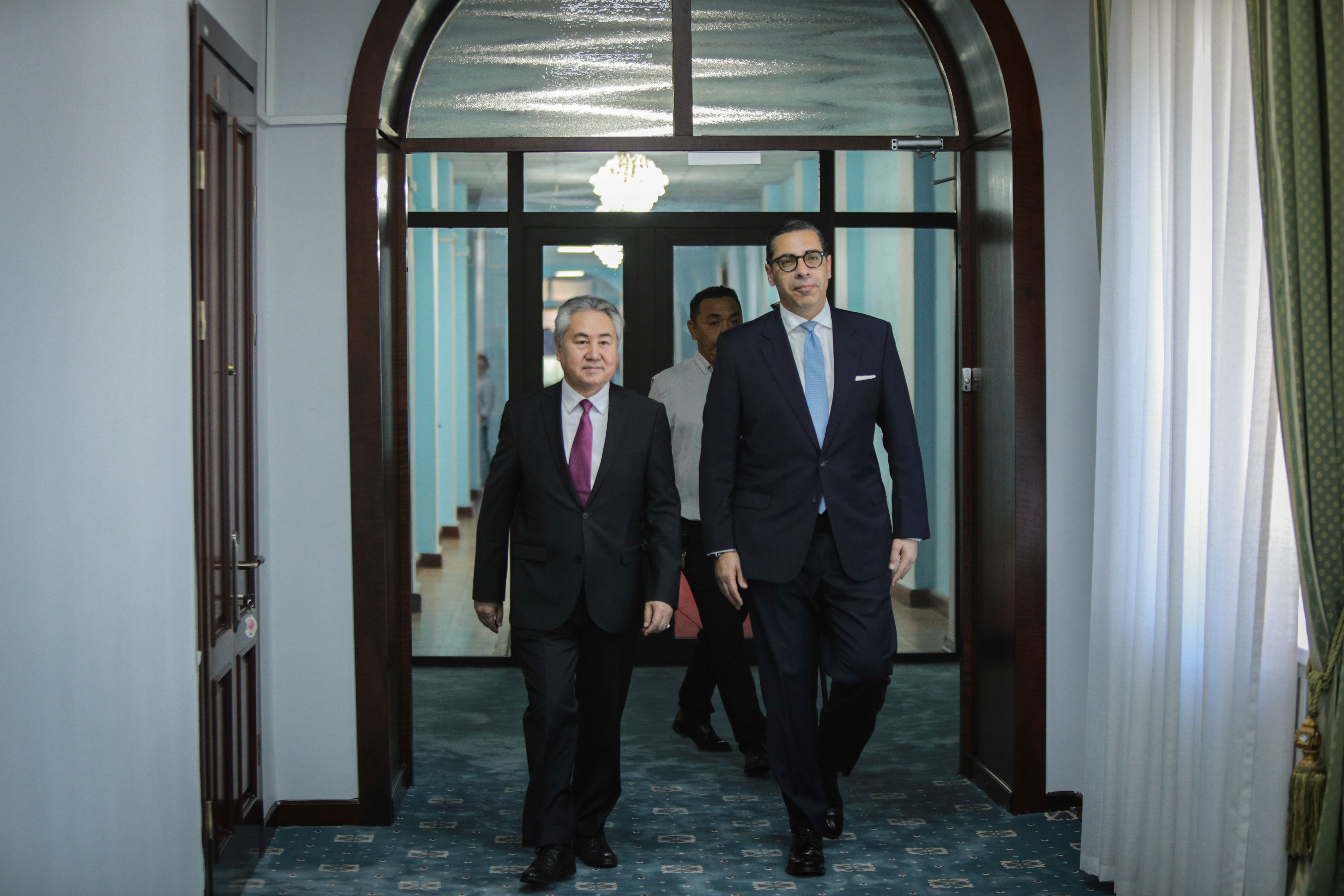
Kyrgyz Foreign Minister Zheenbek Kulubaev on Monday warned his Cypriot counterpart Constantinos Kombos that the European Union’s “intensification” of its sanctions on Russia may harm the central Asian country, as Kombos embarked on the fourth and final leg of his tour of the region.
According to Kyrgyzstan’s foreign ministry, Zheenbek “expressed concern over the possible adverse impact of unilateral restrictive measures on Kyrgyzstan’s trade, economic, and financial development”.
“He stressed that the Kyrgyz side, while opposing the politicisation of international economic and commercial relations, remains committed to an open dialogue aimed at finding mutually beneficial solutions,” he said.
Kombos has in recent years been a supporter of sanctions on Russia in light of the country’s invasion of Ukraine in 2022, telling his Ukrainian counterpart Andrii Sybiha last month that the EU plans to enact a 20th package of sanctions on Russia and those affiliated with its government.
Just two weeks ago, Cyprus hosted an informal European foreign affairs council (Fac) meeting in which EU foreign policy chief Kaja Kallas said that “too many countries continue to do business with Moscow, while simultaneously enjoying privileged access to European markets and investments”.
“Europe must use its leverage more effectively when it comes to trade, investment, market access, partnerships, and this is why we are preparing new sanctions [on] Russia to really pressure them, so that they would go from pretending to negotiate to actually coming to the negotiating table,” she said.
However, despite those sanctions and Europe’s stance, Kyrgyzstan maintains a large volume of trade with Russia, with Russia’s Tass news agency having quoted the Kyrgyz cabinet’s deputy chairman Daniyar Amangeldiev as having said that trade with Russia exceeds US$5 billion (€4.3bn).
“Today, Russia remains one of Kyrgyzstan’s largest trade partners and investors,” he said at an economic forum in St. Petersburg, with the trade turnover worth more than a fifth of Kyrgyzstan’s gross domestic product.
The European Union has attempted to strengthen its economic presence in central Asia in recent years to compete with Russia’s footprint in the region, pledging €10bn in support of “sustainable transport” across five central Asian states, including Kyrgyzstan, last year.
That pledge was made as part of a joint declaration, which also saw Kazakhstan, Tajikistan, Turkmenistan, and Uzbekistan, which also precluded any recognition of northern Cyprus as an independent country on the part of any of the five states.
The joint declaration stated that all five countries “reaffirmed our strong commitment” to United Nations security council resolutions 541 and 550.
Resolution 541 said the security council “deplores the declaration of the Turkish Cypriot authorities of the purported secession of part of the Republic of Cyprus” while calling on UN member states not to recognise the north.
Resolution 550 said it “reiterates the call upon all states not to recognise the purported state of the ‘Turkish Republic of Northern Cyprus’, set up by secessionist acts, and calls upon them not to facilitate or in any way assist the aforesaid secessionist entity”.
A year on, Kyrgyzstan has been elected to a non-permanent seat on the UN security council, and will take that seat next year, with Kombos on Monday having “congratulated the Kyrgyz side on this significant achievement” and “wished its success in its forthcoming work”.
He was also briefed on Kyrgyzstan’s “key priorities” for its two-year term on the security council.
Kulubaev also said that he had “highly appreciated” the support offered by the EU to Kyrgyzstan during Cyprus’ six-month term as the holder of the Council of the EU’s rotating presidency “in implementing socio-economic reforms, strengthening democratic institutions, developing human capital, and promoting sustainable development initiatives”.
Additionally, both countries signed a deal to avoid double taxation between the two countries, with Kombos describing the deal as a “pivotal moment” and “an opportunity to create momentum in terms of investment and trade”.

Click here to change your cookie preferences