
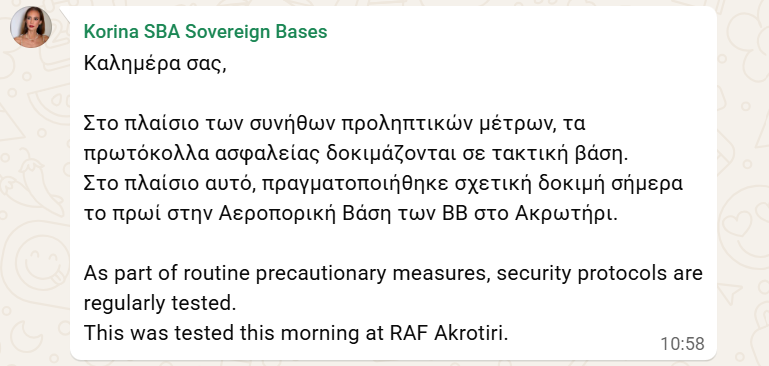
The activation of “operation wideawake”, the British military’s protocol for breaches of a base’s security, at the country’s Akrotiri air force base on Wednesday morning, was a test and not an actual security incident, British bases spokeswoman Korina Orphanides said.
“As part of routine precautionary measures, security protocols are regularly tested. This was tested this morning at RAF Akrotiri,” she said.
Earlier in the morning, bases personnel had been informed that “operation wideawake” had been initiated, with personnel ordered to “check their working areas for suspicious items” and report anything suspicious to the local emergency services and the British bases’ grounds operations team.
Additionally, they were informed that while the operation was in force, there was to be “no movement around station”.
Typically, “operation wideawake” is only activated when senior officers on any given base believe that it may have been breached by terrorists.
Its most notable recent real-world activation came in October last year, when the Larkhill Royal Artillery barracks in England was broken into by thieves who stole fuel from a tanker.
The drill comes at a time of heightened scrutiny over the British bases in Cyprus, with Akrotiri having been hit by an Iranian-made drone in March, and the bases having been used as the launchpad for operations in the Middle East in which British aircraft engaged and shot down drones launched by Iran during its conflict with the United States and Israel.
Following the strike on the Cyprus base, outgoing British Prime Minister Sir Keir Starmer had sought to clarify that British bases in Cyprus are “not being used by US bombers”, though it is believed that the drone itself had been aimed at a hangar which houses American Lockheed U-2 reconnaissance aircraft.
Those aircraft are known to fly reconnaissance missions over the Middle East from Akrotiri as part of what is known as “Operation Olive Harvest”.
Prior to the outbreak of the conflict in the Middle East, British newspaper the Daily Telegraph had reported that “Russian spies” may have bought a number of houses near the Akrotiri base, raising fears that those properties were being used as part of attempts to pry into its operations and compromise it.
It was later reported by The Times that the drone which hit the base contained “a Russian-made Kometa-B navigation system”, and that this navigation system had first been seen in Russian drones intercepted by Ukrainian air defences in December last year.
In the same vein, a dual Azerbaijani and British citizen was arrested on suspicion of espionage in June last year, accused of spying on both the Akrotiri base and the National Guard’s Andreas Papandreou airbase in Paphos.
Authorities in Greece and Cyprus believe that the case may be linked to that of another Azerbaijani man who was handed a jail sentenced last month for monitoring a military base on the island of Crete.



Click here to change your cookie preferences