
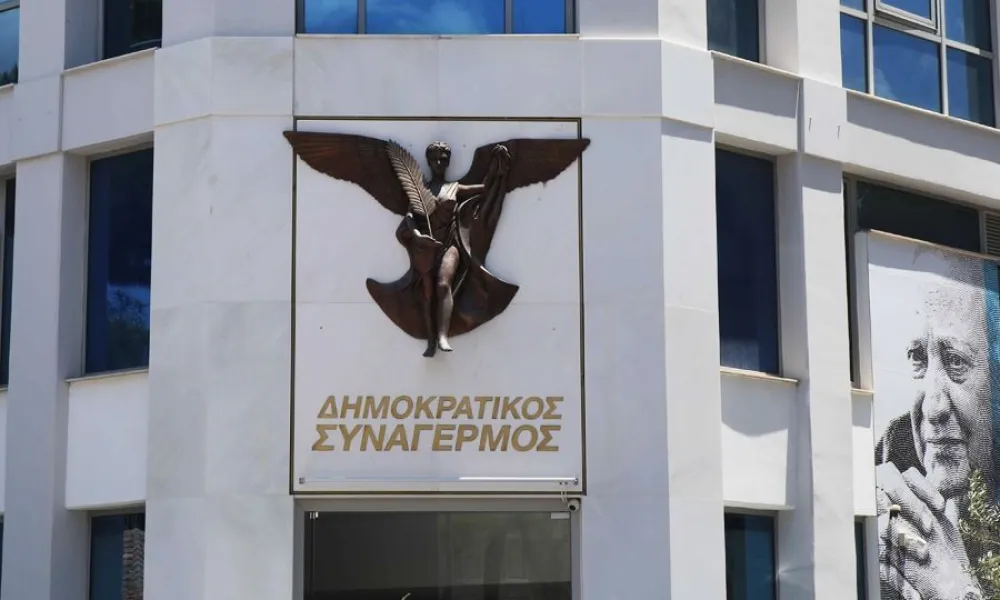
Disy on Friday hit back at the government, excoriating President Nikos Christodoulides’ “last-minute” attempt to extend European Affairs Deputy Minister Marilena Raouna’s term in office until the end of the year and accusing the government of trying to “mislead public opinion” on the matter.
“The president is attempting to turn one of his own failures into a political attack on Disy. Yesterday, a government request which was submitted as urgent was voted down. Anything else constitutes a conscious attempt to mislead public opinion,” it said.
It added that “the government’s choice to submit a [bill on a] supposedly serious matter at the last minute, without the necessary time to study, consult, or for substantive parliamentary work, cannot but raise reasonable questions of political expediency”.
“If the extension was indeed so crucial for the interests of the Republic of Cyprus and for the negotiations for the multiannual financial framework, why was it not foreseen in a timely manner?” it asked, with the multiannual financial framework constituting the EU’s budget for the period covering the years between 2028 and 2034.
It asked why an extension to Raouna’s term “was not incorporated from the outset into the relevant legislation, as happened during the previous Cypriot presidency of the Council of the EU”.
“The creation of new structures, the extension of terms of office, and the burdening of the public with new, inflexible expenditures are serious political decisions. They cannot appear at the last minute, and it cannot be asked of parliament to approve them without the necessary documentation,” it said.
It added that it is “inconceivable to attempt to cultivate the impression that the securing of European funds for the Republic of Cyprus depends on the six-month extension of the term in office of one person”.
To this end, it said that “since 2004, the Republic of Cyprus has participated as an equal at the European Union, negotiated the multiannual financial frameworks and secured significant amounts of European funding through the competent state institutions”.
“The finance ministry, the foreign ministry, the development office, and the competent state institutions have proven over time, with success, that they can accomplish this task. The country’s own historical course refutes the government’s claims,” it said.
It then moved to defend its own stance, saying that it is “the only party which has consistently defended the country’s European course with actions, seriousness, and documentation, and not with communication exaggerations”.
“If the president seeks responsibilities to be taken, let him seek them in his government and not in Disy. Political expediency cannot be called a European necessity,” it said.
Raouna was appointed as deputy minister in advance of and for the purpose of overseeing Cyprus’ six-month term as the holder of the Council of the European Union’s rotating presidency during the first half of this year.
She took office in January 2024, with the legislation implemented to allow the creation of the post foreseeing that it would cease to exist at the end of this month, one month after the end of Cyprus’ six-month term.
This was also the procedure followed when late president Demetris Christofias appointed Andreas Mavroyiannis as his European affairs deputy minister when the island first held the Council of the EU’s rotating presidency in the second half of 2012. He ceased to be a deputy minister on January 31, 2013.
However, on this occasion, the government had wished to extend Raouna’s term in office, and parliament’s rejection of this proposal received a terse response from government spokesman Konstantinos Letymbiotis.
“Obviously, the 22 European Union member states which have an organised political structure for European issues have got something wrong, and obviously, by the same token, Cyprus does not need such a structure either, even though it is a country with a national issue, with critical European negotiations ahead of it, and with the Cyprus problem’s European dimension gaining even greater importance,” he said.
He said that “the argument that the Republic of Cyprus has been in the European Union for 22 years without this structure is anachronistic, to say the least”.
“States evolve. Needs change. European politics today requires knowledge, continuity, contacts, presence and organised handling,” he said.





Click here to change your cookie preferences