
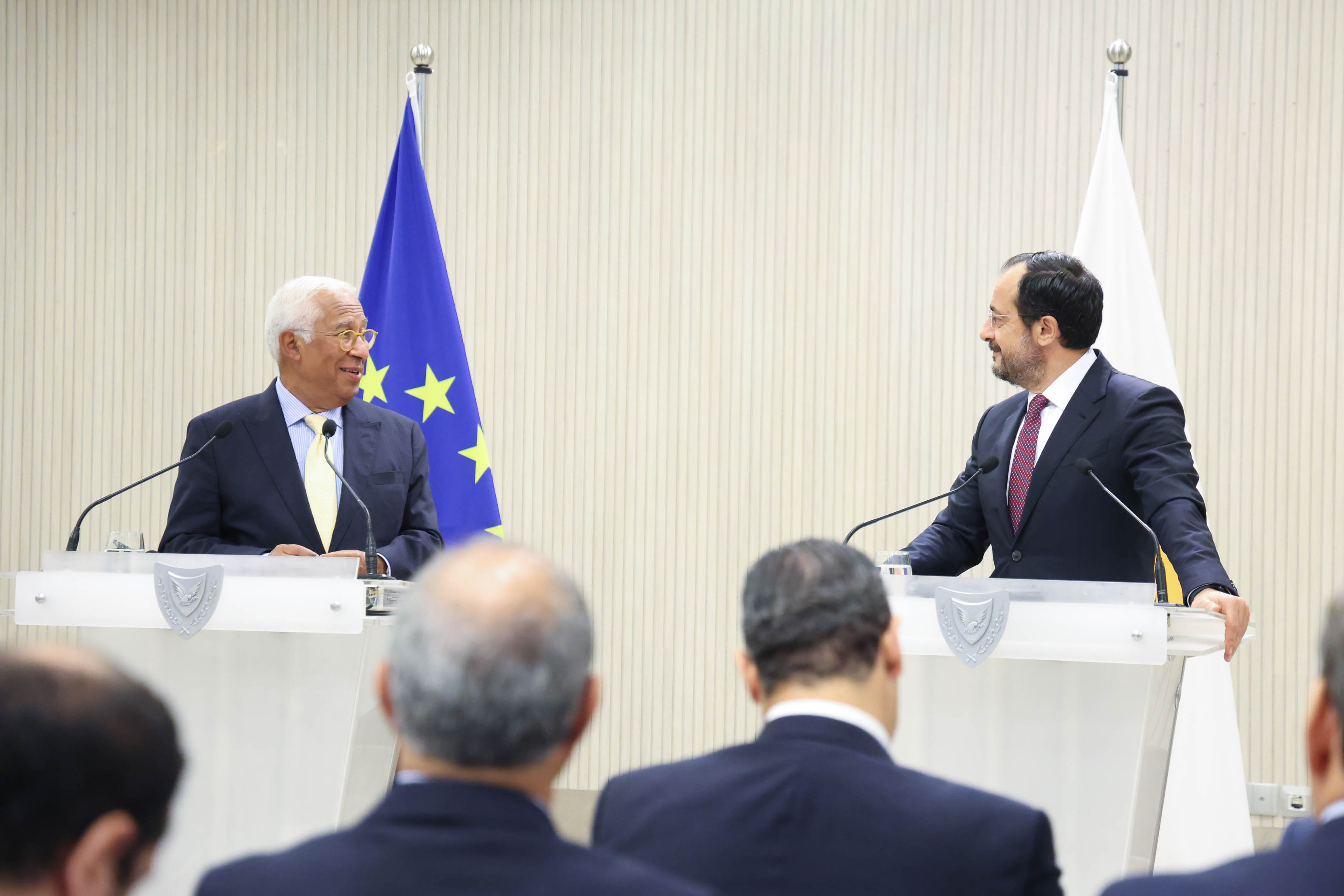
President Nikos Christodoulides on Friday reiterated his readiness to take part in an expanded conference on the Cyprus problem, calling on the UN Secretary-General to convene a meeting at which the resumption of negotiations from where they left off would be announced.
European Council President Antonio Costa, meanwhile, said the EU was ready to contribute positively towards a Cyprus settlement, including through strengthening relations between the bloc and Turkey.
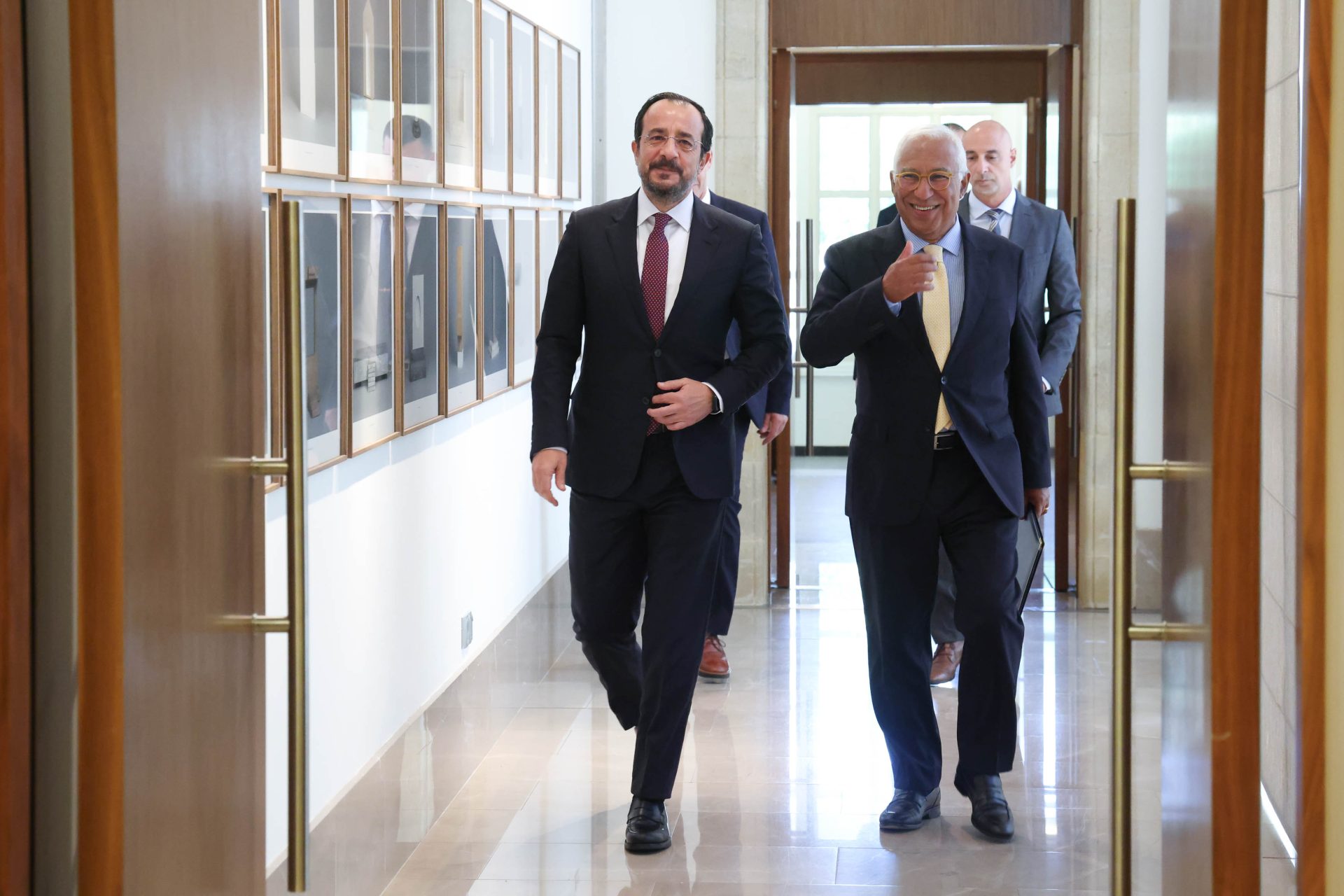
The two leaders spoke following talks at the presidential palace in Nicosia, held as part of Costa’s tour of EU capitals ahead of upcoming European Council meetings.
Christodoulides said discussions covered the EU’s next Multiannual Financial Framework (MFF), Ukraine, enlargement, the Middle East, competitiveness and migration, as well as two issues of particular importance to Cyprus, the Cyprus problem and the Republic’s bid to join the Schengen area.
On Schengen, Christodoulides said he had raised Cyprus’ “desire and readiness” for full accession, pointing to a European Commission evaluation which, he said, confirmed the country’s readiness and recommended completing the process as a priority.
Turning to the Cyprus problem, Christodoulides said he had briefed Costa on developments following the recent visit of UN Secretary-General Antonio Guterres and thanked the European Council president for his personal involvement.
“The Cyprus problem is a European problem and the EU can play the most decisive role in achieving a solution and the reunification of our country, based on the principles, values and laws of the EU,” he said.
Asked what role Brussels could play in restarting negotiations and whether there were indications Turkey could adopt a constructive approach, Christodoulides said the EU was uniquely placed to help.
He said this was partly because the bloc possessed the tools to create a “mutually beneficial” environment for a settlement and partly because the EU acquis could provide answers to issues on which the two sides continued to disagree.
Christodoulides referred to the joint letter sent to the UN Secretary-General by Costa and European Commission President Ursula von der Leyen in 2025, as well as the appointment of European Commission Executive Vice-President Raffaele Fitto as the EU’s special envoy for Cyprus, as evidence of the bloc’s willingness to become more actively involved.
On Turkey’s position, Christodoulides said all parties should ultimately be judged at the negotiating table.
“All of us, including Turkey and the Republic of Cyprus, the Greek Cypriot side and the Turkish Cypriot side, will be judged at the negotiating table,” he said.
He reiterated his readiness for talks to resume and for outstanding disagreements to be discussed.
“This is also the message we are sending to the Secretary-General, on the need to convene an expanded conference during which the resumption of negotiations from where they were interrupted will be announced,” he said.
It would then be at the negotiating table, he added, that all sides would demonstrate whether they had the necessary political will.
Costa: EU ready to help through Turkey relations
Costa reaffirmed the EU’s commitment to progress on the Cyprus problem based on UN Security Council resolutions and international law, saying Brussels actively supported the UN Secretary-General’s efforts towards a negotiated settlement.
“It is clear to us that a united Europe needs a reunified Cyprus,” he said.
Costa said both he and von der Leyen had already conveyed to Turkish President Recep Tayyip Erdogan that the EU was prepared to contribute positively towards a settlement.
“We have conveyed to the Turkish President that we are ready to contribute positively to resolving the problem, including by strengthening the EU’s relations with Turkey,” he said, describing this as an important way in which Brussels could assist efforts towards a Cyprus settlement.
Costa also highlighted Cyprus’ geostrategic position, describing the island as an important pillar of EU security and pointing to its role in maritime security and regional stability in the eastern Mediterranean and Middle East.
EU budget, Ukraine and migration
Much of Friday’s meeting also focused on the next EU budget for 2028-2034, with Christodoulides saying the aim was to reach a political agreement by the end of 2026.
He said Cyprus had stressed the need to fund strategic priorities including competitiveness, defence and security and migration, while protecting traditional policies such as cohesion funding and the Common Agricultural Policy.
The particular circumstances of small and island member states should also be reflected in the budget, he said.
Costa praised the work carried out during Cyprus’ EU Council presidency and said recent devastating wildfires and drought conditions demonstrated the need for the EU budget to allow the bloc to respond quickly to emerging challenges.
On Ukraine, Christodoulides said Cyprus, as “the only EU member state under occupation”, understood what was at stake and remained committed to international law, international legitimacy and the UN Charter.
He also backed continued European support for Ukraine, including the smooth release of the €90 billion package agreed during the Cyprus presidency.
On migration, Christodoulides said Cyprus had reduced arrivals by 92 per cent compared with 2022 and increased returns by 180 per cent through what he described as a comprehensive policy.
The leaders also discussed EU enlargement and relations with the Middle East and Gulf. Christodoulides welcomed Costa’s plans to convene the second EU-Gulf leaders’ summit in Saudi Arabia in October and said Cyprus was ready to help deepen the EU’s relations with the region.



Click here to change your cookie preferences