
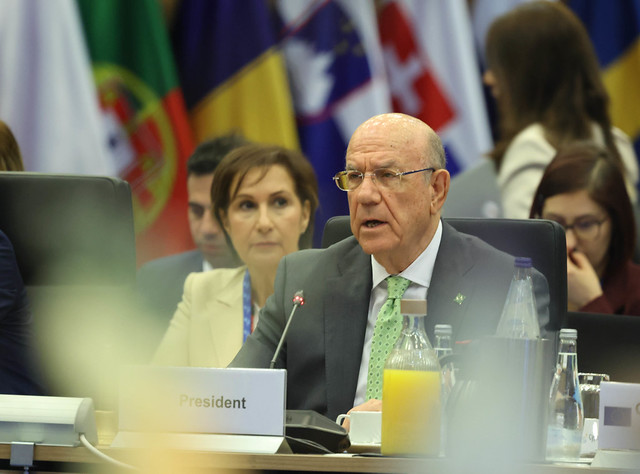
Finance Minister Makis Keravnos dropped a bombshell on Tuesday, telling MPs that the Great Sea Interconnector (GSI) could end up costing a great deal more than the €1.9 billion as advertised, while also questioning whether the project would ultimately bring down the cost of electricity.
In parliament, Keravnos said the often cited €1.9 billion figure in fact covers the cost of the subsea cable alone.
However, other expenditures – such as insurance coverage, warehouses and maintenance works – should be factored into the final cost.
Without up-to-date financial data and a clear picture as to the project’s viability, the minister stressed, the government cannot take a decision to become an equity investor in the GSI.
Such a considerable investment would impact public finances and expenditure margins dictated by EU rules.
Should the state not invest in the project, the cost would be borne by consumers.
Keravnos cited an earlier estimate (2017) by Cyprus’ energy regulator which found that the cost to consumers from an operational GSI would come to 3.7 cents per kilowatt-hour.
“We’re not sure that the price of energy would come down [with the GSI],” he told MPs.
He also recalled a feasibility study previously done on the GSI by an American firm on behalf of the government, the results of which were “discouraging”.
It’s understood he was referring to a legal due diligence and feasibility-related study carried out by Curtis, Mallet-Prevost, Colt & Mosle LLP in late 2024. It found that the project carries significant financial risk and inadequate profitability.
For this reason, said the minister, the government subsequently asked for an updated study, the findings of which are still pending.
He also recalled that the European Investment Bank had previously expressed doubts about the GSI’s viability, recommending in July 2023 that Cyprus look at energy storage as an alternative.
In February 2024, the cabinet recognised the geopolitical significance of the GSI, but set as preconditions a due diligence report, updated cost estimates and a business plan.
According to Keravnos, whereas it’s important to end Cyprus’ energy isolation, the current global energy crunch has “caused discussions” among EU finance ministers, who opined that electrical interconnectors are not a cure-all.
Both Keravnos and Energy Minister Michalis Damianos dismissed the notion of doublespeak inside the government regarding the project.
They said that it cannot be stated the project can go ahead regardless of cost.
Damianos said that if the cost turns out excessively high, additional investors and other means of financing should be found.
He described the GSI as more a project relating to energy adequacy and security, rather than a project to bring down electricity costs.
Nevertheless, he added, the government has the responsibility to ensure technical excellence, economic viability and the benefit to consumers.
The entry of French infrastructure conglomerate Meridiam does give the project momentum, but additional investment is required, Damianos noted.
He went on to stress the major geopolitical importance of the project for Cyprus, Greece and Israel.
Regarding ongoing work, Damianos said that over the next few weeks they expect Greek authorities to issue a Navtex for more depth surveys.
He reiterated that the French research vessel has the political backing of the French government.
Meanwhile officials with the Cyprus Energy Regulatory Authority (Cera) recalled that under the cross-border cost allocation agreement between Cyprus and Greece, the distribution of capex (capital expenditure) for the GSI comes to 63 per cent for Cyprus and 37 per cent for Greece.
For other expenditures – like operating costs – the cost distribution is 50-50.
Cera officials revealed that on August 28 they sent a letter to Greece’s independent power transmission operator (Admie) asking a series of questions about the project’s state of play following the entry of Meridiam.
Admie is the project promoter.
Cera vice-chairman Alkis Philippou said a number of questions remain “open” – such as the ownership status of the GSI and who controls the cable.
As things stand, he added, control and management of the cable itself are “100 per cent in non-Cypriot hands”.
Sources apprised of the matter later told the Cyprus Mail that Admie ought on its own to have briefed the energy regulator of the new state of play after the deal with Meridiam.
“The Cypriot side should not have to seek answers long after the fact,” they said.
The same sources said that taking one look at Admie’s website should provide clues as to the GSI’s probable true cost.
They cited for example an interconnector, listed on the website, which is just 300km long but has a price tag of around €2 billion.
By comparison, the GSI – the leg from Crete to Cyprus – is 900km.
The ministers’ remarks in parliament drew a firestorm of reactions from political parties.
In a written statement after the session of the House energy committee, Akel said that “every time we discuss the GSI in parliament, we grow more alarmed”.
Akel added: “These discussions really make us angry. Because, if there are reasons why this electrical interconnection must happen, we should get answers on two key questions: what will it cost Cyprus, and what will Cypriot consumers end up paying?”
The party asked rhetorically whether the project is being carried out “so that certain individuals can make a fortune, or so that certain geostrategic interests are served, with Cypriot consumers being asked to pay for even more expensive electricity”.
According to Akel, the question the government ministers failed to answer in parliament was this: “Will the project happen or not?”
The government also has no answers to other crucial matters – such as who will ultimately have control and management of the GSI.
“Some will supply [Cyprus] with power, they will be able to affect prices and the electricity market and, by extension, they will play an important part in Cyprus’ energy supply.
“This is a matter that concerns not just energy, but also the security and sovereignty of our country.”




Click here to change your cookie preferences