
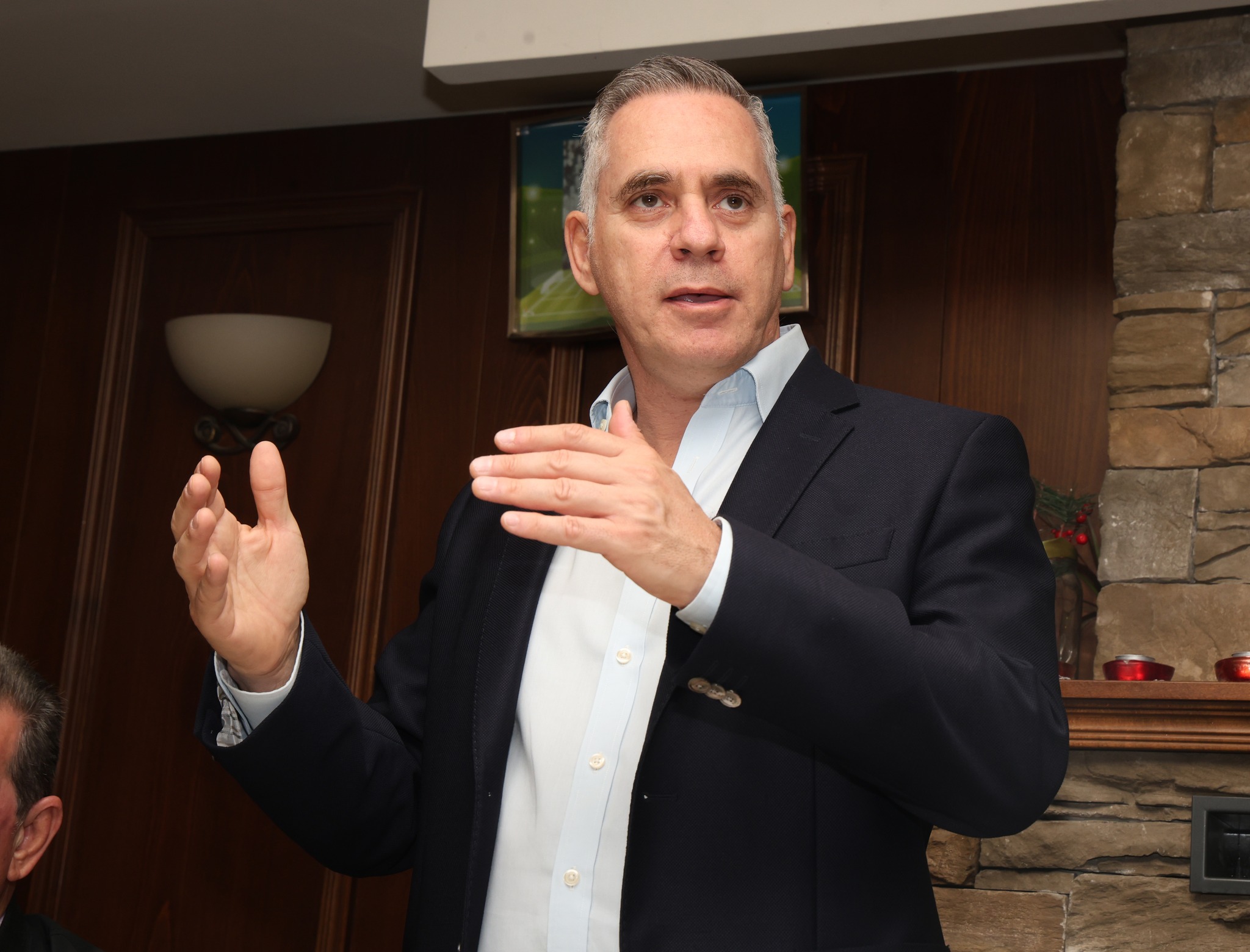
Diko leader Nicholas Papadopoulos says the project faces a ‘geostrategic risk’ from Turkey but argues EU backing and private investment point to its viability
A navtex, a message used to transmit information to seaborne vessels, will be issued “in the coming days” to warn sailors of plans to conduct seabed surveys for the laying of cables between Cyprus and Crete as part of the Great Sea Interconnector project, Diko leader Nicholas Papadopoulos said on Thursday.
He told Politis radio that “there is a geostrategic risk” associated with the project “due to Turkey”, which claims ownership over parts of the sea through which it is planned the interconnector cable will pass.
However, he said, “this factor is being dealt with by the European Union, Greece, and multinational companies which have expressed interest in investing in the project”, with French asset management firm Meridiam having bought a controlling stake in the project last month.
“The fact that specialised companies are willing to invest their own capital is an indication that they consider the project viable and profitable,” he said.
In terms of finances, he said that “if the electrical interconnection were in operation today, electricity from Greece would be on average approximately 30 per cent cheaper” than the price Cypriot consumers currently pay for domestically produced electricity.
This, he said, add up to “an annual benefit for the Cypriot economy of at least €185 million”.
He said that the Republic of Cyprus has agreed to pay a total of €125m for the project thus far, “while the remaining cost of the project will be covered by investors and European funding”.
On this front, he said that the interconnector “may prove to have even greater benefits for the Republic of Cyprus than has been initially calculated”, and said that if this transpires, “this could lead to a demand for a greater Cypriot contribution than the €125m” the country is currently obliged to pay.
“The interconnection will enhance competition in the electricity market and allow Cyprus to export green energy to Europe which is currently being lost.”
Keravnos, Damianos warnings
His comments come after French President Emmanuel Macron and Greek Prime Minister Kyriakos Mitsotakis had discussed the matter on Wednesday, with Mitsotakis’ office on Wednesday night saying that the pair had spoken about the “next steps” to be taken after Meridiam’s buyout.
President Nikos Christodoulides, meanwhile, had said that Meridiam’s purchase of a controlling stake constitutes the first “substantial development towards the implementation” of the project since 2012.
However, some inside the government have expressed reservations regarding the project’s future, with Finance Minister Makis Keravnos having said on Tuesday that it may cost well more than the currently forecast €1.9 billion to construct.
He also said that the government is “not sure” whether the project will reduce consumer energy prices.
Keravnos is not the first member of Christodoulides’ cabinet to have said words to this effect, with Energy Minister Michael Damianos having said last month that the implementation of the Great Sea Interconnector “does not necessarily mean that the price of electricity will also decrease”, and that in fact, “it may increase”.
In response to Damianos’ comments, a European Commission spokesperson told the Cyprus Mail that “boosting electricity interconnections helps bring down energy prices by allowing the integration of more renewables in the system”.
The threat from Turkey
Regarding the seabed surveys and the related navtex, Greece’s independent transmission system operator Admie, which owned the interconnector project until it was bought out by Meridiam last month, was quoted as having said that around 60 per cent of the seabed surveys have been completed thus far.
The remaining 40 per cent of the impacted seabed, it said, is located in disputed waters which are claimed by both Greece and Turkey.
These conflicting claims have impeded attempts to carry out seabed surveys between Cyprus and Greece before, with Turkish naval vessels being deployed in 2024 after the Italian research vessel the Ievoli Reulme strayed into what Turkey believes to be its own waters.
The naval vessels escorted the research ship away from Turkey, but not before Greece, too, dispatched a number of its own naval vessels, including the frigates the Nikiforos Fokas and the Aittitos, to the area.
Greek Foreign Minister Giorgos Gerapetritis has since indicated that should a similar dispute arise again, Greece would once again be prepared to send warships into the disputed waters should Turkey do the same.
The dispute about the ownership of the waters stems from the question of whether islands generate their own exclusive economic zone (EEZ) or not.
Greece and Cyprus, citing the United Nations convention on the law of the sea (Unclos), state that they do, while Turkey, which is not a signatory to Unclos, states they do not.
As such, according to Turkey’s position, beyond the 12 nautical miles of territorial waters to which Turkey believes both islands are entitled, the sea between Cyprus and Crete is Turkish.
By contrast, the position held by Greece and by the Republic of Cyprus is that, given that islands generate a full EEZ, the EEZs of Greece and Cyprus border one another south of Kastellorizo, Greece’s easternmost inhabited island.
With this dispute ongoing, Mitsotakis is expected to visit Kastellorizo on Sunday as a physical demonstration of Greece’s claim and intent in the region.



Click here to change your cookie preferences