
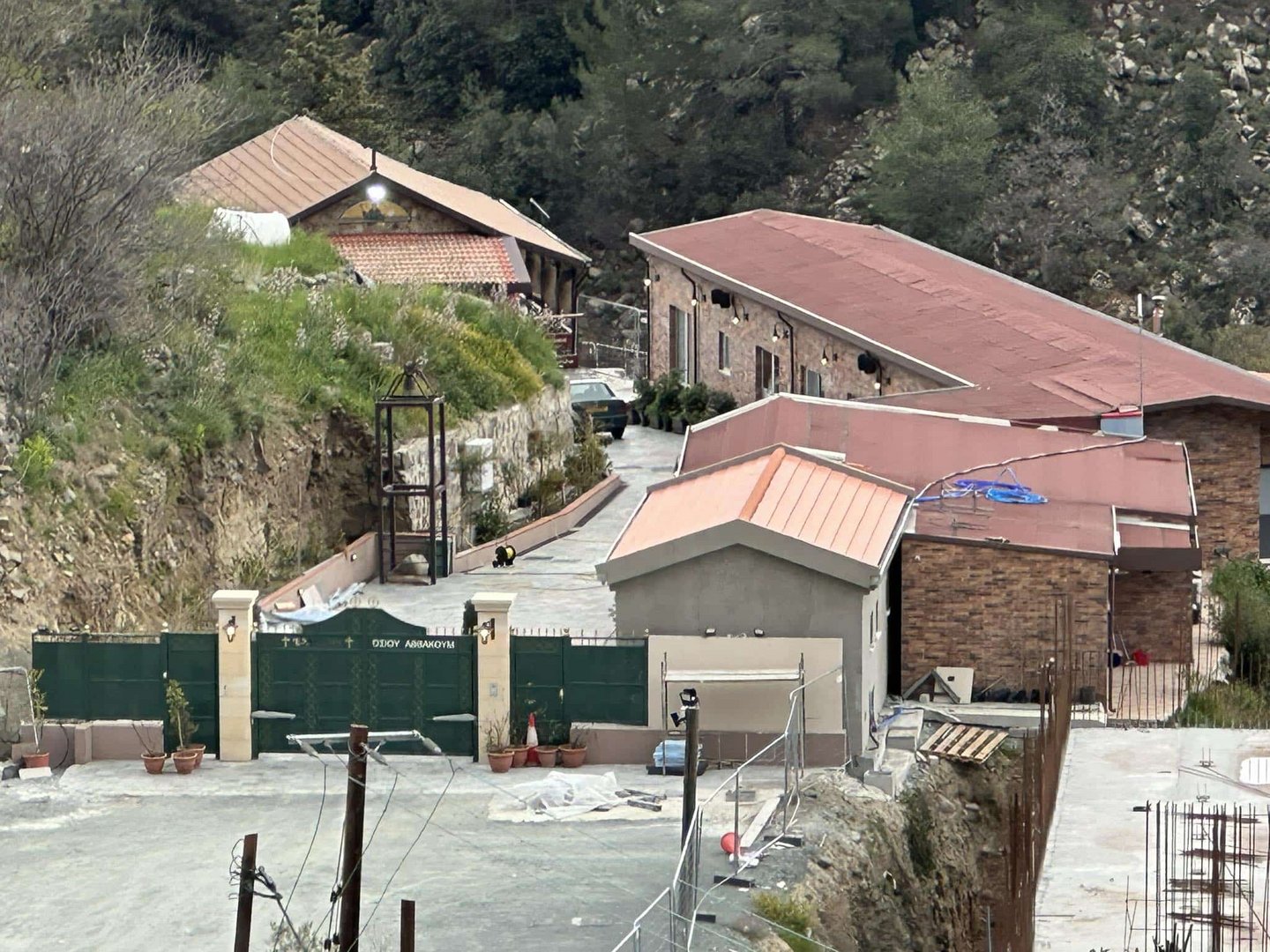
The Avakoum monastery made cash payments of over €100,000 for the purchase of cement, while a series of other transactions involving the cloister lacked any invoices, Nicosia criminal court heard on Monday.
On trial are monks Nektarios and Porfyrios. They face charges including conspiracy to defraud, forgery and the use of false documents, theft by proxy, handling stolen goods, money laundering, interfering with judicial proceedings and submitting fraudulent tax returns.
Monday’s proceedings centred on the testimony of business people who had financial dealings with the monastery.
The CEO of a cement-manufacturing company told of his dealings with the monastery dating back to June 2022.
The witness claimed that he was contacted by the person coordinating the works at Avakoum, who relayed to him a request by then-abbot Nektarios that invoices not be issued for future cement deliveries, in order to avoid paying VAT.
The witness said he agreed, citing his relationship with the church and his desire to “help out” the monastery.
According to the witness, his company made 12 cement deliveries in 2022, 18 deliveries in 2023, and two more in 2024.
For these deliveries – with the exception of the last – initially no invoices were issued. Payments were made in tranches, and always in cash, by the person coordinating the works at the monastery.
Subsequently, the company issued summary invoices for the years 2022 and 2023.
For the first summary invoice, the witness said, €101,000 in cash was received; and €9,000 for the second invoice.
During cross-examination, Costis Efstathiou – attorney for one of the defendants – challenged the witness’ narrative.
The lawyer put it to the witness that in fact he was the one who initiated the proposal to avoid paying VAT – and not his contact at the monastery.
Efstathiou pointed out the absence of evidence that would corroborate the deliveries of concrete. There were no waybills, he noted.
Taking the stand, a second witness – also a businessman with dealings with the monastery – claimed he found a receipt for a payment of €8,000 for the delivery of woodstoves.
In August 2021 he sold a woodstove worth €2,000 to the monastery – paid by cheque. Later in the same month, he sold another stove for €3,600. For the second sale, he was paid by Nektarios personally.
The witness said that previous to the trial, when making a statement to police in June 2024, he then went to his office and checked his files.
It was then that he discovered in a drawer a pad, which he had “forgotten” about.
Inside the pad was a receipt for a payment of €8,000 – concerning the sale of stone to the monastery.
A third witness then took the stand – a person who leases a mini market, owned by Nektarios.
The witness said the rent comes to €1,750 a month.
In recent months, said the witness, payments are in cash – after Nektarios’ bank account was seized due to the criminal investigation.
The court next heard from a woman who had donated €1,000 for a hagiography of Apostle Barnabas.
The woman said she paid €100 upfront, with the remaining €900 to be paid via wire transfer to the monastery’s account.
The monastery’s accountant – a woman known as Georgia – told her at the time that she did not have a pad to issue her a receipt.
The witness told the court she was displeased at the fact the painting of the apostle was never completed.
She told the court she wants her money back.
The trial continues on Wednesday.



Click here to change your cookie preferences