
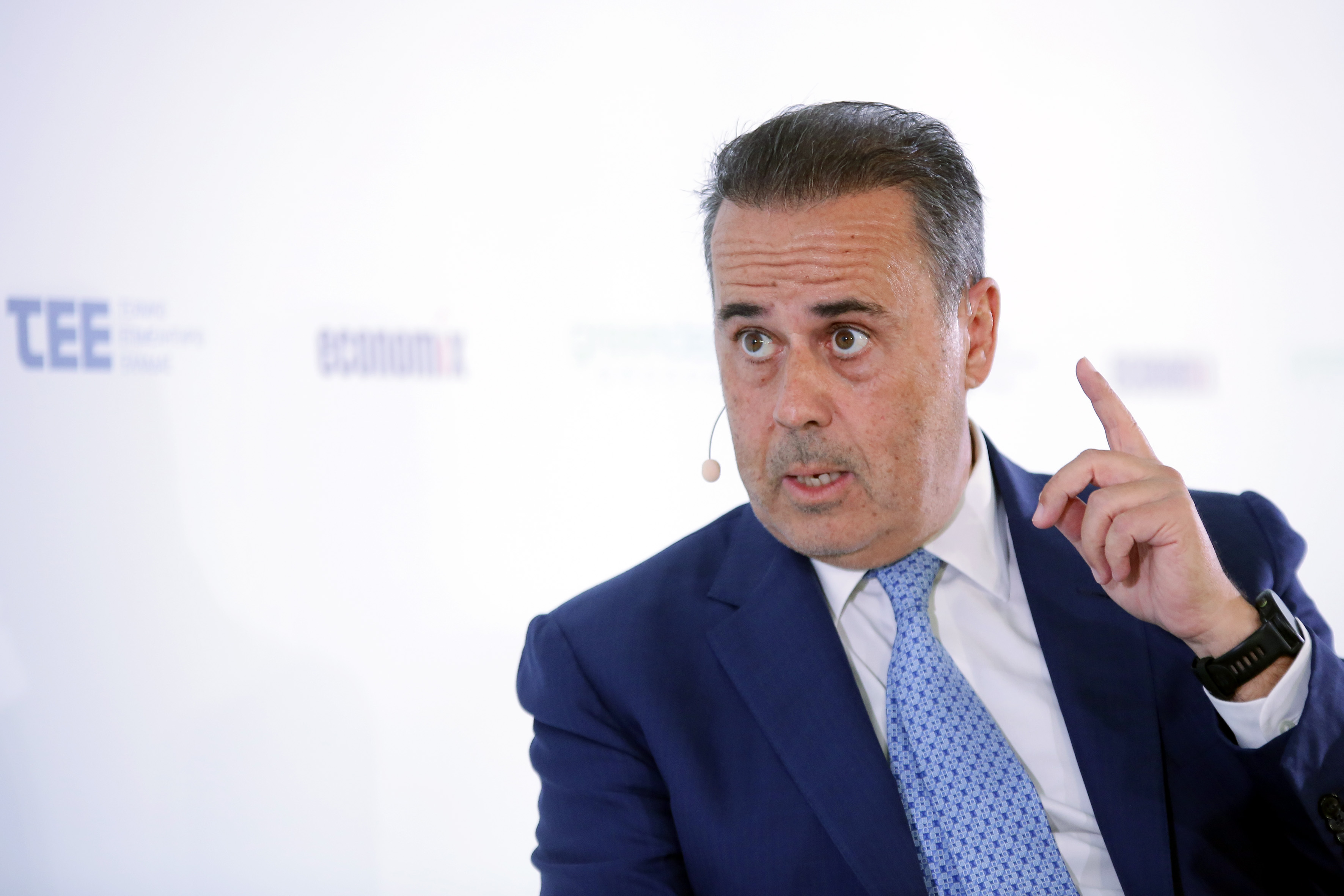
Greek Energy Minister Stavros Papastavrou on Monday denied that his country had asked Turkey’s permission to issue a navtex, a notice to sailors, regarding its plans to conduct seabed surveys in the seas between Crete and Cyprus for the construction of the Great Sea Interconnector.
“Turkey repeatedly requested permission to proceed with the project. This did not happen. The only country which gave permission for the issuing of the navtex is Greece. Any information provided [to Turkey] by France does not constitute, nor can it be considered, directly or indirectly, a request for permission,” he told radio station MegaNews.
This version of events was corroborated by Greek government spokesman Pavlos Marinakis, who said later on Monday that “the project is proceeding according to plan”, and “the process of giving permission proceeded according to plan, and permission was only sought from the Greek and Cypriot authorities”.
He confirmed that the French government had sent a diplomatic communication known as a “note verbale” to Ankara to inform it of the plans, as the research vessel which is set to conduct the surveys, the Abeille Marengo, sails under the French flag.
However, he stressed that the communication “does not constitute recognition” of Turkey’s claim to the seas in which the surveys are due to take place, and that the formal request for permission to conduct the surveys was only sent to the governments of Greece and Cyprus.
“That is the big difference,” he said.
Navtex issued last Friday, Turkey said it ‘cancelled’ it
The navtex was issued on Friday, prompting a swift response from Turkey’s foreign ministry, which declared that “a French-flagged vessel intends to conduct an unlawful marine scientific research activity in connection with unauthorised cable-laying on the Turkish continental shelf”.
“The unauthorised navigational warnings issued by Greece and the Greek Cypriot administration of southern Cyprus to this end have been cancelled by Turkey,” it said.
Previously, Turkish Foreign Minister Hakan Fidan had said that his country would not object to the undertaking of seabed surveys between Crete and Cyprus, provided that it is provided with a written notification of the plans in advance.
“We do not raise any objections. We discussed it with [Greek] Prime Minister Mitsotakis and [French] President Macron. My president raised the issue in New York during his meeting with Prime Minister Mitsotakis,” he said last month.
He added that during those discussions, Turkish President Recep Tayyip Erdogan had “described the project as remarkable” but had gone on to say that “I would prefer you to buy electricity from us rather than transporting it from a distance of 2,000 kilometres and spending over €2 billion of European funds”.
“I can provide from a distance of just 70 miles from mainland Turkey water, electricity, and natural gas, from which everyone, Greek Cypriots, Turkish Cypriots, and the entire population, can benefit,” he said.
Turkey, Greece disagree over whether islands generate full EEZ
The issue is sourced in the ongoing dispute between Greece and Turkey over who owns the seas between Cyprus and Crete, which itself is sourced in the question of whether islands are entitled to a full exclusive economic zone (EEZ).
Greece and Cyprus, citing the United Nations convention on the law of the sea (Unclos), stating that they do, while Turkey, which is not a signatory to Unclos, stating that they do not.
As such, according to Turkey’s position, beyond the 12 nautical miles of territorial waters to which Turkey believes both islands are entitled, the sea between Cyprus and Crete is Turkish.
By contrast, the position held by Greece and by the Republic of Cyprus is that, given that islands generate a full EEZ, the EEZs of Greece and Cyprus border one another south of Kastellorizo, Greece’s easternmost inhabited island.




Click here to change your cookie preferences