
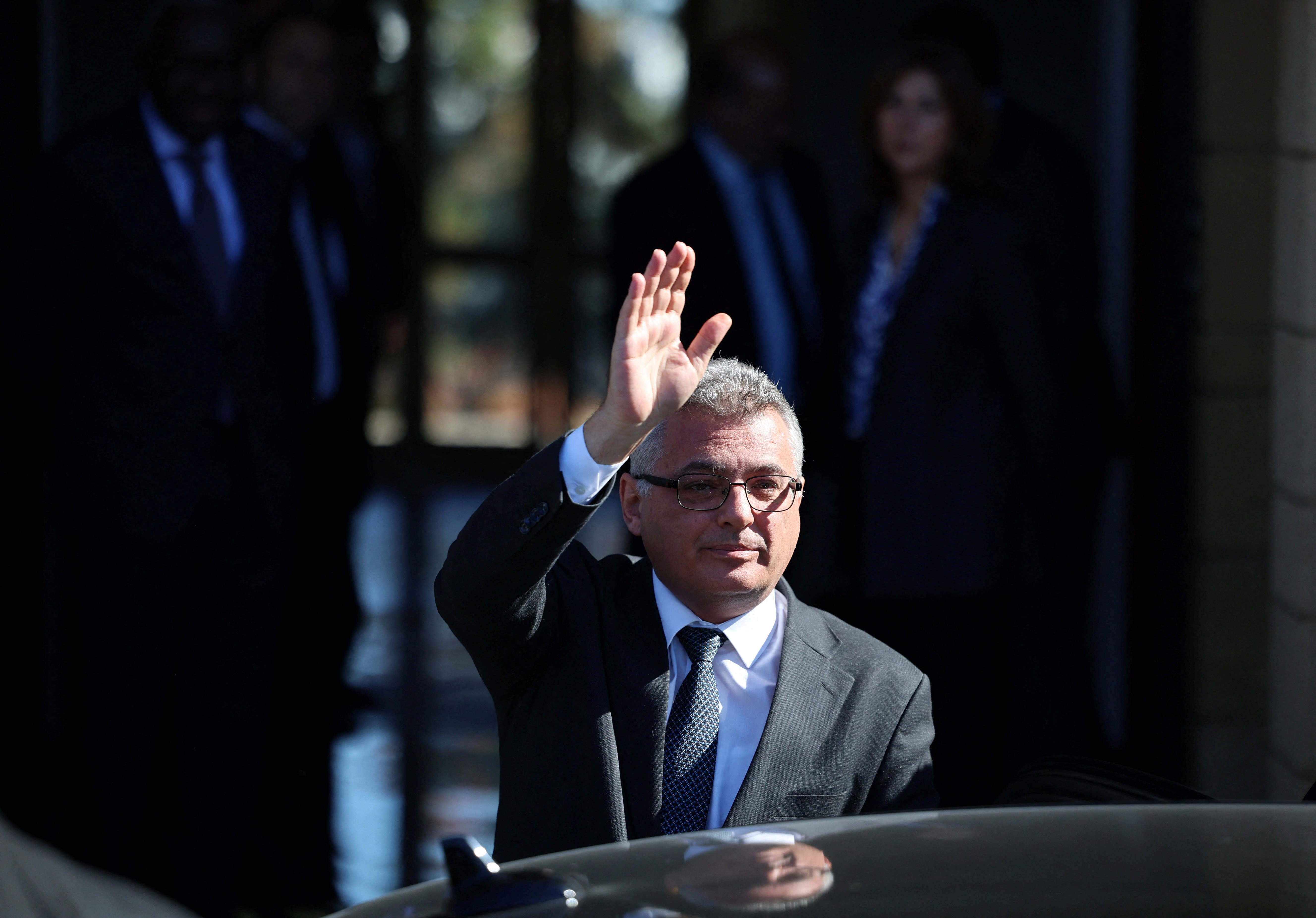
Turkish Cypriot leader Tufan Erhurman said that a proposal he submitted to President Nikos Christodoulides at Monday’s tripartite meeting with United Nations envoy Maria Angela Holguin, with the potential to be a “gamechanger”, remains on the table ahead of planned further meetings.
“This is a proposal which I consider very important, one which could be a gamechanger. I do not want it to be wasted like loose change. I do not want it to be evaluated based on initial reactions. If it is carefully considered, I think it will provide an opportunity to create a significant change in negotiations on the Cyprus problem,” he said.
He added that he had asked that Christodoulides evaluate the proposal before a planned tripartite meeting involving the two leaders and UN Secretary General Antonio Guterres, which will take place before the end of next month.
“This is an important and valuable proposal for me. Please allow me this opportunity just once. Until now, I have preferred to share everything I have said with the public. However, this time, I want to give diplomacy a chance,” he said, before adding that for this reason, he would not disclose the content of the proposal.
Regarding the content of the other proposals he had put forward to Christodoulides during the day’s meeting, he said that he had suggested the establishment of a mechanism for direct contact between the various military elements on the island’s two sides, but that Christodoulides rejected it.
Additionally, he said he had proposed that both sides accept the plans for education programmes which have been put forward by the bicommunal technical committee on education, and that Christodoulides asked for more time to consider them.
On the matter of the bicommunal Imagine education programme, he said that it will be relaunched under the supervision of the same technical committee, “with participation from both sides, regardless of the children’s citizenship status”.
Four proposals put on table before crossing point agreement
He then spoke about the agreement reached for the opening of two new crossing points, saying that the first proposal was for the road between Athienou and the Nicosia suburb of Aglandjia to be built entirely north of the Green Line and to be built by the Turkish Cypriot authorities.
The second proposal, he said, was for the road to be built north of the Green Line until it reached the Greek Cypriot village of Yeri, from whence it would be built with funding from the European Union.
He said a third proposal was to open that road, the Louroujina crossing point, a crossing point in the eastern Nicosia suburb of Mia Milia, and the Karavostasi crossing point at the same time, and added that initially, if opening all four crossing points was not possible, the backup plan was to open only the crossing points at Mia Milia and Karavostasi.
Then, he said, the fourth and final proposal was that Louroujina and Karavostasi be opened, and that this was accepted.
With that proposal accepted, he said that the possible Mia Milia crossing point and the road from Athienou to Aglandjia, as well as “the Pyla issue”, where the Turkish Cypriots wish to build a road from the bicommunal Larnaca district village to the nearby Turkish Cypriot village of Arsos, will be taken to the planned meeting with Guterres.
Rotating presidency a ‘concrete indicator’ of political equality
He then spoke on the matter of a rotating presidency in a post-solution Cyprus, saying that it is “one of the concrete indicators of political equality”.
“Our reason for wanting a rotating presidency is not because a rotating presidency is the most important issue for the Turkish Cypriot side. Just as Greek Cypriots see security as a vital issue for them, Turkish Cypriots also see security as the most important issue,” he said.
He added that “we are simply saying that the issue of political equality is one of the main reasons why a solution has not been reached to date”.
“We will know in principle that Turkish Cypriots could lead in any structure which may be established at some point down the line. This is a symbolic situation showing whether Greek Cypriots are truly ready to share power and wealth on the island with Turkish Cypriots,” he said.
He said that “it must be made clear before [any negotiating process] whether the Greek Cypriot side is ready to share power and wealth on the island with the Turkish Cypriots”.
“This approach is not a precondition, but a conclusion drawn from past experiences. Past experiences have shown us that the Greek Cypriot side is not ready for this. This time, if they are ready, it is worth trying. If they are not, it is not worth trying. For us, too, deadlock is not a solution, but this time must be different,” he said.
Asked about the impact of Turkish President Recep Tayyip Erdogan’s statements on proceedings, he drew attention to the fact that Erdogan had said that “we do not see the lack of a solution in Cyprus as a solution”, adding that “I share that same view”.


Click here to change your cookie preferences