
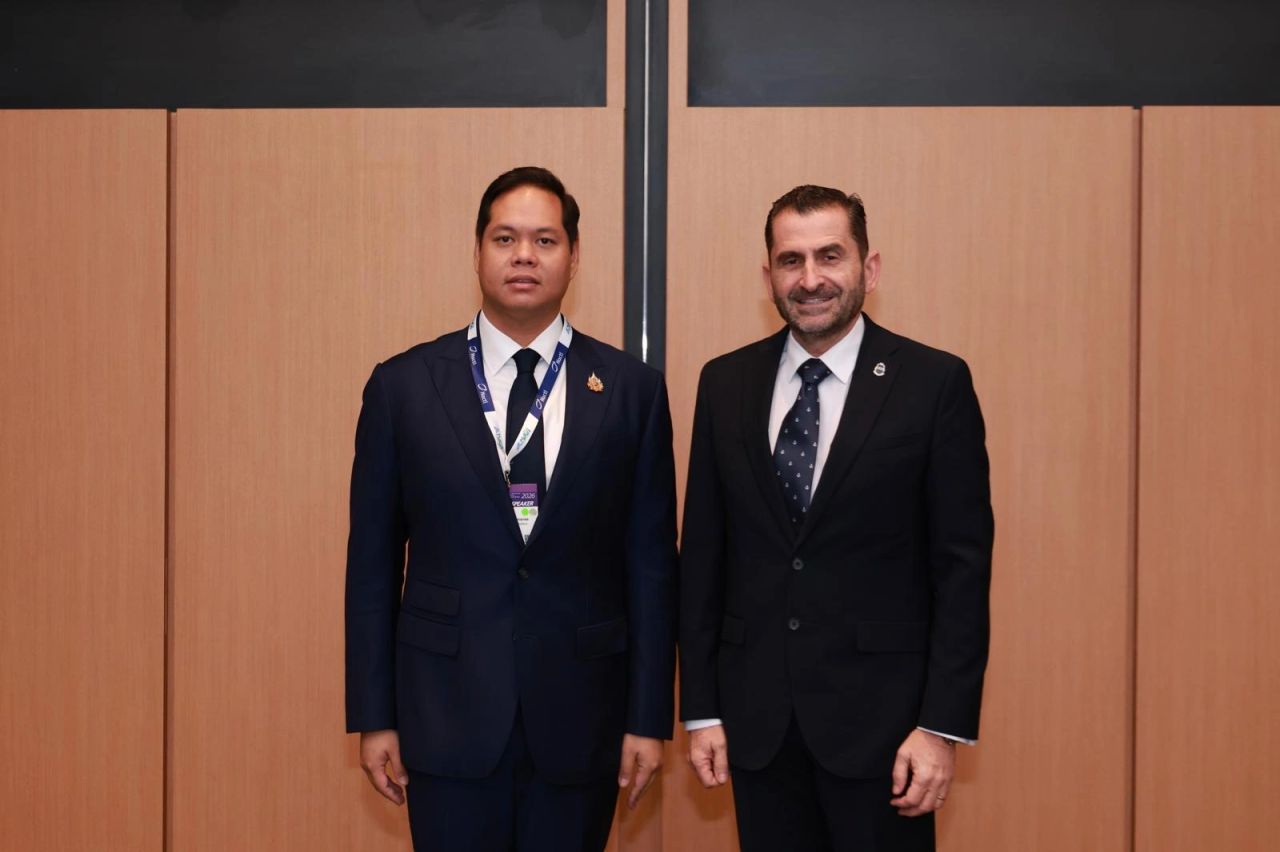
Thomas Kazakos, secretary-general of the International Chamber of Shipping (ICS), met Thailand’s deputy transport minister, Sanphet Bunyamanee, at Hong Kong Maritime Week as a series of tanker attacks slowed traffic through the Strait of Hormuz.
According to the ICS account of the meeting, Kazakos stressed that ships should be able to pass through the strait without tolls, charges or controls. He also urged governments to work through the International Maritime Organisation (IMO) to agree on global rules for cutting shipping emissions.
For Thailand, the danger at Hormuz is already familiar. Three Thai seafarers died after the Mayuree Naree was attacked in the strait in March. Their remains were returned to Thailand in July.
Thai state media reported that Bunyamanee discussed how Thailand could draw on the industry’s experience to make its maritime transport and logistics more efficient and sustainable.
In a separate address in Hong Kong, he set out plans to expand Laem Chabang, Thailand’s main container port, from 11 million to 18 million twenty-foot equivalent units a year.
Ship-tracking firm Kpler recorded five commodity vessels crossing the strait on Saturday and none on Sunday, down from 31 the previous weekend, Reuters reported.
On Tuesday, Oman evacuated 24 crew members from the gas tanker Tara Gas after it caught fire off the Omani coast. India’s foreign ministry said two were admitted to hospital in Khasab.
The IMO had logged 138 confirmed incidents in the Strait of Hormuz and the wider Middle East by November 17, with 25 seafarers killed.
Oman and Iran also discussed how to keep shipping lanes open on Tuesday, according to Oman’s foreign ministry. In July, Reuters reported that Muscat had proposed a jointly managed system with voluntary payments to fund services such as search and rescue. Tehran had sought to retain control of the waterway and charge ships for passage.
The attacks have also reached the Cypriot fleet. The Cyprus-flagged container ship GFS Galaxy was struck near its stern in July, damaging its engine room and leaving it unable to continue.
In August, the ICS and seven other maritime associations wrote to the heads of the United Nations and the IMO opposing compulsory fees at Hormuz. Kazakos, a former director-general of the Cyprus Shipping Chamber (CSC), took that argument to a UN Security Council briefing in September, saying that “Shipping must not be held to ransom”.
At Monday’s Hong Kong Global Maritime Trade Summit, ICS chairman John Denholm warned that threats to freedom of navigation and weakening respect for maritime law could undermine global trade. He told more than 250 delegates that conflicts were disrupting established routes, competition between major economies was intensifying and governments were turning increasingly to “unilateral measures and regional regulation”.
Denholm said about 90 per cent of world trade by volume moves by sea. That leaves households dependent on secure shipping routes for food, energy and other essentials.
At the same time, he said, the industry is being asked to switch to cleaner energy while keeping freight reliable and affordable. Route disruptions, conflict and protectionism can push up shipping costs and delay deliveries well beyond the region where they begin.
The ICS held the third edition of the summit with Hong Kong’s Transport and Logistics Bureau and the Hong Kong Shipowners Association under the theme Navigating Risk – Partnering for Resilience. Speakers also included Emma Roberts, BHP’s vice-president for maritime and supply chain excellence, and Nick Brown, chief executive of Lloyd’s Register.
Hong Kong’s financial secretary, Paul Chan Mo-po, said the year had shown “how much change trade can absorb”. He argued that the city’s maritime business depends on predictable rules, time saved and the services available to ships on each voyage.
Closing the summit, Hong Kong’s transport and logistics secretary Mable Chan said “no single jurisdiction or sector can build supply chain resilience alone”. She called for joint investment and cooperation as trade routes shift and the industry faces pressure to cut emissions.
The summit ended with a call for governments and the industry to work together to keep shipping routes open and protect seafarers.
The emissions talks resume in London next week, with governments still divided over how quickly ships can switch to cleaner fuels and who should pay for the change.
The draft IMO Net-Zero Framework would cover ocean-going ships above 5,000 gross tonnage, which account for more than 85 per cent of global shipping emissions, according to the IMO.
It would count greenhouse gases from fuel production through to use on board, charge ships that exceed emissions thresholds and reward those using zero- or near-zero-emission fuels. Governments approved the draft in April 2025 and deferred a decision on formal adoption that October.
Brazil and Japan have proposed easing the early fuel standards. Brazil’s proposal would start in 2029, a year later than the current draft, before requiring steeper cuts in later years.
China has proposed giving ships extra credit towards meeting the standards if they use zero- or near-zero-emission fuels. In Singapore in October, sustainable methanol cost $48.47 per gigajoule, more than twice the $22.78 for conventional marine fuel oil, according to S&P Global.
Ships calling at EU ports already face a fuel standard under FuelEU Maritime, which tightens from a 2 per cent cut in greenhouse gas intensity in 2025 to 6 per cent in 2030.
Britain opened a consultation on its own maritime fuel standard on Monday, with rules expected from 2030. At the IMO, technical talks run from November 23 to 27, followed by the Marine Environment Protection Committee meeting from November 30 to December 3. A further session on December 4 remains provisional.



Click here to change your cookie preferences