
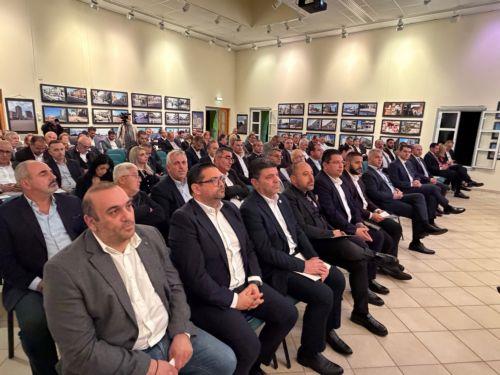
The Famagusta Chamber of Commerce and Industry urged the government this week to bring down electricity costs, speed up public works and provide financial support to people displaced in 1974 who still cannot use their properties.
Speaking at the chamber’s annual general meeting in Deryneia, president Charalambos Manoli said “the Cypriot economy grew 3.3 per cent year-on-year in the second quarter, but businesses were still dealing with high energy and borrowing costs, red tape and difficulty finding staff.”
Cyprus and Italy had the EU’s joint second-highest electricity price after Ireland in the first half of 2026 for non-household users consuming between 500 and 2,000 megawatt-hours a year. They paid an average of 23 cents per kilowatt-hour, about 28 per cent above the EU average of 18 cents.
Manoli called for faster progress on bringing natural gas into use, more energy storage, stronger support for solar panels and greater competition in the electricity market.
He also made the case for more public investment in the government-controlled part of Famagusta district, which recorded about 8.49 million overnight stays in tourist accommodation in 2025. That accounted for 44.5 per cent of all such stays in the areas controlled by the Republic.
The chamber wants the government to set dates and secure funding for infrastructure projects, resolve outstanding issues with the Paralimni – Ayia Napa – Deryneia local plan and clear delays in permitting complex developments. It also called for better public transport, more support for Famagusta General Hospital, a university presence in the district and a longer tourism season.
On property, Manoli said “displaced owners had gone more than half a century without being able to use their land or earn income from it.” The chamber has proposed allowing owners to sell development rights, granting them tax relief and helping them buy homes. He urged the government to assess and implement the proposals.
Manoli also renewed the chamber’s call for the fenced-off area of Famagusta to be returned to its lawful residents and for the city’s port to operate under European Commission supervision as a confidence-building measure. The chamber also wants to reopen its office in the occupied city under UN administration.
The meeting followed an agreement to bring Famagusta’s business community back together under one chamber after years of differences.
Manoli said a united chamber could make a stronger case for the district.
Yiannis Karousos, who heads the Famagusta district local government organisation, said “the chamber was already coordinating efforts to improve licensing and address problems facing entertainment venues.”
Karousos pointed to the lack of a university and the district’s failure to secure funding for smart water metres. He welcomed €500,000 in approved funding for a solar park in the area formerly served by the Kokkinochoria sewerage board. He expects the park to save the organisation €33,000 a month.
In remarks read by deputy mayor Chrysanthos Zannettou, Famagusta mayor Simos Ioannou recalled how people displaced from the city had helped build businesses elsewhere in Cyprus after 1974. He said “their experience would also be needed to rebuild Famagusta and reaffirmed the municipality’s support for resuming talks on the basis of UN resolutions.”
Cyprus Chamber of Commerce and Industry (Keve) president Stavros Stavrou, in remarks read by vice-president Augustinos Papathomas, called for simpler licensing and more digital public services. He backed efforts to extend the tourism season by giving visitors more reasons to come outside summer.
Paralimni – Deryneia mayor Giorgos Nikolettos pointed to local food, farming, sport, culture and outdoor activities as ways to bring in visitors year-round and create more opportunities for young people.
Finally, Ayia Napa mayor Christos Zannettou outlined the municipality’s own year-round tourism plans and called for investment across all five of its districts, from Ayia Napa and Sotira to Liopetri, Avgorou and Achna.


Click here to change your cookie preferences