
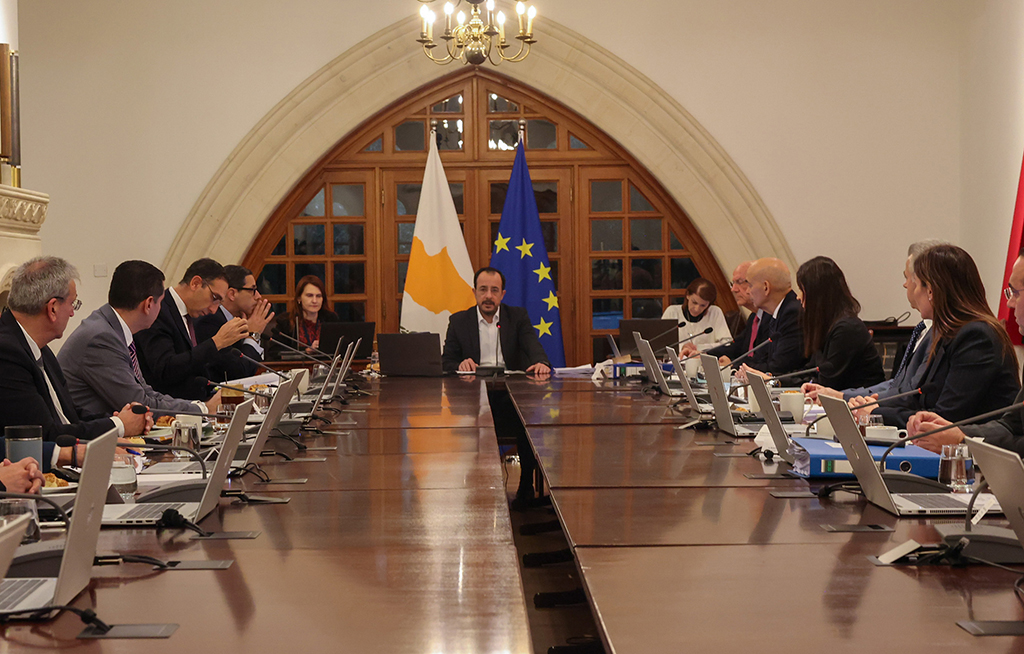
President Nikos Christodoulides outlined “five key priorities” he has set for his government on Wednesday, ahead of the first cabinet meeting to be held following Friday evening’s reshuffle.
He said that every decision the government takes “intersects horizontally with these five key priorities”, before explaining the priorities.
The first, he said, is “defence, security, and foreign policy”, while the second is “a strong and resilient economy” and the third is “reforms and the modernisation of the state”.
Fourth on the list is “transparency and accountability”, and the fifth is “the prosperity of the country and, of course, its people”.
“All the decisions we make in cabinet fall into these five categories,” he said.
Addressing the issue of the reshuffle, he said that his government, since he was elected in 2023, has had “a clear ideological framework in which we operate”, and that that framework constitutes “social liberalism”.
“All our decisions, initiatives, actions, fall precisely within the ideological and political framework of social liberalism and we will continue within this framework,” he said.
That reshuffle has seen four new names appointed to cabinet – Labour Minister Marinos Mousiottas, Justice Minister Costas Fitiris, Health Minister Neophytos Charalambides, and Social Welfare Deputy Minister Clea Hadjistefanou-Papaellina – while Michael Damianos has been moved from the health ministry to the energy ministry.
Christodoulides then spoke briefly about the Cyprus problem, with a meeting involving him, Turkish Cypriot leader Tufan Erhurman, and United Nations envoy Maria Angela Holguin scheduled for Thursday.
“The resolution of the Cyprus problem and the liberation of our country is our highest priority. I want to mention this, because in general, there is a direct connection between foreign policy and domestic policy,” he said.
“This strengthening of all the factors of power of our country, domestic and external, which fall under the five priorities I mentioned earlier, further strengthens our negotiating capacity at the negotiating table to liberate our homeland and reunite our land.”
He also made reference to the fact that Cyprus will undertake the Council of the European Union’s rotating presidency for half a year from the start of next month, and described the forthcoming six-month term as a “national mission”.
“This is not only to push the European Union’s agenda even further, but to highlight, as we have been doing in recent years, that the Republic of Cyprus has a say and a role in developments both in the European Union and in the region.”

Click here to change your cookie preferences