
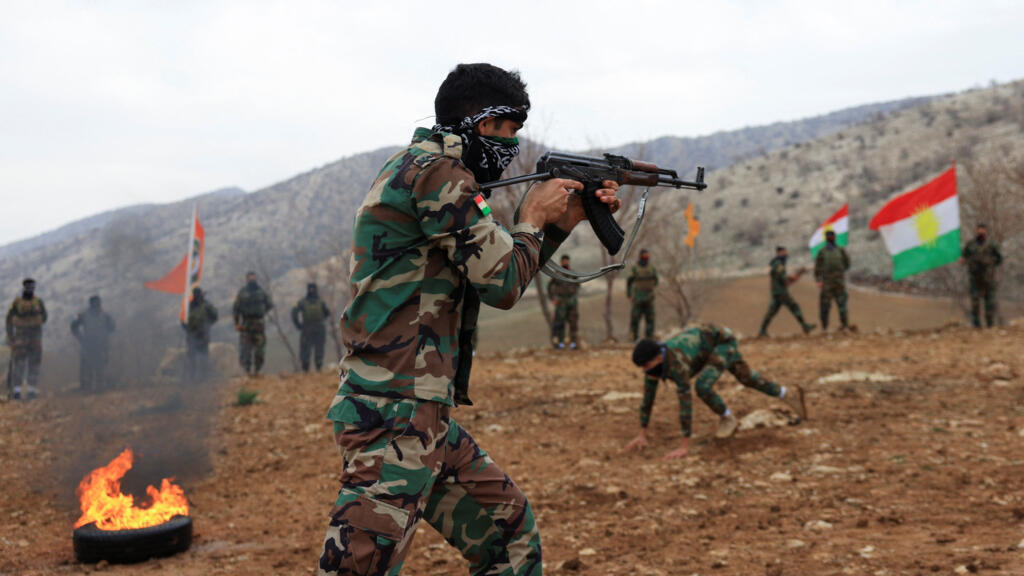
Israeli forces have carried out strikes in western Iran in support of Iranian Kurdish militias preparing potential operations near the border, according to sources cited on Friday, as regional tensions continue to widen.
Three sources familiar with the situation told Reuters that Israeli bombing has targeted areas close to the Iraqi frontier, where Kurdish armed groups hope to exploit the conflict between Iran, Israel and the United States to seize territory. The groups are believed to be considering moves against Iranian security forces in towns near the border.
The prospect of a Kurdish incursion gained attention after US President Donald Trump said it would be “great” if Kurdish fighters crossed into Iran. Kurdish militias based in Iraq have held discussions with the United States over possible action, the sources said.
Two Kurdish sources and one Israeli source said contacts between Israel and Iranian Kurdish groups have been ongoing for about a year. Their immediate objective, according to the same sources, would be to take control of areas along the border, including the towns of Osnaviyeh and Piranshahr.
Thousands of fighters are believed to be gathering on the Iraqi side of the frontier, though Reuters said it could not independently verify those claims. Estimates place the total strength of the Kurdish militias at between 5,000 and 8,000 fighters, largely equipped with light weapons.
An Israeli source said the groups are not expected to overthrow the Iranian government but could stretch the resources of Iran’s Islamic Revolutionary Guard Corps by forcing it to defend additional fronts. Kurdish sources also said fighters inside Iran have been supplying intelligence on potential targets to the United States and Israel.
Five Iranian opposition organisations recently announced a new alliance. Among them are the Kurdistan Free Life Party (PJAK), the Democratic Party of Iranian Kurdistan (PDKI) and the Kurdistan Freedom Party (PAK), groups that maintain fighters in Iraq and have previously conducted guerrilla operations.
Despite the reports, Kurdish officials have publicly denied plans for an imminent attack. Khalil Nadiri, a senior official with PAK, said the group would “join coalition forces” only if a US-led ground invasion of Iran took place, stressing that Kurdish fighters should not “be put on the front lines of the attack”.
The Kurdistan Regional Government in Iraq has also rejected claims that its territory would be used to launch cross-border operations. Government spokesperson Peshawa Hawramani said allegations that Kurdish authorities were preparing to arm and send fighters into Iran were “completely unfounded”.
Iran has warned it will retaliate if hostile forces deploy along its border and has already launched missile and drone strikes against Kurdish armed groups and US facilities in northern Iraq.
Analysts warn that backing Kurdish militias could complicate the conflict further. Former Israeli intelligence officer Dani Sitrinovic said an uprising in Iran may lack broad support. “I think everyone is waiting to see whether the regime will hold out or not,” he said.
Kurdish leaders, meanwhile, remain wary of foreign support. One source involved in the discussions said they fear being “betrayed” again, recalling previous conflicts where Kurdish forces fought alongside Western allies but later lost political backing.



Click here to change your cookie preferences