
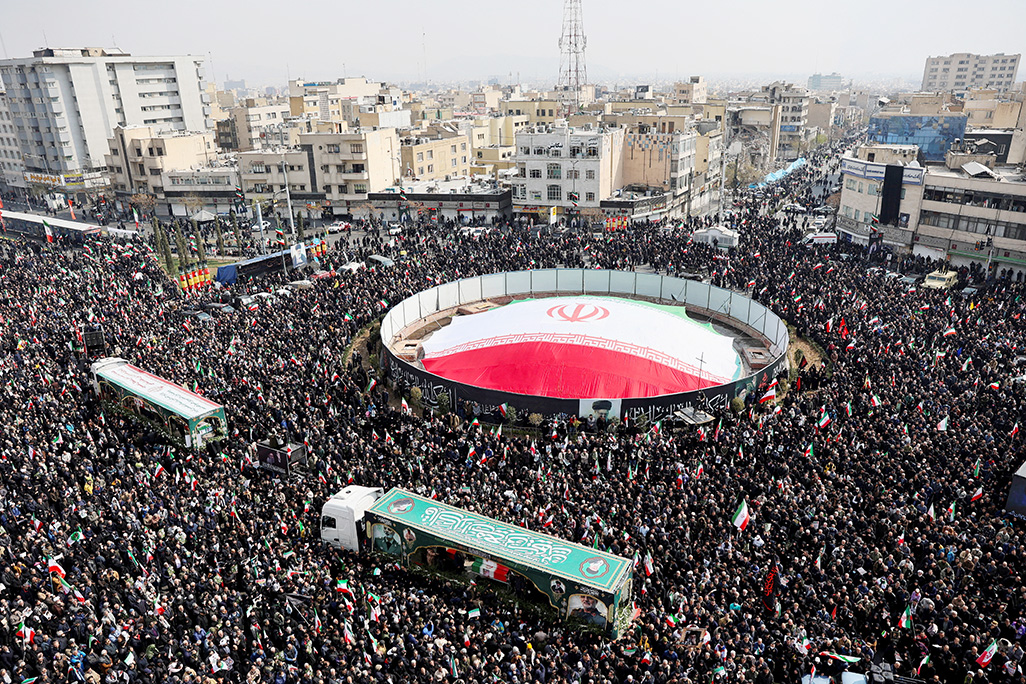
Israeli officials in closed discussions have acknowledged there is no certainty the war against Iran will lead to a collapse of its clerical government, a senior Israeli official told Reuters, with no sign of an Iranian uprising amid the bombardment.
However, despite commentary by U.S. President Donald Trump that the war may finish soon, Israel’s assessment is that Washington is not close to instructing an end to the conflict, two Israeli officials said.
The intense U.S. and Israeli bombing campaign killed the supreme leader, Ayatollah Ali Khamenei, as well as a host of senior military commanders, but it has also killed civilians and smashed homes and public buildings, angering many Iranians.
With missiles striking across Tehran and other cities, and with the Iranian authorities threatening deadly force against any who dares protest, Iranians who might otherwise come to the streets may also fear to do so until the war ends.
Still, Iran’s long-term challenges look worse than ever, with ever harsher sanctions strangling the economy and little prospect of better times ahead for a population whose protests in January were crushed with thousands dead.
ISRAEL DOES NOT ASSESS U.S. CLOSE TO ENDING WAR
The senior Israeli official did not say what had led the country to assess that a collapse of Iran’s ruling system was not a certainty.
On the day Israel launched its joint air war with the U.S., its Prime Minister Benjamin Netanyahu said: “Our joint action will create the conditions for the brave Iranian people to take their destiny into their own hands.”
He particularly spoke of Iran’s main ethnic and linguistic minorities, the Kurds, Baluchis and Arabs, adding to reports that the U.S. or Israel may back uprisings by those groups.
However, in a statement on Tuesday, Netanyahu repeated that though Israel’s aspiration was to help Iranians “cast off the yoke of tyranny,” that ultimately “it is up to them” – an apparent acknowledgement that a rising does not look imminent.
Israel and the U.S. have not issued a joint public statement setting out clear unified war aims, or articulating the conditions under which they might decide to end the campaign.
On Monday, Trump described the war as “very complete, pretty much”, but on Tuesday the White House said it would only end when Trump determined its objectives were met and that Iran was in a state of unconditional surrender.
In a closed‑door briefing with foreign diplomats on Tuesday, Israeli Foreign Minister Gideon Saar declined to set a timeframe for the military campaign – chiming with the government’s assessment that Trump was not close to ending it.
Saar acknowledged in the briefing that Iran’s government could survive the war but expressed confidence it would collapse later, sources said.
Speaking to reporters on Tuesday, Saar said the war would proceed until Israel and the U.S. determined the time had come to end hostilities, but that Israel did not seek “endless war”.
Assaf Orion, a former head of strategy with the Israeli military and a fellow at the Washington Institute for Near East Policy, said weakening Iranian military capabilities appeared a more direct, tangible and measurable war aim.
“Creating conditions for regime change is indirect and hence more difficult to fathom,” he said, adding that while the military campaign appeared to be planned for weeks, any uprising against Iran’s ruling system might take months or years.
IN WAR, NO STREETS LEFT TO PROTEST IN – TEHRAN RESIDENT
On Wednesday Iran’s police chief Ahmadreza Radan warned that “anyone taking to the streets at the enemy’s request will be confronted as an enemy, not a protester. All our security forces have their fingers on the trigger”.
While many Iranians want change and some openly celebrated the death of Khamenei, whose security forces killed thousands of anti-government protesters just weeks ago, there has been no sign of protest since the war began.
“I hate this regime. I want it to go, but under bombardment there are no streets left to protest in,” said Ali, 26, from Tehran.
Although Tehran’s streets are far quieter than usual, banks, petrol stations and shops are all operating as usual, though with reduced hours and tighter rationing of fuel. All government offices are open.
“Every day and every night there is bombing. My apartment building and its windows shake,” said a Tehran resident who asked to retain anonymity for fear of reprisals.
“Despite discontent with the regime, the sense of Iranian pride and patriotism is growing and people are expressing hatred for Reza Pahlavi, Trump and Netanyahu,” the resident added, naming the son of Iran’s former shah, who had urged military intervention.
However, the bombing has destroyed airports and ports as well as other civilian infrastructure, adding to the problems Iran’s government may face in reviving a stagnant economy that has angered much of the population.
“Iran prefers the war to continue because if it ends, protests will start due to economic problems and shortcomings that the war has also worsened,” said a university teacher in Tehran who also requested anonymity.



Click here to change your cookie preferences