
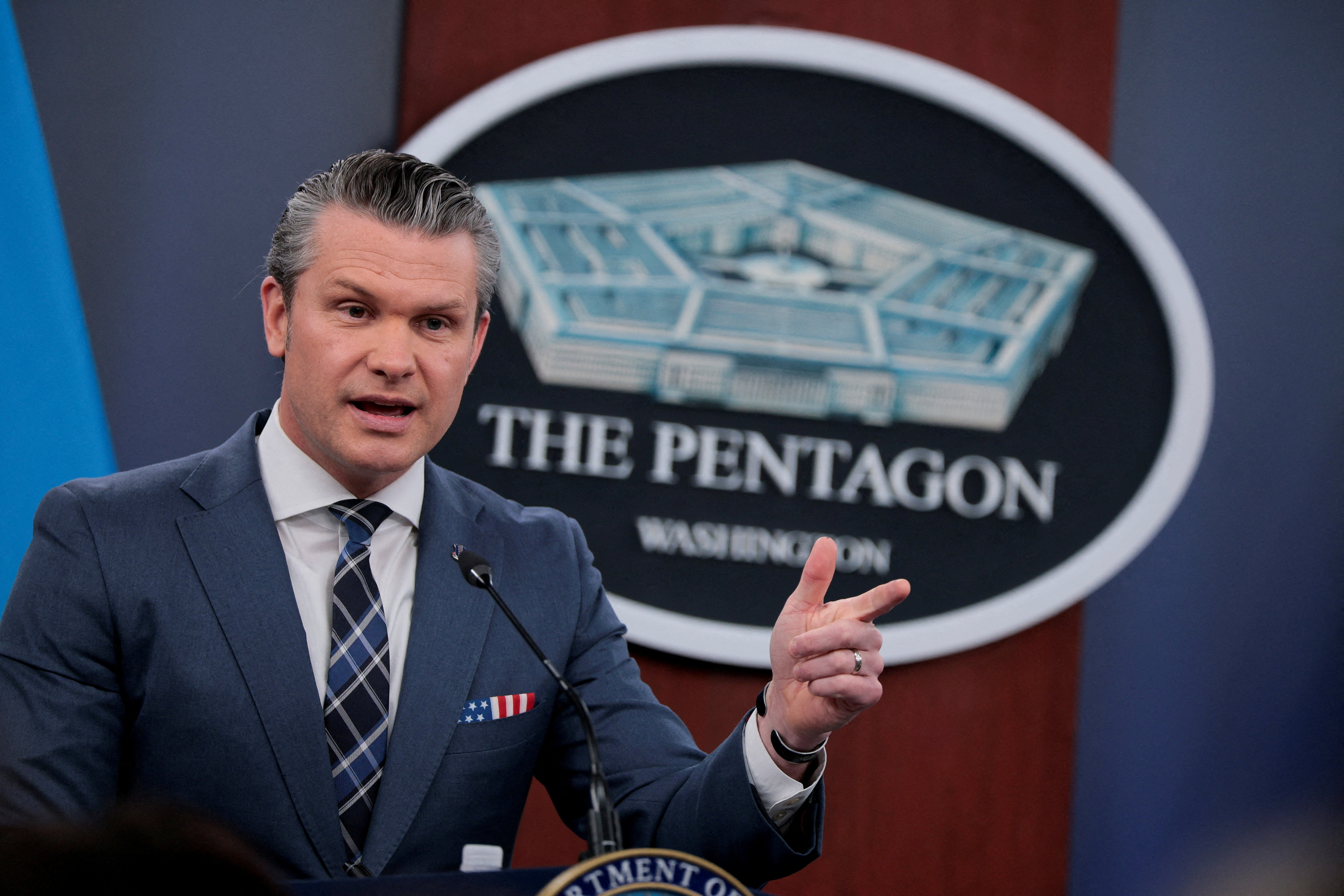
U.S. Defense Secretary Pete Hegseth said on Thursday that the United States’ objectives in the war against Iran have not changed since strikes started on February 28.
The United States has carried out strikes against 7,000 targets inside Iran so far, and hit more than 40 Iranian mine-laying vessels and 11 submarines.
“Our objectives, given directly from our America-first president, remain exactly what they were on day one,” Hegseth told reporters.
“These are not the media’s objectives, not Iran’s objectives, not new objectives. Our objectives – unchanged, on target and on plan,” Hegseth added. He spent several minutes in his opening statement criticizing the press.
Hegseth told reporters that the objectives remained to destroy Iran’s missile launchers, as well as its defense industrial base and navy and to never allow Iran to get a nuclear weapon.
Reuters reported on Wednesday that President Donald Trump’s administration is considering deploying thousands of U.S. troops to reinforce its operation in the Middle East, as the U.S. military prepares for possible next steps in its campaign against Iran.
Those options include securing safe passage for oil tankers through the Strait of Hormuz, a mission that would be accomplished primarily through air and naval forces, the sources said. But securing the Strait could also mean deploying U.S. troops to Iran’s shoreline, sources told Reuters.
In the same briefing, General Dan Caine, the chairman of the Joint Chiefs of Staff, said the U.S. military remained on track to achieve its objectives and that the United States was striking deeper into Iranian territory every day.
But Caine acknowledged that Iran still retained some missile capabilities.
“They came into this fight with a lot of weapons,” Caine said.
HEGSETH SAYS U.S. CONTROLS IRAN’S FATE
Iran’s attacks on energy infrastructure in response to Israeli attacks on its gas facilities marked the biggest escalation of the nearly three-week war, causing gas prices to surge and oil prices to rise further on Thursday.
Reuters has reported that one of the locations where the Trump administration discussed sending ground forces was Kharg Island, the hub for 90% of Iran’s oil exports where the U.S. carried out strikes on Friday, saying it had only hit military targets.
Hegseth, in the press conference, cited the strikes against Kharg Island as an example of how the United States could control Iran’s fate, warning Iran against targeting Arab countries.
“The United States military controls the fate of that country,” he said.
Kharg sits 16 miles (26 km) from Iran’s coast, about 300 miles (483 km) northwest of the Strait of Hormuz, in waters deep enough to enable the docking of tankers that are too large to approach the mainland’s shallow coastal waters.



Click here to change your cookie preferences