
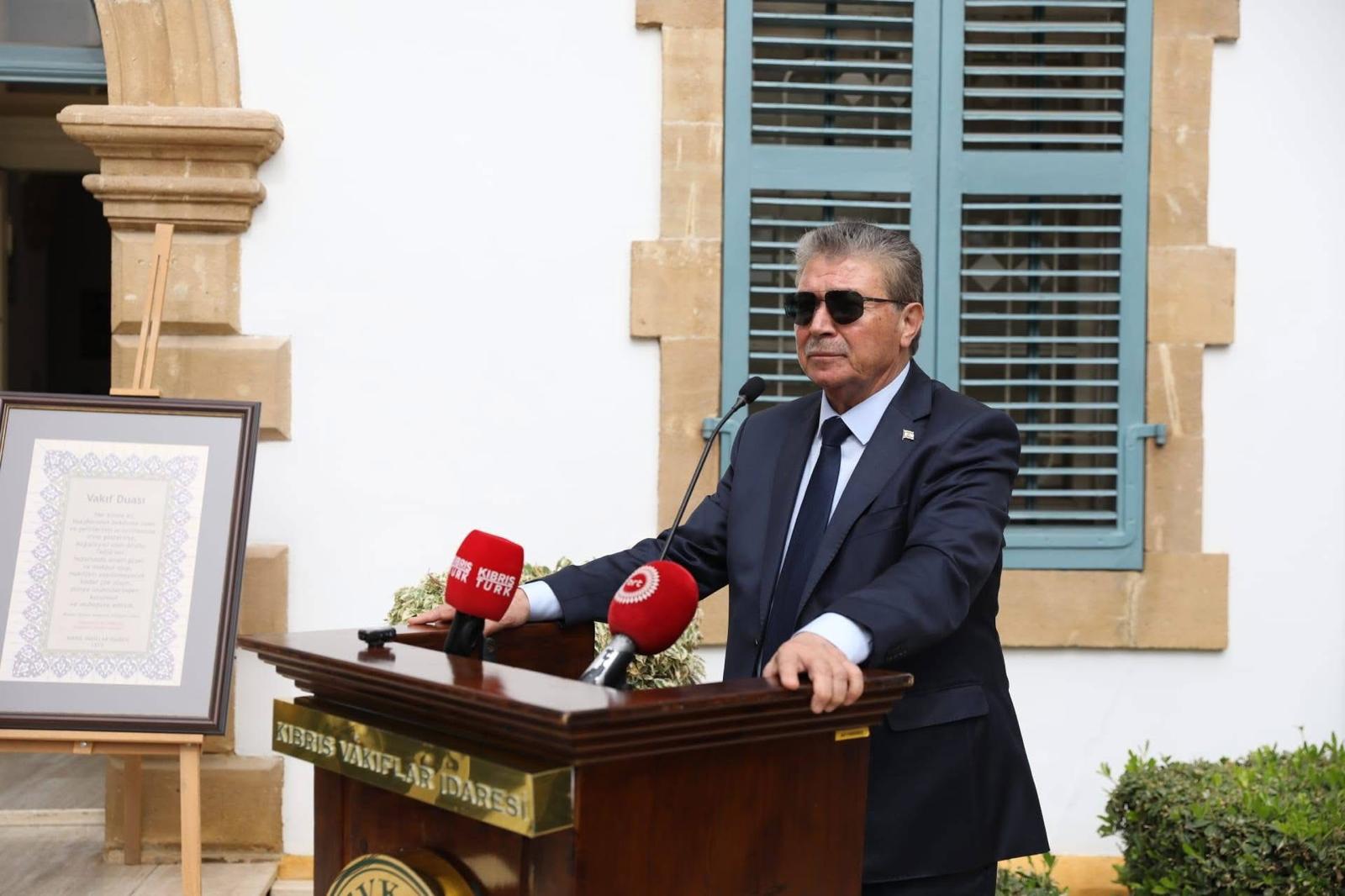
Turkish Cypriot ‘prime minister’ Unal Ustel on Thursday expressed “surprise and regret” at references to Cyprus in the European Parliament’s latest annual report on Turkey, which had called on the country to give the Turkish Cypriot community the necessary space” to chart its own political course.
“This statement contains a clear implication that Turkey is interfering with the will of the Turkish Cypriot people. This approach neither aligns with historical facts, nor is it acceptable,” he said.
He added that “the Turkish Cypriot people are a people with their own state, democratic institutions, and free will”.
“Our people freely make their choices and exercise their democratic rights without any pressure. The support of the Republic of Turkey is not an intervention, but a natural consequence of historical and cultural ties, as well as its responsibilities as a guarantor power,” he said.
He then added that the report’s references to efforts towards resolving the Cyprus problem were written “while ignoring the legitimate position of the Turkish Cypriot side based on sovereign equality and equal international status”.
However, Ustel’s position on the Cyprus problem does not correlate with the official position of the Turkish Cypriot community, whose elected leader Tufan Erhurman favours a federal solution to the Cyprus problem.
Despite this, Ustel said that the report’s positive references to Erhurman’s election “demonstrate an approach far removed from the principle of respect for the will of the people”.
He then added that the report’s mentions of violations of the buffer zone, which refer only to those committed by Turkey, are “one-sided” and “far from reality”.
“This portrayal of alleged events in the buffer zone through a one-sided narrative casts a shadow on the principle of reality,” he said, before saying of the impasse over the mutual understanding regarding planned bicommunal construction projects in the buffer zone village of Pyla that “the responsibility for implementing the agreement … is not unilateral”.
Of the report’s call for Turkey to withdraw its troops from the island, he said the “assessment of the current realities on the island through the lens of ‘occupation’ completely ignores the attacks and security needs of the Turkish Cypriot people”.
This, he said, has been the case since intercommunal conflict broke out on the island in 1963.
“The security of the Turkish Cypriot people is not a matter of debate for us,” he said, before highlighting past instances in which the European Union, in his view, failed to act with impartiality regarding Cyprus.
“While the Turkish Cypriot people strongly demonstrated their will for a solution during the Annan plan process, the Greek Cypriot side’s ‘no’ vote, which eliminated hopes for a solution, coupled with the EU’s acceptance of the Greek Cypriot administration as the sole and legitimate government of the island and its inclusion in the union, fundamentally disrupted the balance of a solution,” he said.
He added that allowing the Greek Cypriot-led Republic of Cyprus to join the EU without the Turkish Cypriots in 2004 “eliminated the need for a solution which the Greek Cypriot side may have otherwise felt”.
Additionally, he said, it “paved the way for Greek Cyprito administrations to act with a maximalist approach at the negotiating table and seriously weakened hopes for a comprehensive solution in Cyprus”.




Click here to change your cookie preferences