
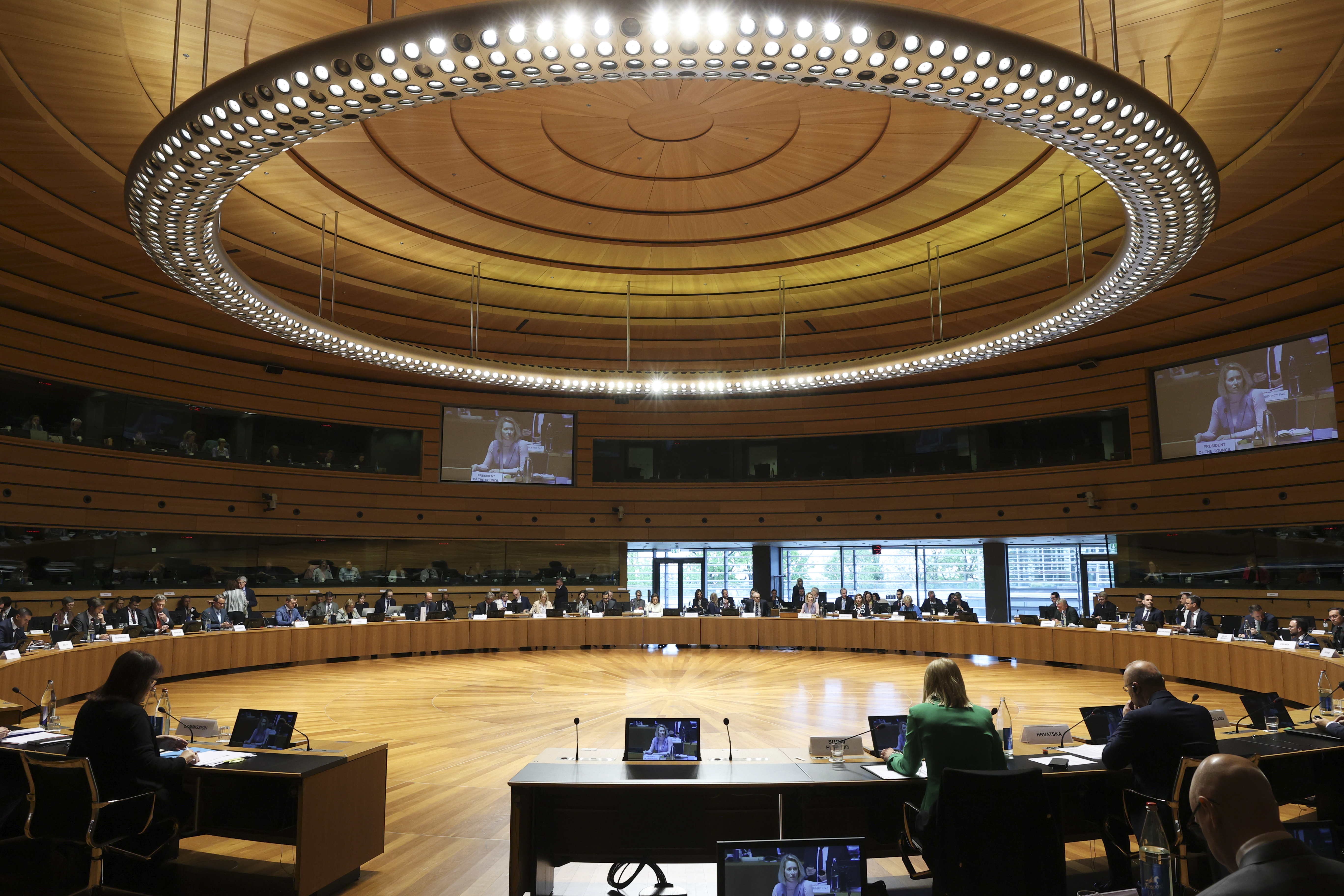
Cyprus is yet to publicly take a side in the debate over whether the European Union should suspend its association agreement with Israel in light of the latest developments in the region, with the bloc’s 27 foreign ministers debating the matter during a foreign affairs council (Fac) summit in Luxembourg on Tuesday.
Cypriot Foreign Minister Constantinos Kombos made no direct reference to Israel during his statements on the sidelines of the summit, saying only that “we will be discussing today the situation in the wider Middle East”, and that “there are so many questions and so few answers”.
Demands for the association agreement to be terminated had been issued to the EU’s foreign affairs chief Kaja Kallas at the weekend by three foreign ministers: Spain’s Jose Manuel Albares, Slovenia’s Tanja Fajon, and Ireland’s Helen McEntee.
They had written a joint letter expressing their “deepest concern regarding several measures by the Israeli government, including executive decisions, military decisions and laws adopted by the Knesset, that contravene human rights and violate international law and international humanitarian law”.
“Our many statements in this regard, and direct calls for the government of Israel to fully comply with its international and moral obligations, and to revert those measures, have been ignored,” they said.
They highlighted the Knesset’s approval of a law last month which legalised the death penalty for Palestinians, saying describing it as a “grave violation of fundamental human rights” and a “step backwards in Israel’s commitment to democratic principles”.
Additionally, they pointed out that Kallas herself had said the law constituted a violation of the association agreement, before saying that it “constitutes an additional step in the systematic persecution, oppression, violence and discrimination exerted against the Palestinian population”.
Away from the matter of the death penalty bill, they said described conditions for the civilian population of Gaza as “unbearable”, and that they are “marked by continuous violations of the ceasefire agreement and the clearly insufficient entry of humanitarian aid into the strip”.
They added that the situation in the West Bank is “rapidly deteriorating”, describing “escalating violence against Palestinians” in which “radical settlers are acting with absolute impunity”, with this, in addition to military operations carried out by the Israel Defence Forces, bringing about “intolerable deaths of innocent civilians”.
“Bold and immediate action is required, and all actions must remain on the table. The European Union can no longer remain on the sidelines,” they said.
Upon his arrival at Tuesday’s summit, Albares said that “I expect every European country to uphold what the international court of justice and the United Nations say on human rights and the defence of international law”.
“Anything different would be a defeat for the European Union,” he warned.
However, others remain less than convinced, with Danish Foreign Minister Lars Lokke Rasmussen saying that “there is no sign of any majority in favour of doing anything with the association agreement”.
Like Kombos, Germany’s Johann Wadephul did not take an absolute position, saying that “we have expressed our criticism regarding the introduction of the death penalty” and that “we also have a very clear position on settler violence”.
Belgium’s Maxime Prevot, meanwhile, said that his country is calling for a partial suspension of the association agreement, but lamented that “a full suspension is probably out of reach given the positions of the various European countries”.




Click here to change your cookie preferences