
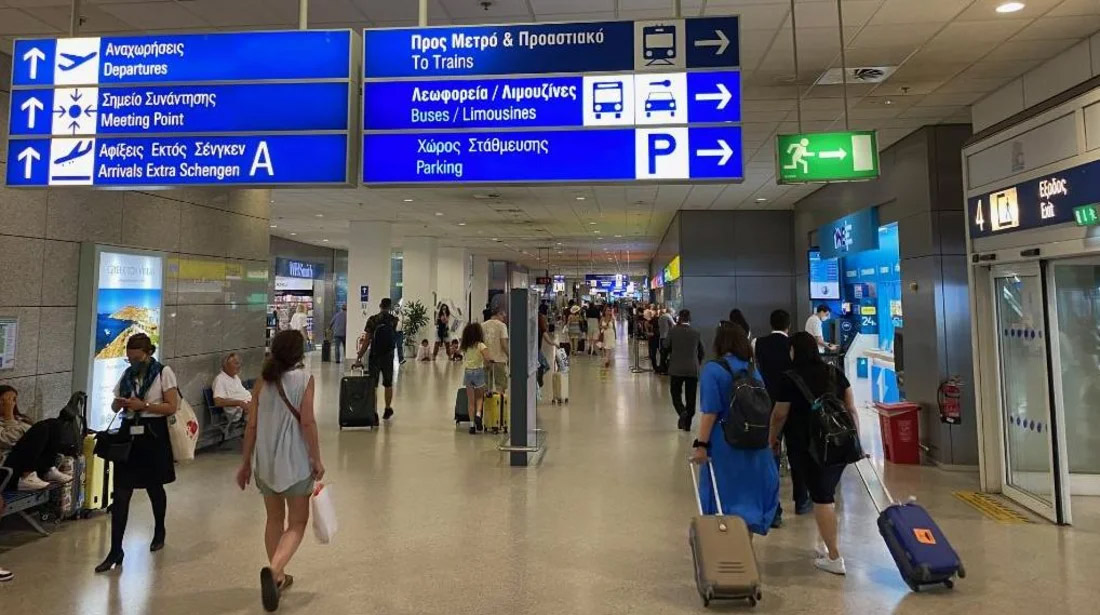
Government says Cyprus has met all the technical requirements, but Green Line remains a hurdle
The government insists Cyprus is well on track to join the Schengen Area. Notably, though, it no longer says this will happen this year but rather that this is their goal, time-wise.
The buoyant outlook it’s projecting may be genuine – or a case of doubling down on prior rhetoric, with President Nikos Christodoulides having repeatedly played up his election-campaign promise from 2023.
On February 5, Christodoulides said the island was “finalising” technical preparations for full integration into the Schengen zone in 2026.
“We continue our efforts to complete technical requirements, always in cooperation with the European Commission, with the aim of full integration of our country into the Schengen zone, further strengthening our security,” he stated at the time.
The Schengen Area is a system of open borders that encompass 29 European countries that have officially abolished border controls at their common borders. It mostly functions as a single jurisdiction under a common visa policy for international travel purposes.
Of the 27 EU member states, only two – Cyprus and Ireland – are not members of the Schengen Area. Cyprus is committed by treaty to join the system and aims to do so in 2026, although its participation is hampered by Turkey’s occupation of the north. Ireland maintains an opt-out in order to maintain the Common Travel Area with non-EU member United Kingdom and operates its own visa policy.
We contacted the foreign ministry to ask about progress on the matter.
Sources there told us that “our goal for technical readiness by the end of 2025 has been achieved.”
They added: “We’ve ticked all the boxes.”
The Cyprus Mail is told that the evaluation of Cyprus’ compliance with the technical requirements is an “ongoing, dynamic process”.
Once the European Commission is done with the evaluation, it will issue a report concerning Cyprus’ technical preparedness, accompanied by a recommendation to the EU Council.
Our sources were confident: “We expect the commission’s recommendation to be a positive one.”
From then on, they said, it’s a political decision at the EU Council.
“Now if some countries still raise concerns about the Green Line, we’ll cross that bridge when we get there. But first we had to get the technical part done, so that no one could use that as an excuse. Otherwise it would be like putting the cart before the horse,” the source said.
They were referring to the scepticism voiced by some EU members – like Austria and the Netherlands – that the Green Line may pose a security threat or a backdoor for illegal migration.
The same sources said that Cyprus has done a great deal of legwork to meet Schengen requirements. They cited simplified visa procedures at Cypriot consulates, the securing of new equipment, and the upgrades underway at Larnaca international airport.
The airport is currently undergoing a major expansion, with construction having begun in March 2025. The €170 million project, fully funded by Hermes Airports, will modernise the airport and prepare it for future Schengen accession, featuring a new 20,000 square metre extension to the east of the existing terminal.
The project includes new arrivals and departure gates, additional baggage carousels, expanded security check areas, and enhanced passport control. The new design is said to be ‘Schengen-ready’, focusing on separating Schengen and non-Schengen passenger flows during peak periods through flexible gate usage.
As for the European Commission, it has a slightly different take.
We asked them about the 2026 timetable touted by the government. A commission spokesperson said: “The timeline is dependent on progress made by Cyprus in implementing the recommendations addressed to it and on the subsequent decision making process within the council.
“In parallel to the Schengen evaluation process completion, Cyprus needs to continue its progress in meeting the Schengen requirements for the implementation of the large-scale IT systems (ETIAS, EURODAC, VIS and EES). The commission will continue supporting the process.”
The commission went on to say that it is “in close contact” with the Cypriot authorities to discuss appropriate solutions to address potential gaps that could affect security or create migratory risks for the Schengen area, notably at the Green Line, to allow Cyprus’ full membership.
“Once this process is concluded, confirming that Cyprus is technically ready, the decision will then be subject to unanimous approval by the council. The commission has no formal role in this decision, which is not based on a commission proposal.”
Once the commission adopts its final first-time evaluation, the revisits and verification visits, Cyprus “will need to finalise the implementation of any outstanding recommendations and address any issues identified in the report. This will allow the commission to subsequently communicate to the council Cyprus’ full technical readiness.”
And their sales pitch: “With the lifting of controls at the internal borders, Cyprus will further reap the benefits of this cooperation, as it will enable smoother travel for both tourists and Cypriots and easier delivery of services and goods in Cyprus and from Cyprus, benefiting the economy of the island and of the Schengen area as a whole.”
An important element of joining Schengen would be the introduction of the EES (Entry/Exit System), an automated IT system for registering non-EU nationals travelling for a short stay, each time they cross the external borders of 29 European countries using the system.
The EES registers the person’s name, travel document data, biometric data (fingerprints and captured facial images) and the date and place of entry and exit. It also records refusals of entry. The system also enables more efficient identification of overstayers as well as of those who attempt to cross the borders using fake or forged documents.
As of April 10 this year, the EES went live, replacing the stamping of passports. Cyprus, not yet a Schengen member, has not implemented it.
Ironically perhaps, this may have given the island a bit of an edge as a travelling destination, with recent reports indicating the system’s rollout has in fact caused long queues at European airports.
For example The Guardian cited the Airports Council International (ACI) body as complaining that passengers in airports in countries such as France, Germany, Belgium, Italy, Spain and Greece are waiting several hours at border checks.
Olivier Jankovec, the director of the ACI European division, told the Financial Times: “This situation, in the coming weeks and certainly over the peak summer months, is going to be simply unmanageable.”
For its part, the European Commission has attributed this to teething troubles with the EES.
Meantime back in Cyprus, the crossing points – transit between the north and south – have come under the full control and jurisdiction of the police.
Sources at the interior ministry told us that, up until the summer of 2025, checks at the crossing points were done by a combination of police and personnel from the Civil Registry directorate (interior ministry).
The Civil Registry had been involved in order to check the IDs of Turkish Cypriots. But now, their presence is not necessary as most Turkish Cypriots hold a Republic of Cyprus ID.




Click here to change your cookie preferences