
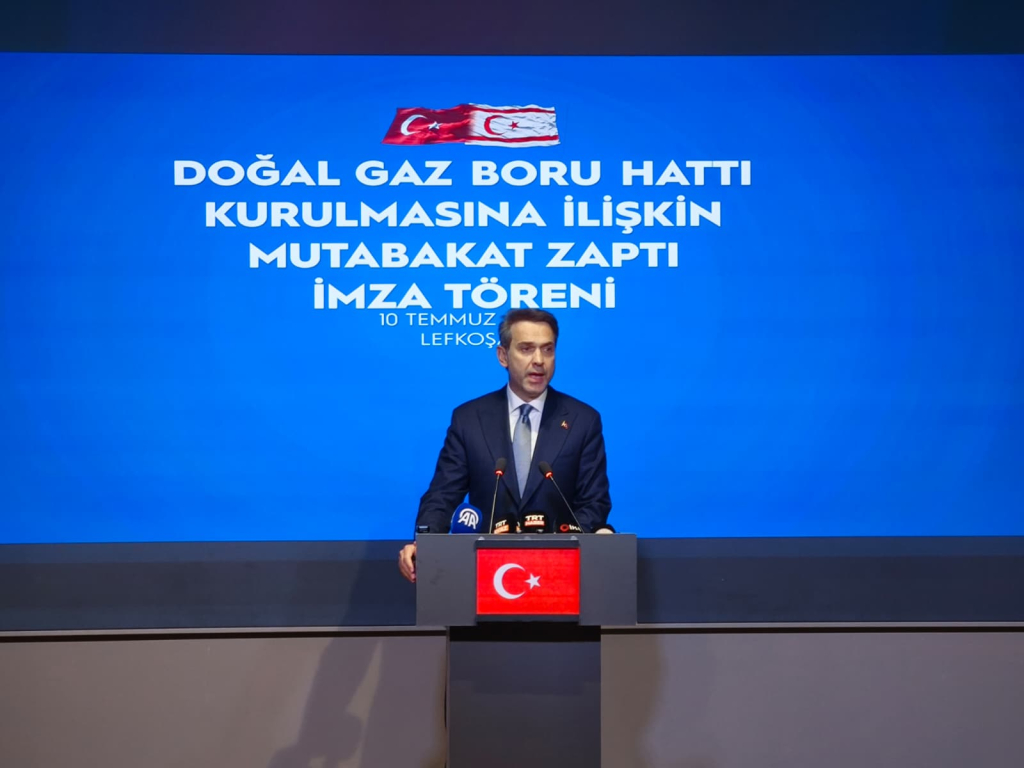
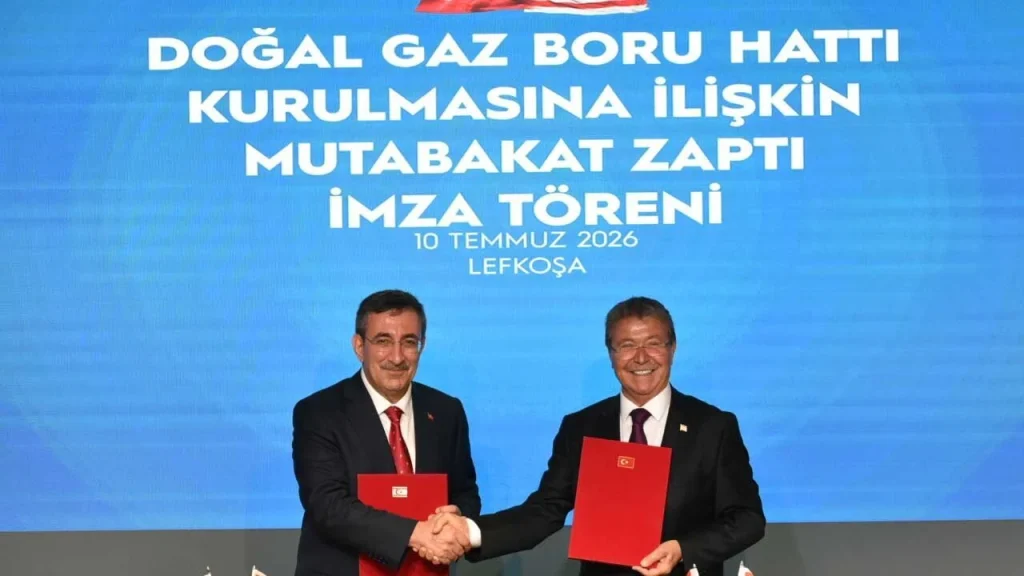
The Turkish government and the Turkish Cypriot authorities on Friday signed a memorandum of understanding which foresees the construction of a natural gas pipeline between Turkey and Cyprus.
According to Turkish Energy Minister Alparslan Bayraktar, who travelled to the island to sign the agreement, it will stretch from the town of Anamur, which sits on Turkey’s Mediterranean coast in the Mersin province, to the Teknecik power station, located just outside Kyrenia.
Anamur is located between the cities of Mersin and Alanya, with work currently underway to connect those two cities with a natural gas pipeline. At present, Mersin is supplied by natural gas flowing from Azerbaijan via Georgia, and from Turkmenistan via Iran.
Bayraktar also said that the project would in fact consist of two parallel pipelines, each 22 inches (56 centimetres) in diameter, thus allowing the system to be “bidirectional”.
“We will design the pipeline not only to transport natural gas from Turkey to the island, but also to be able to deliver any natural gas source which may emerge in the region to Turkey and from there into Europe,” he said.
He explained that the natural gas which is to be delivered to the island through the pipeline will “primarily be used for electricity generation”, and said that “the project will be an important part of the TRNC’s energy transformation and energy supply security”.
On this front, he said that with “the widespread adoption of electric cars” anticipated in Cyprus in the coming years, electricity demand is expected to increase.
“Today’s step will contribute to the meeting of these growing electricity needs of the future in a safe and sustainable manner,” he said, before adding that the pipeline will “make a significant contribution to the TRNC’s economy by reducing oil and petroleum product imports”.
“We believe that the natural gas we will bring will provide an abundance of electricity to the TRNC. The TRNC can become a net electricity exporter. In this respect, this project is also of historical significance.”
He closed by describing the pipeline as “one of the projects of the century”.
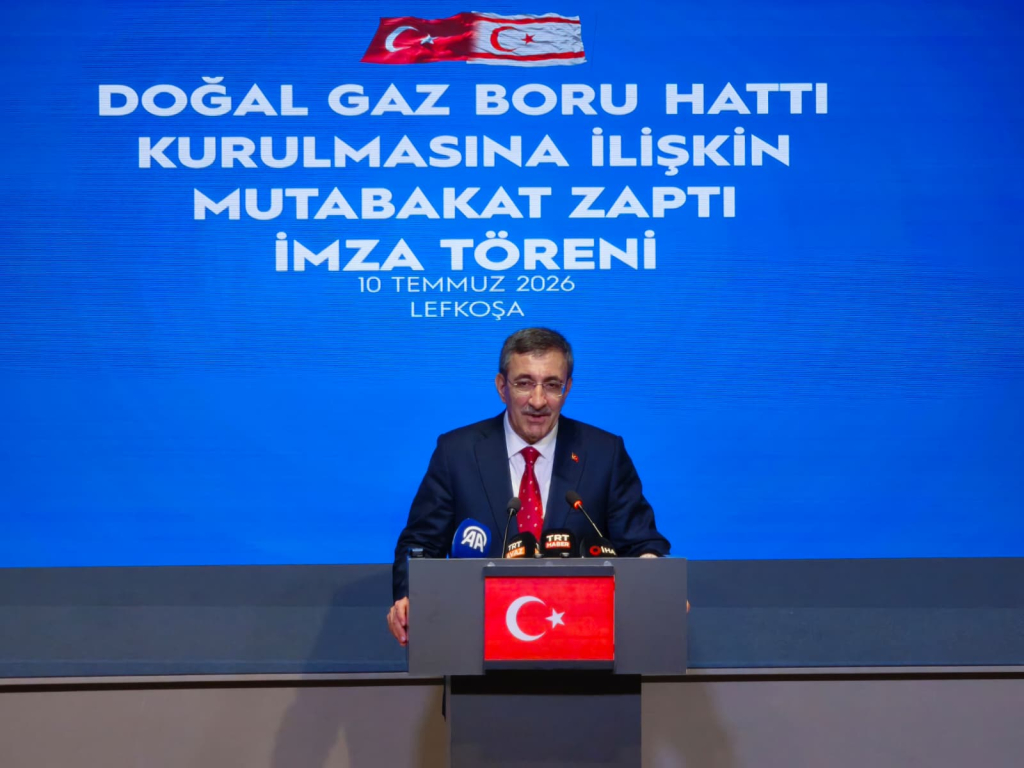
Turkish Vice President Cevdet Yilmaz joined his energy minister in Cyprus, and began his address at the signing ceremony by saying that “the most expensive energy is the energy which is not available”.
He said that Turkey “considers meeting the energy needs of the TRNC to be a strategic priority”, and pointed out that Turkey has spent more than 8 billion TL (€149m) on energy infrastructure in northern Cyprus in the last five years.
On the pipeline project itself, he said that “within the scope of the project, pipelines, receiving terminals, and auxiliary facilities will be constructed to enable the transmission of natural gas”.
“Thus, the infrastructure which will provide the Turkish Republic of Northern Cyprus with access to natural gas will be created,” he said.
As such, he said, “the commissioning of natural gas will usher in a new era”, before adding that “the project will not be limited solely to energy production”, as “natural gas could also be used in transportation, agriculture, tourism, and industry”.
“Turkey will continue to support the TRNC in achieving a strong infrastructure and a highly competitive and sustainable economic structure. This step taken in the energy sector will be a historic turning point in cooperation between the two countries,” he said.
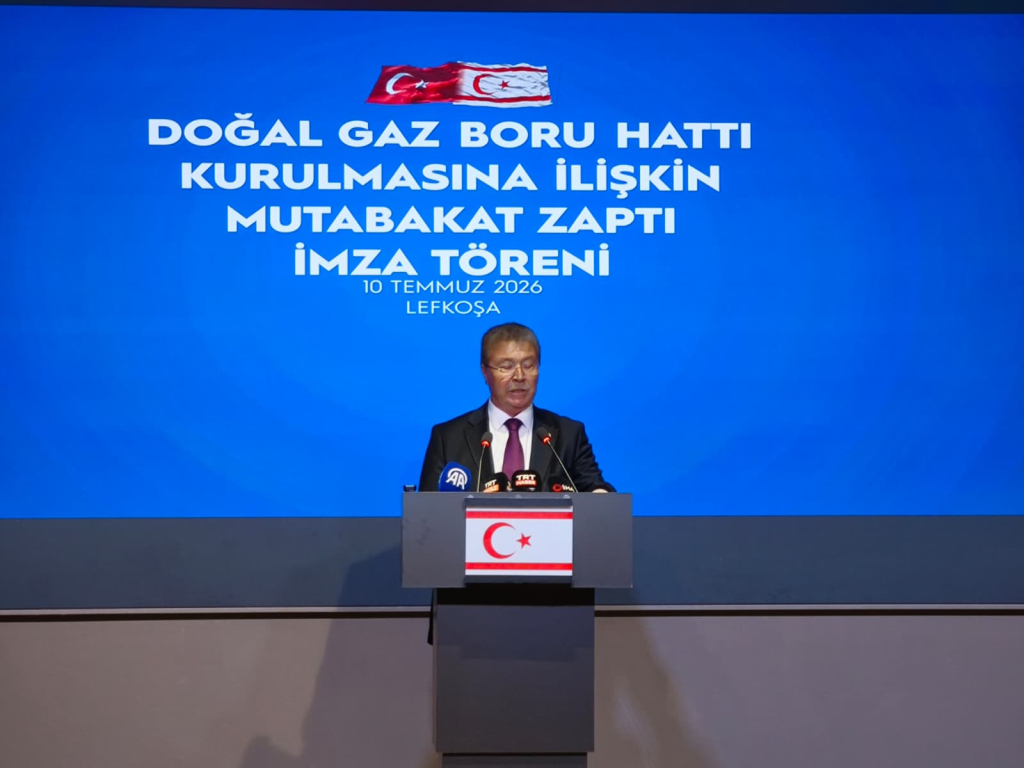
Turkish Cypriot ‘prime minister’ Unal Ustel, meanwhile, said that “energy is security, development, production, competitiveness, and sustainable growth”.
“It is becoming increasingly difficult for countries without strong energy infrastructure to achieve their economic goals. As a government, we prioritise permanent investments which consider future generations instead of short-term solutions,” he said.
He stressed that the pipeline will “strengthen the security of energy supply” and “reduce electricity production costs”, and as such “increase the competitiveness of industry, contribute to the tourism sector, and pave the way for an environmentally friendly energy transition”.
“The project is not for today, but for future generations. It is a demonstration of our will to leave a stronger, more sustainable, and more competitive country for our children,” he said.
On the political front, he said that the signing of Friday’s agreement “sent a strong message to the eastern Mediterranean”,
“The Turkish Cypriot people are present in this region, have deep roots, and are building their future with their sovereign will. With the strong support of their motherland, Turkey, they will continue on their path. We know that where Turkey is, there is security, and where Turkey is, there is strength,” he said.





Click here to change your cookie preferences