
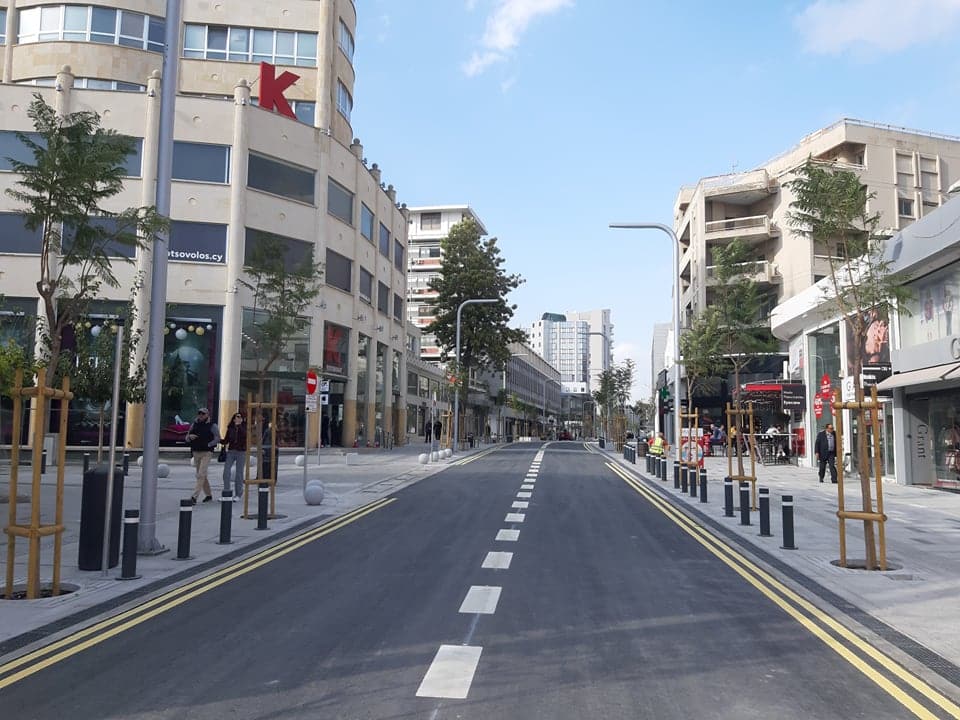
The joint platform of Makarios Avenue shopkeepers on Friday claimed that any reduction in traffic in central Nicosia was the result of the area’s “artificial death”, caused by what it described as poor decisions by the authorities.
The remarks came after Nicosia mayor Charalambos Prountzos last week reiterated the transport ministry’s position that any changes to traffic arrangements on Makarios Avenue must ensure there was no risk of the European Commission reclaiming funds used to co-finance the regeneration project.
Responding to Prountzos, the group pointed to the European Commission’s mechanism for imposing financial corrections when co-financed urban infrastructure projects deviate from agreed sustainability conditions.
According to the shopkeepers, the process does not involve automatic or arbitrary sanctions, but follows a formal procedure governing the management of European funds in which member states are given an opportunity to present their case.
They argued that allowing controlled vehicle access to Makarios Avenue reflected the wishes of residents, shopkeepers and small businesses seeking to restore transport links to the city centre.
“The total ban on vehicles led to the area’s isolation from traffic. Instead of the project serving to unify the historic commercial heart and the modern commercial triangle, it ultimately resulted in the fragmentation of the capital’s city centre,” the group said.
It added that the restrictions had caused financial hardship for businesses in the area and a “dramatic reduction” in turnover.
The shopkeepers further argued that the road closure had failed to deliver the intended environmental benefits, instead diverting traffic to alternative routes and contributing to what they described as the “artificial death” of the wider city centre.
“It is indisputable that the fall in traffic is a direct consequence of the decline in visitor numbers, the resident population and employment, as well as the decline in commercial and business activity,” they said.
The group stressed that despite the avenue being reopened to traffic, key elements of the regeneration project, including wider pavements and additional trees, remained intact, preserving what it described as the architectural upgrade for which the project was funded.
The shopkeepers also disputed Prountzos’ figures on commercial occupancy in the area.
While the mayor said 70 premises were occupied, the group put the figure at 42, including two banks and two construction sites for high-rise developments.
It also challenged his figure of 36 vacant premises, claiming the actual number was 48 when empty units on Makarios Avenue were included. According to the group’s calculations, two out of every three shops in the area were now vacant.
Prountzos had told the Cyprus Mail that of 106 ground-floor premises recorded along the avenue, 70 remained occupied and 36 were vacant, with only 16 of the vacant properties currently available for rent.
The shopkeepers also rejected the mayor’s suggestion that excessively high rents were partly responsible for the number of empty shops, arguing that rents in shopping centres were considerably higher.
According to the group, premises available for rent on Makarios Avenue cost less than €10 per square metre, while the overall average did not exceed €30 per square metre.
“Reopening Makarios Avenue is the key to ending the peculiar transport gridlock affecting the entire historic commercial centre and the pedestrianised area,” the group said.
The shopkeepers argued that the option of reinstating the previous traffic restrictions meant the risk of permanently losing EU funding was minimal.
“The possibility of fully reversing the traffic measures is emerging as the Cypriot side’s ultimate safety net. If the European Commission definitively rejects the city’s arguments and finds a breach, the existing controlled traffic arrangements can be reinstated immediately,” the group said.
“By simply re-imposing the ban on private vehicles, the irregularity is deemed to have been fully rectified, a fact which makes the possibility of a permanent loss or withholding of funds extremely remote, if not non-existent.”
Speaking to the Cyprus Mail, shop owner Marilena Ieromonachou, who represents affected businesses and residents on the southern section of Makarios Avenue, said the current debate concerned only the latest in a series of more complex problems the area had faced in recent years.
Ieromonachou, who has operated her shop since 1989, said she had witnessed numerous changes in the area. She traced the beginning of its most serious problems to the opening of the Mall of Cyprus in 2007, followed by the decision almost five years ago to turn the southern section of Makarios Avenue into a one-way road.
“We’ve been through ups and downs, but this was the cherry on top,” she said.
In an interview with the Cyprus Mail last week, Prountzos rejected claims that restrictions on traffic were the main problem facing the Makarios Avenue area.
“It is a disservice to the residents and shopkeepers on Makarios Avenue to promote the narrative that closing the area to traffic is the main issue at hand,” he said.
Prountzos argued that the debate surrounding the avenue should not focus on traffic access, stressing that the nature of consumers behaviour and the circumstances had changed significantly.
“We cannot look back to the 1990s regarding the high street, there are shopping malls, there is online shopping, we live in an entirely different reality now,” he said.
He said that market analysis conducted by both the academy of urbanism and the technical chamber (Etek) identified two key factors needed to attract businesses and customers back to the avenue, namely “the authenticity of shops and affordability of rents”.




Click here to change your cookie preferences