
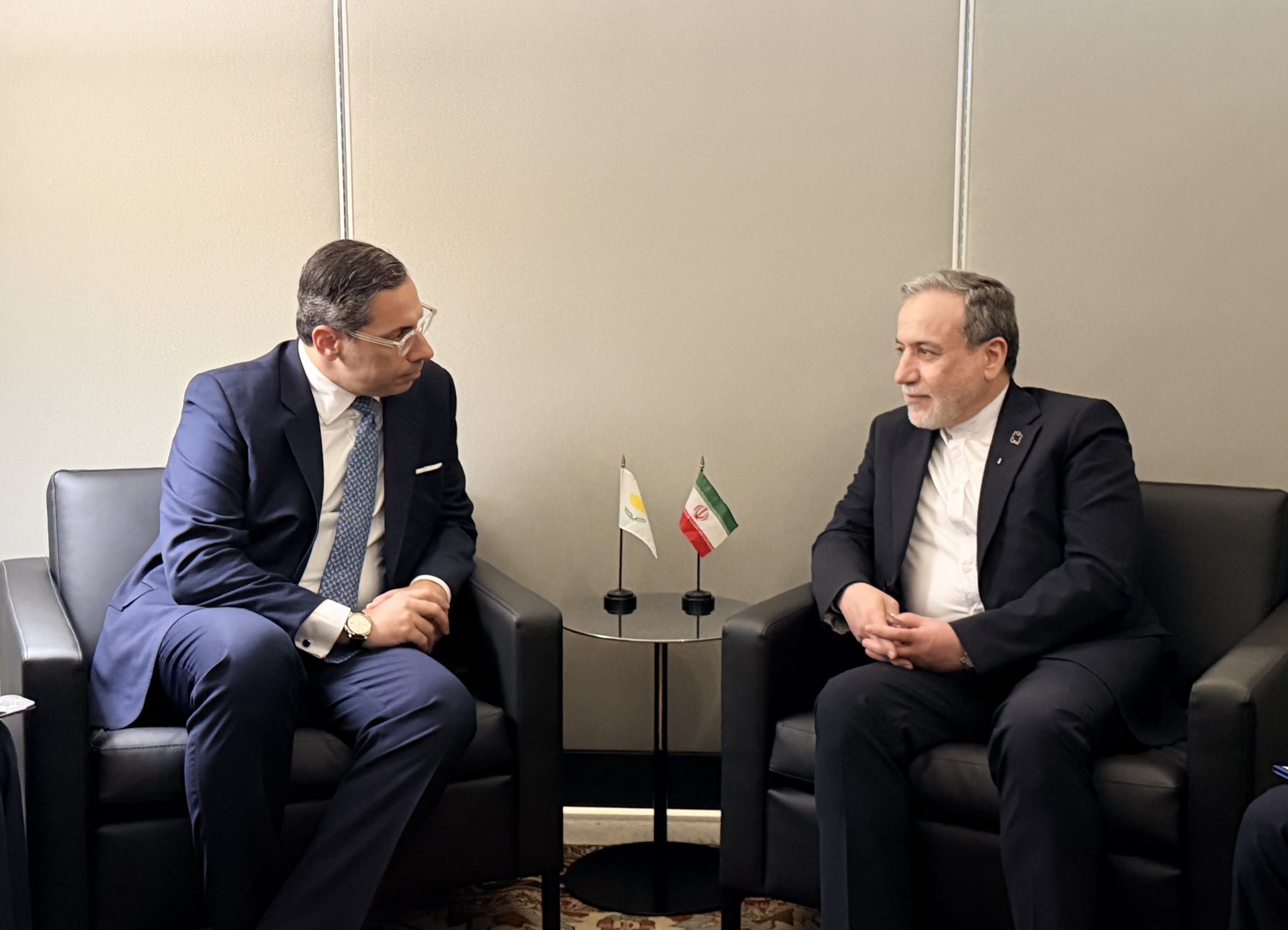
Foreign Minister Constantinos Kombos told his Iranian counterpart Seyyed Abbas Araghchi of the “importance of comprehensive dialogue and effective diplomacy in pursuit of lasting regional de-escalation” when the pair met on the sidelines of the United Nations general assembly in New York.
He said that he and Araghchi had discussed “core aspects of ongoing developments, including ensuring freedom of navigation, in full respect with international law”.
The meeting comes with the conflict in Iran having reached something of a stalemate, with the Strait of Hormuz neither entirely open nor entirely closed, though developments elsewhere in the Middle East have been more noteworthy of late.
In recent weeks, Yemen’s Iran-backed Shia militant Houthi movement has taken control of almost the entirety of the country’s west coast, including the eastern half of the Bab al-Mandab strait, a crucial chokepoint between the Gulf of Aden and the Red Sea. The movement has also attacked Saudi Arabia’s east-west oil pipeline.
Around five per cent of global oil supplies passed through the Bab al-Mandab strait in February, typically passing northwards towards the Suez Canal and the Mediterranean beyond.
These issues have caused the price of oil to rise, with the price of a litre of diesel having reached €2 in Cyprus this week, while the price of petrol hovers at around €1.68 per litre.
In response, the British government confirmed on Tuesday morning that it will “provide additional defensive military support” to Saudi Arabia “following renewed Houthi attacks and escalating violence in the region”.
It said that that support will be offered in the form of an RAF Voyager air-to-air refuelling aircraft, which will “support Saudi defensive activity in support of the legitimate government of Yemen”.
Operations against Houthis launched ‘from UK base in Cyprus’
Meanwhile, British newspaper the Financial Times reported that the support offered to Saudi Arabia will operate “from a UK base in Cyprus”, with it likely that the Akrotiri air force base near Limassol will therefore form the launchpad for it.
The Cyprus Mail has contacted the British defence ministry over the question of whether Cyprus will be the launchpad for the support and was told that the ministry will not “provide commentary on operational detail”.
Last month, Iranian diplomatic sources were quoted by newspaper Politis as having said that Cyprus faces no threat so long as the British bases on the island are not used in operations against the county,
Akrotiri was, however, hit by an Iranian-made drone on March 2, prompting President Nikos Christodoulides to promise upon his arrival a European Council summit later that month that “we are going to have an open and frank discussion with the British government” over the future of the bases, heavily hinting that he would like to see them abolished.
That summit then ended with the European Council declaring that it stands ready to assist” the Cypriot government in discussions regarding the bases’ future and stating that it “acknowledges the intention of Cyprus to initiate a discussion with the UK” on the matter, though the UK has insisted throughout that the bases’ status is not up for negotiation.
However, former Turkish Cypriot leader Mehmet Ali Talat told the Cyprus Mail that it would be “impossible” to abolish the British bases without first solving the Cyprus problem, and added that it constitutes “a great disrespect by the Greek Cypriot leadership to bring up the issue of the bases without consulting the Turkish Cypriots”.




Click here to change your cookie preferences