
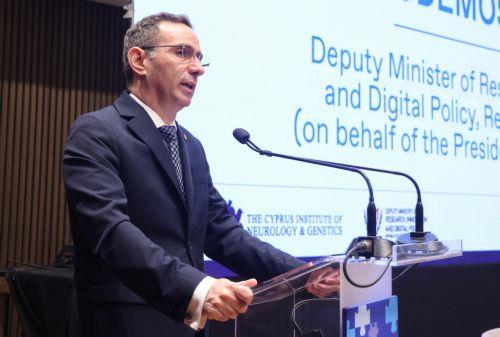
Deputy Research Minister Nicodemos Damianou reckoned many of the graduates in front of him this week had already asked AI to summarise a paper, review their code or suggest their next experiment. Addressing them at the Cyprus Institute of Neurology and Genetics (CING), he said, “I hope it helped. I also hope you checked its answer.”
Damianou was speaking as 70 students received master’s and doctoral degrees, bringing the institute’s alumni to 462. He used the ceremony to set out where Cyprus wants to use AI in healthcare, from reading medical images to tailoring care to individual patients.
Healthcare and life sciences are among five priority sectors for adopting AI and six areas where Cyprus wants to build its research capacity under the National AI Strategy 2032. For the institute, Damianou said, that creates “a clear opportunity”. Alongside medical imaging, diagnostics and personalised care, the strategy identifies bioinformatics and reliable health data infrastructure as priorities.
The strategy also calls for settings where researchers can test new tools with safeguards in place. Damianou said the institute was already acting as “a scientific testbed in the area of rare diseases” and could develop a dedicated testing environment with other research organisations and biotechnology providers.
Founded in 1990, the institute serves around 6,500 patients a year and provides more than 80,000 clinical and laboratory services, Damianou said. Its researchers have helped develop potential treatments for inherited peripheral neuropathies, thalassaemia and myotonic dystrophy, now at various stages of development.
The state also draws on its expertise for national diagnostic and screening programmes and for specialist genetic and forensic services. Damianou said its role as a regional referral centre strengthens Cyprus’ standing in research and clinical care.
In July, Damianou accompanied President Nikos Christodoulides to the opening of the institute’s new building, the largest development project in its history. He described the €31 million investment, backed by the government and the European Investment Bank (EIB), as “a clear expression of confidence in the Institute’s achievements and its future”.
Damianou recalled that Christodoulides had described continued support for the institute as a clear policy choice. The government invests in it, Damianou said, because it “strengthens our scientific capabilities and improves the care available to our people”.
Research and innovation are central to the government’s ambition to make Cyprus a regional technology hub and build a more resilient, competitive economy, he added. Institutions of this calibre also give talented Cypriots “the opportunity to build careers at home, or to return with knowledge and experience gained abroad”, an aim he linked to the Minds in Cyprus programme.
Damianou also welcomed the forthcoming physiotherapy centre, pointing to the institute’s work in rehabilitation and in helping patients maintain their independence and quality of life.
For the graduates, the changes he described are already reaching the lab. AI is changing how researchers analyse biological data, spot patterns, study disease and investigate potential treatments, he said, while advances in genetics, biotechnology and computing are opening up new ways to understand and treat disease. Damianou called it “an enormously exciting time to be a scientist”.
He had opened the speech with the story of Katalin Kariko, who arrived in the United States from Hungary in 1985 with her husband, their two-year-old daughter and the family’s savings sewn into the child’s teddy bear. Her research proposals were repeatedly rejected, and her university demoted her and cut her salary.
A conversation by a photocopier in 1997 led to her collaboration with immunologist Drew Weissman, Damianou recalled. Their work helped make mRNA vaccines against Covid-19 possible, and the pair shared the 2023 Nobel Prize in Physiology or Medicine.
Damianou returned to that photocopier when he urged the graduates to work with people outside their own fields. When the prize was announced, he recalled, Kariko joked that the university should buy more photocopiers so scientists would have more chances to stand around and talk.
For all the answers AI can provide, Damianou said what would distinguish the people using it was their ability to “ask the right questions, recognise what matters, challenge a result that appears convincing, understand the consequences of a discovery and exercise judgment when there is no obvious right answer”.
He said the graduates’ responsibilities to patients and society would place greater weight on “integrity, empathy and scientific judgment” as the technology became more powerful.
He urged them to “never become so confident in what you know that you stop questioning it” and to stay open to a career different from the one they had imagined.
Damianou also asked them to judge their success “by the problems you helped solve, the people you helped and the opportunities you created for others”. That might mean a patient getting an earlier diagnosis, a family finally finding an answer or a young researcher getting the encouragement they needed to keep going.


Click here to change your cookie preferences