
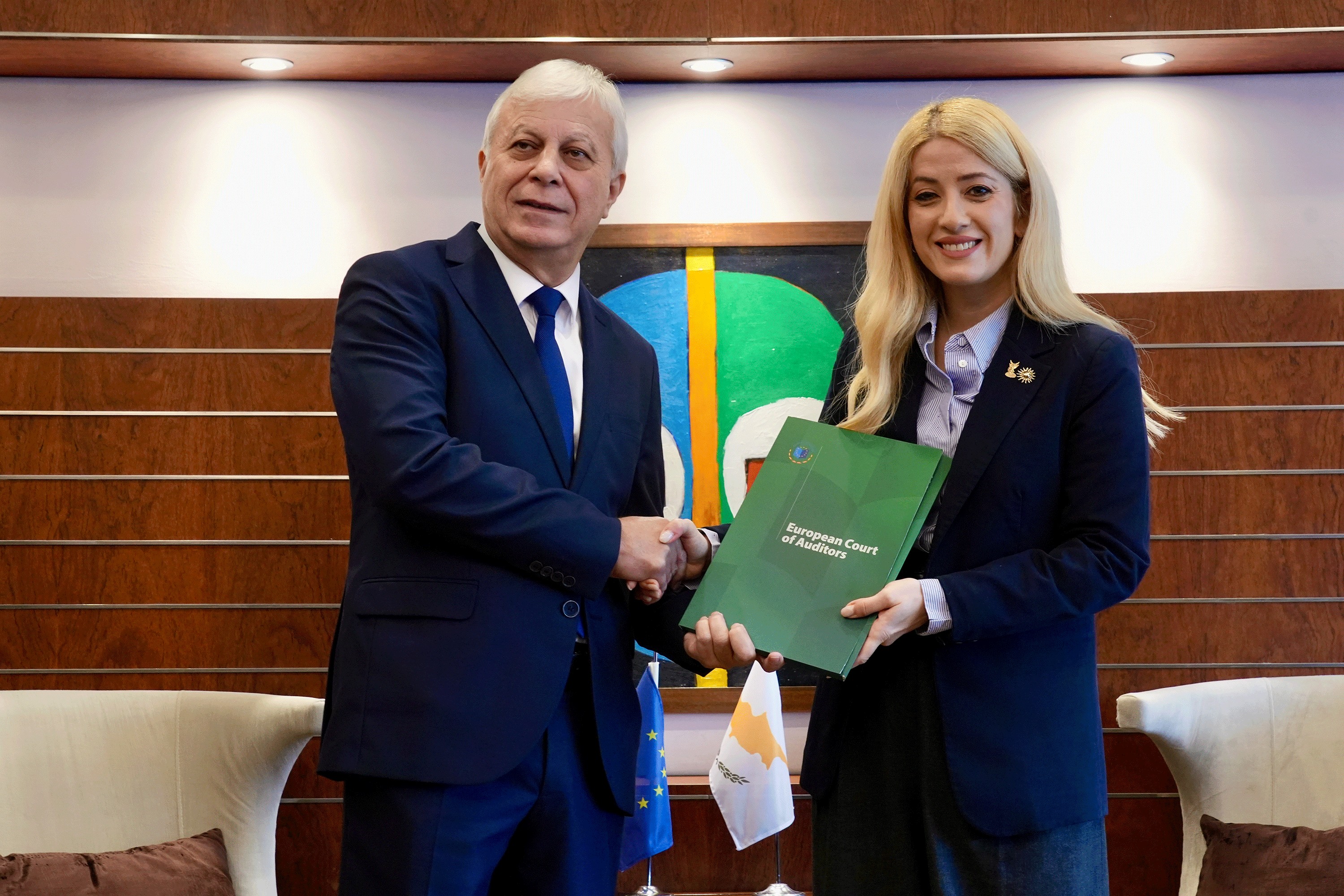
No findings implicating Cyprus emerged from the European Court of Auditors’ (ECA) examination of the EU budget and the Recovery and Resilience Facility, ECA member Lefteris Christoforou said on Thursday, as he presented the court’s annual report to House president Annita Demetriou.
Christoforou said the outcome of the audit reflected “very positively” on Cyprus’ image and its sound financial management of European funds.
Referring to the absorption of European funding, he said Cyprus ranked among the leading EU member states, having absorbed 100 per cent of the €917.3 million available under the previous Multiannual Financial Framework (MFF).
He added that under the current MFF, Cyprus’ absorption rate stood at 37.4 per cent, compared with an EU average of approximately 30 per cent, with €528 million already absorbed.
Regarding the Recovery and Resilience Facility, Christoforou said Cyprus had absorbed 100 per cent of the funds, amounting to €992 million. He clarified that the loss of approximately €28 million was due to the government’s failure to submit legislation increasing fuel taxation, as it had chosen, he said, to protect the public from an additional tax burden.
Christoforou praised the government, the state administration and all bodies involved in the utilisation of European funds. He also highlighted the significant contribution of parliament and parliamentary parties in advancing and passing the legislation required to secure funding under the Recovery and Resilience Plan.
Referring to the ECA’s annual report, he explained that it examines the regularity and legality of EU revenue and expenditure, with the aim of improving financial management.
He also noted that the presentation of the report coincided with crucial negotiations on the next Multiannual Financial Framework, which will determine the EU’s priorities for the coming seven years.
Christoforou stressed the need for a stronger and larger financial framework, focused on European citizens, with greater flexibility and effectiveness to enable Europe to assume a stronger strategic role.
For her part, Demetriou underlined the importance of the European Court of Auditors’ annual report, saying its individual areas of examination provided an opportunity to assess the work being carried out.
She also expressed her appreciation for the ECA’s work and the guidance it provides to member states to help them make greater use of European programmes, as well as the specific guidelines arising from the report’s findings.





Click here to change your cookie preferences