
HELLENiQ Energy prioritises Greece but keeps Cyprus option open
HELLENiQ ENERGY has not ruled out participating in Cyprus’ offshore natural gas exploration programme through a partnership with another energy company, although the Greek group is currently prioritising the development of its existing exploration portfolio in Greece, chief executive Andreas Shiamishis has said.
Speaking during a gathering with international journalists in Athens, which the Cyprus Mail participated in, Shiamishis said the company’s earlier decision to stay out of Cyprus’ exclusive economic zone (EEZ) was largely driven by a lack of the necessary deepwater exploration experience and concerns about the political and operational risks involved.
“What we may do in the future is still under consideration and clarification,” he said, explaining that the company had previously concluded it could not offer the expertise that Cyprus was looking for when it began developing its offshore exploration programme.
“The decision to not get involved in Cyprus’ EEZ was taken some years ago. As a company, we felt that we could not offer what Cyprus was potentially seeking at the time. This included know-how in deep exploration, as the reserves are located in deep waters,” he said.
He explained that, at the time, HELLENiQ ENERGY had neither produced oil nor undertaken drilling operations, making participation in an offshore exploration programme potentially irresponsible.
“If we expressed a desire to get involved it would have been irresponsible,” he said.
Political stability and the scale of international operators were also important considerations, according to Shiamishis, who said that offshore exploration in the region required the involvement of companies with the financial resources, clout and experience to manage the associated risks.
“The second factor was that in our region you require a certain sense of political stability. This stability can only be provided by the largest international companies. Therefore, our decision to not get involved mostly revolved around that particular factor,” he said.
His comments come as Cyprus continues to develop its offshore natural gas programme, which has involved major international energy companies including ExxonMobil, Eni, TotalEnergies and Chevron.
HELLENiQ ENERGY, meanwhile, already has an established presence in Cyprus through other activities, including the supply, transportation and marketing of liquid fuels, lubricants and liquefied petroleum gas, as well as renewable energy.
Its involvement in these areas has not, however, extended to the country’s offshore hydrocarbon exploration programme.
Current strategy focuses on maturing domestic energy projects
Asked whether HELLENiQ ENERGY might reconsider its position if Cyprus proceeded with licensing additional exploration blocks, Shiamishis pointed to the company’s existing commitments in Greece.
“At the moment, we have nine blocks in Greek space. They have to be developed,” he said, using the Greek term for bringing the projects to maturity.
He explained that the company had already brought in international partners, including ExxonMobil and Chevron, while retaining minority stakes in its exploration activities.
The strategy allows HELLENiQ ENERGY to participate in potentially significant exploration opportunities while sharing the financial burden, technical requirements and risks with larger international operators.
“We have a lot of work to do in Greece over the next three to four years. I am not excluding the possibility of a potential collaboration with another company in Cyprus’ blocks. However, at the current moment, this is not our first priority,” he said.
Shiamishis nevertheless expressed support for Cyprus’ efforts to develop its natural gas resources, acknowledging the considerable time and investment required to bring offshore discoveries into production.
“That said, I hope that Cyprus does well in this area because it has been a 20-year journey and effort is needed, it’s not easy,” he said.
HELLENiQ ENERGY’s growing involvement in Greek exploration is reflected in its February 2026 agreement with Chevron, under which the two companies secured exploration rights for four offshore areas south of Crete and the Peloponnese.
Chevron holds a 70 per cent operating interest in the consortium, with HELLENiQ ENERGY retaining the remaining 30 per cent. The four areas cover approximately 47,000 square kilometres, with some exploration targets located in waters exceeding 1,500 metres in depth.
The agreement illustrates the type of international partnership Shiamishis was referring to when discussing the possibility of future cooperation in Cyprus.

Energy transition poses challenges for refiners
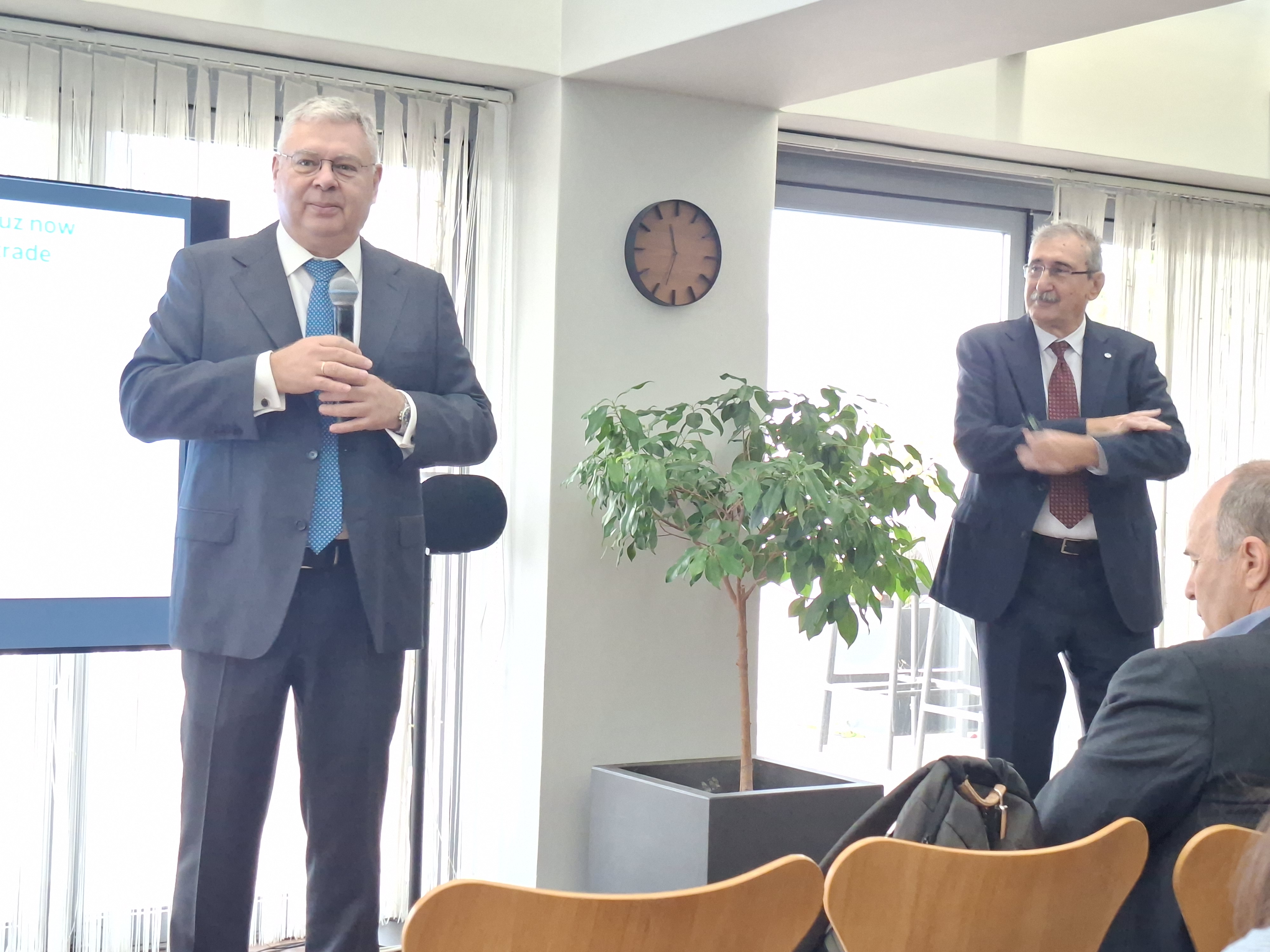
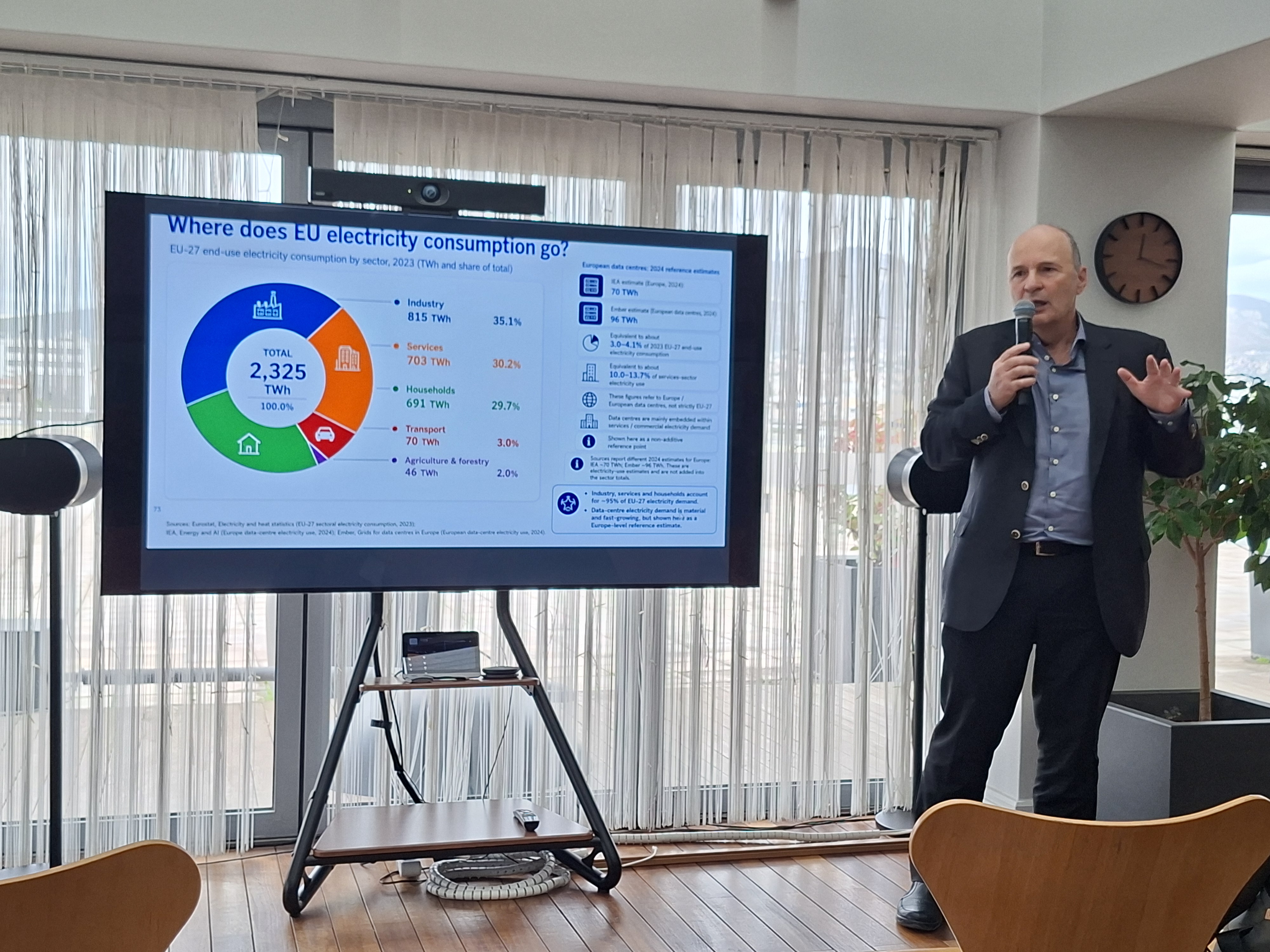
The Cyprus discussion was part of a wider programme examining the changing energy landscape, with HELLENiQ ENERGY executives and industry specialists discussing refining, international oil markets, electricity pricing, renewable energy and energy security.
The programme was organised in cooperation with the HELLENiQ ENERGY Center for Sustainability and Energy at Alba Graduate Business School, bringing together energy journalists from Southeast Europe for technical presentations, discussions with executives and visits relating to the group’s activities.
One of the central themes was how European climate policy and geopolitical developments are affecting the operating costs of energy companies, particularly those involved in refining and conventional fuel production.
The discussions focused on the impact of the EU’s Fit for 55 climate package and the European Emissions Trading System (ETS), which places a cost on greenhouse gas emissions generated by industrial activities, including refining.
Participants discussed how carbon allowances add to refinery operating expenses, with the company’s reported cost reaching approximately €90 per tonne of carbon emissions.
They also examined the implications of the forthcoming ETS2 system, which extends carbon pricing to fuel distributors supplying the road transport and buildings sectors.
ETS2 is scheduled to become operational in 2028, rather than the originally envisaged 2027, while the EU’s Social Climate Fund is intended to help vulnerable households and other groups manage the financial effects of the transition.
The potential impact on consumers was a particular concern, given that additional carbon-related expenses could eventually be reflected in fuel and heating costs.
For HELLENiQ ENERGY, the challenge is to maintain conventional fuel production while reducing emissions and diversifying into alternative energy sources.
The company’s investment considerations include sustainable aviation fuel, biofuels, renewable electricity and carbon capture technologies.
However, carbon capture remains difficult to justify commercially without additional incentives or changes to the regulatory framework.
The discussions put the estimated cost of capturing a tonne of carbon dioxide at €170 to €180, compared with an emissions allowance price of approximately €90 per tonne cited during the session.
That difference illustrates the financial difficulty of investing in carbon capture when purchasing emissions allowances can be considerably cheaper than capturing and storing the emissions themselves.
For context, European Commission figures published for November 2026 put the average EU allowance price over the preceding six months at approximately €81 per tonne. The figure cited during the meeting should therefore be understood as the company’s approximate reference point rather than the current official market average.
Executives also highlighted the difficulty of forecasting energy prices, given the combination of geopolitical instability, supply constraints, changing demand and uneven infrastructure development.

Why crude oil cannot simply be replaced
Another session examined the mechanics of the global oil industry, explaining how the characteristics of crude oil influence refining operations, international trading and the availability of petroleum products.
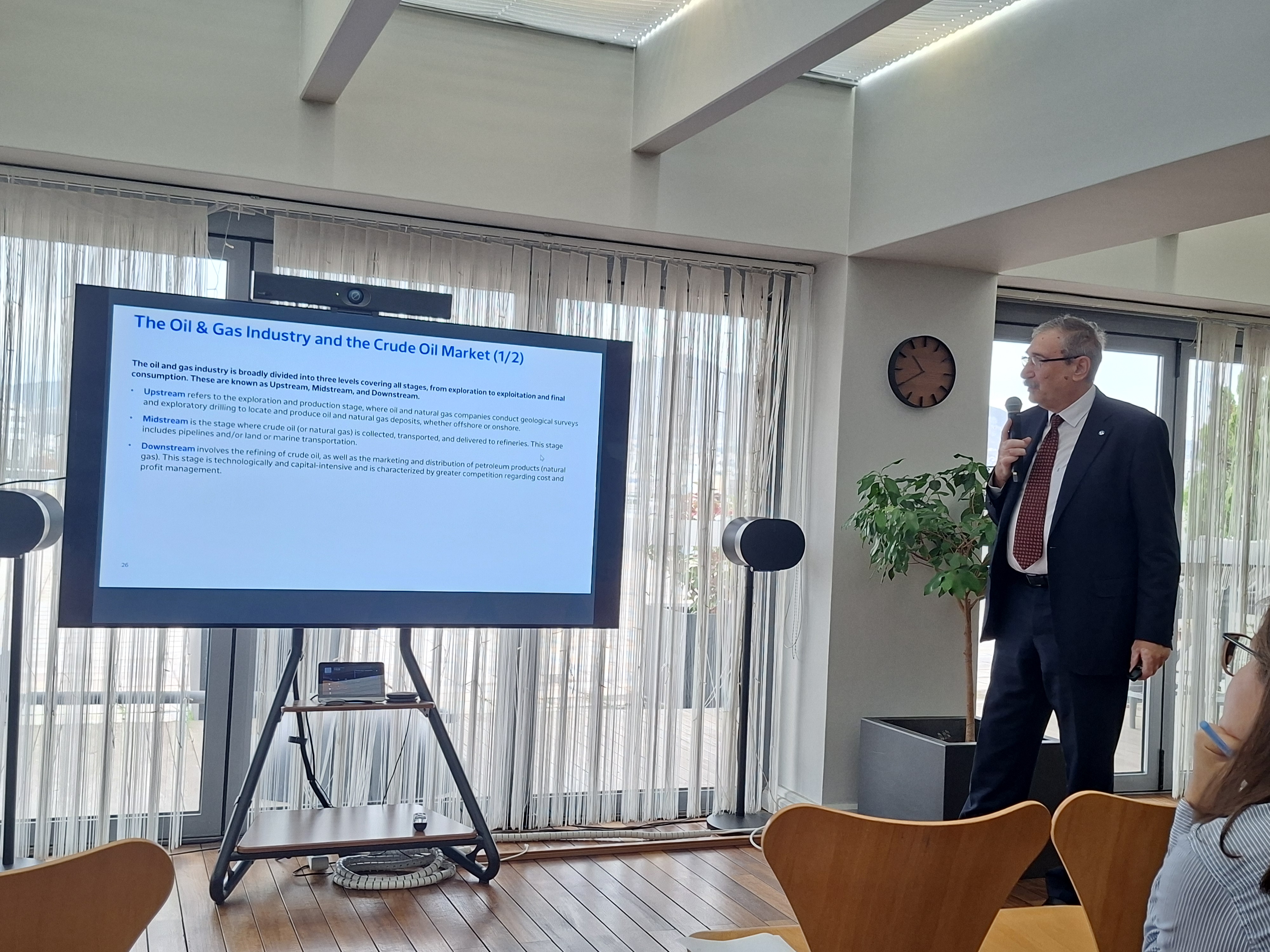
The presentation distinguished between the three principal stages of the oil industry.
Upstream activities cover exploration and production, while midstream operations involve the transportation and storage of crude oil and petroleum products. Downstream activities include refining crude oil into fuels and other products used by businesses and consumers.
The speakers stressed that the energy transition is a lengthy process, with conventional fuels continuing to play a substantial role in the global economy even as investment in alternatives increases.
Coal, in particular, remains an important component of global primary energy consumption.
A substantial part of the discussion concerned the differences between crude oil varieties and why refineries cannot necessarily replace one source of supply with another without incurring additional costs.
Crude oil is assessed according to several characteristics, including API gravity, sulphur content and pour point.
API gravity indicates how light or heavy a particular crude oil is, while sulphur content determines whether it is classified as sweet or sour. Pour point indicates the lowest temperature at which the oil remains sufficiently fluid to flow.
These characteristics influence how crude oil can be transported, which refineries can process it efficiently and the quantities of different petroleum products that can ultimately be produced.
Consequently, a disruption to one source of crude oil cannot always be offset by importing an equivalent volume from somewhere else.
Refineries are designed around particular feedstock characteristics, meaning that changing the type of crude they process can require operational adjustments or additional investment.
The speakers also examined how conflicts, trade embargoes and supply disruptions have historically influenced oil prices and international energy markets.
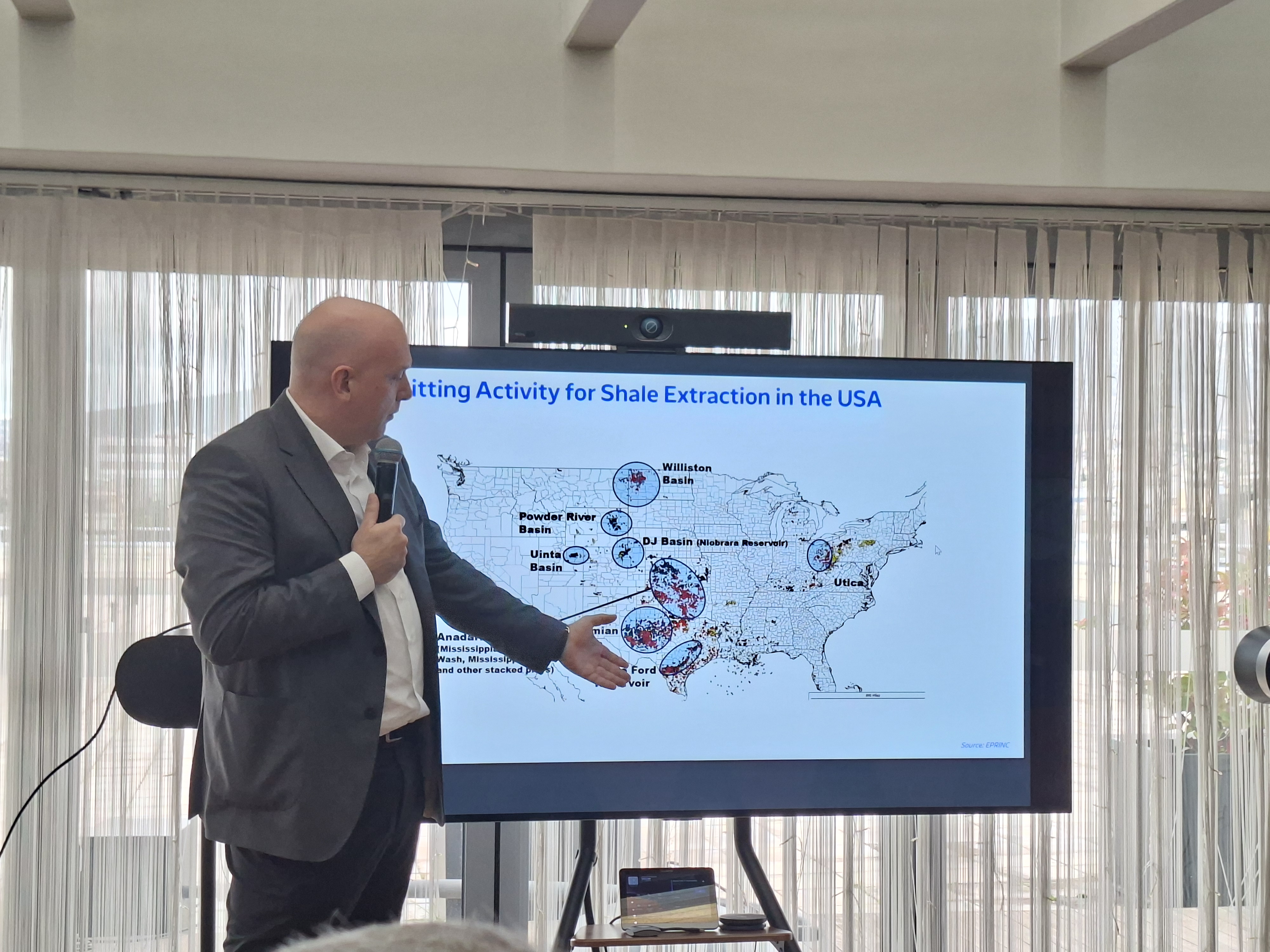
The expansion of US shale production was highlighted as a particularly significant development, transforming global oil and gas supply and changing the country’s position in international energy markets.
By contrast, the development of shale resources in Europe has encountered considerable obstacles, including regulatory restrictions, land ownership arrangements, financing difficulties and a less established industrial ecosystem.
The discussion also examined the importance of transportation infrastructure, particularly for landlocked oil-producing regions.
Where pipelines and other transport connections are limited, crude oil can become more expensive to move to international markets, potentially resulting in lower prices for producers.
Geopolitical disruptions expose supply vulnerabilities
A further discussion examined the relationship between investment in oil and gas production, international supply security and geopolitical developments.
Participants highlighted how environmental pressures and reduced access to financing have contributed to lower investment in upstream oil and gas activities, despite the fact that developing new production capacity can take approximately 15 years from initial exploration to commercial output.
This creates a potential mismatch between the long-term investment required to maintain supply and the shorter-term pressures influencing energy companies and financial institutions.
The meeting also discussed the accumulation of crude oil reserves by China and the importance of strategic petroleum stocks in protecting countries against unexpected supply disruptions.
The European Union requires member states to maintain emergency oil stocks equivalent to at least 90 days of average net imports or 61 days of average inland consumption, whichever is higher.
The International Energy Agency has a separate requirement for its member countries to maintain stocks equivalent to at least 90 days of net imports.
The United States’ use of underground salt caverns for strategic petroleum storage was also discussed as an example of how countries can maintain substantial emergency reserves.
The speakers examined changes in the relationship between diesel and petrol prices following Russia’s invasion of Ukraine, when diesel became relatively more expensive amid disruptions to established European supply routes.
HELLENiQ ENERGY’s refining operations were discussed in the context of the company’s ability to supply regional markets during subsequent disruptions.
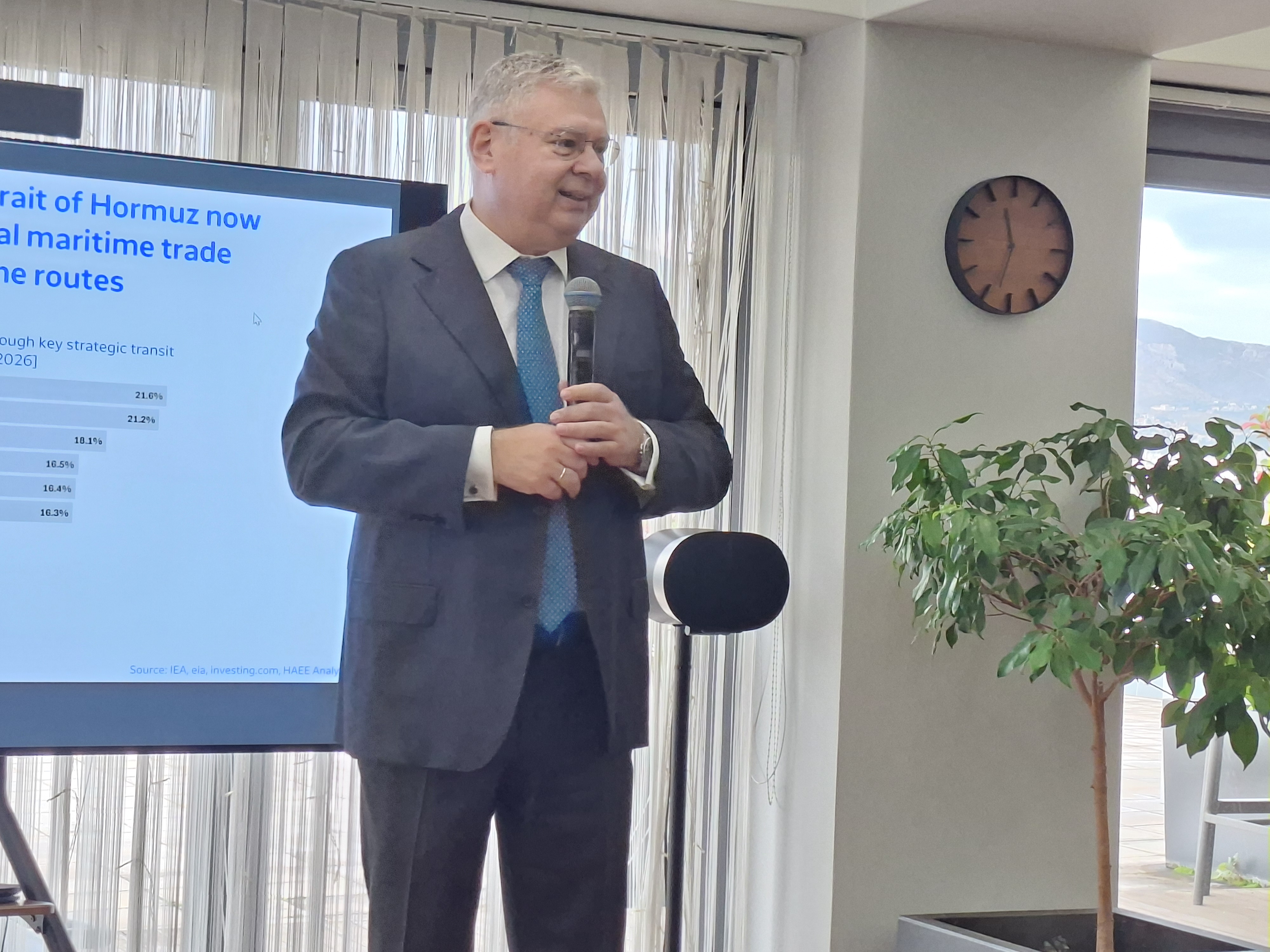
Particular attention was given to the Strait of Hormuz, one of the world’s most important energy transportation routes, through which substantial quantities of crude oil, petroleum products and liquefied natural gas pass.
According to the International Energy Agency, approximately 20 million barrels of oil per day travelled through the strait in 2025, equivalent to around a quarter of global seaborne oil trade.
The waterway is also particularly important for LNG shipments from Qatar and the United Arab Emirates, with approximately 20 per cent of global LNG trade passing through it in 2025.
Although pipelines provide some alternative routes for crude oil exports, the options for transporting LNG from Qatar are considerably more limited.
The discussion also addressed the consequences of attacks on energy infrastructure in the Gulf.
In March 2026, Iranian attacks damaged two of Qatar’s 14 LNG production units at Ras Laffan, affecting approximately 17 per cent of the country’s LNG export capacity.
QatarEnergy chief executive Saad Sherida Al-Kaabi said the damage could take between three and five years to repair, potentially keeping 12.8 million tonnes of annual LNG production offline.
The incident illustrated how damage to a relatively small number of critical facilities can have consequences for international energy supplies over several years, even if the immediate geopolitical situation improves.
Renewables, storage and electricity prices
The final part of the programme examined the development of renewable energy, the economics of electricity markets and the growing importance of energy storage.
The discussion focused on how solar and wind power have become increasingly competitive, while their intermittent nature creates challenges for electricity systems that must continuously balance supply and demand.
Unlike conventional power stations, which can generally adjust production according to demand, renewable generation depends on weather conditions and the availability of sunlight and wind.
This creates the need for flexible generation capacity and storage solutions that can help balance the electricity system.
One of the central issues was renewable energy curtailment, which occurs when electricity generated by solar or wind installations exceeds what the grid can absorb or what the market can use.
The problem is particularly relevant in markets experiencing rapid renewable energy growth without corresponding investment in electricity networks and storage infrastructure.
Greece and Cyprus were both discussed in relation to the growing challenges of curtailment.
Speakers explained how battery storage can absorb surplus electricity generated during daylight hours and release it later, particularly during evening periods when demand is higher and solar generation has declined.
This could reduce reliance on gas-fired power stations used to meet peak demand, while potentially lowering wholesale electricity prices during periods of high consumption.
However, batteries involve energy losses during charging and discharging, with the meeting citing round-trip efficiency losses of approximately 10 to 15 per cent.
Pumped hydroelectric storage was also discussed as an alternative capable of providing longer-duration storage, although such projects generally require more time and investment to develop.
Other technologies mentioned included compressed-air energy storage.
The speakers also highlighted the obstacles facing renewable energy investment, including grid congestion, lengthy licensing procedures, construction complexity and public opposition, particularly in the case of wind projects.
Solar installations have generally expanded more rapidly because of lower costs and relatively straightforward development processes, although they too face limitations when electricity networks cannot accommodate additional generation.
Another unresolved issue concerned the rules governing cross-border electricity trading and exports.
Participants discussed the uncertainty surrounding future arrangements and the extent to which renewable energy producers will be able to sell surplus electricity to neighbouring markets.
This is particularly relevant for countries such as Cyprus, where limited interconnection capacity has historically restricted access to neighbouring electricity markets.
HELLENiQ ENERGY outlined its intention to diversify its renewable energy portfolio through hybrid solar projects, battery storage and a greater contribution from wind power.
The company also identified Bulgaria as an important market for expansion, alongside its existing activities in Greece, Romania and Cyprus.
Its broader strategy is to develop its renewable energy operations across Southeast Europe, with a particular focus on combining different technologies to improve the commercial viability of projects.
HELLENiQ ENERGY’s 2025 annual report provides a picture of its existing position. At the end of that year, its renewable energy subsidiary had 494 megawatts of installed capacity, including 354MW of photovoltaic installations and 99MW of wind farms in Greece, as well as 41MW of photovoltaic capacity in Cyprus.
The company also reported a renewable energy project pipeline that included 123MW of hybrid projects in Bulgaria and 41MW of hybrid projects in Cyprus.
The meeting also discussed plans to expand the group’s Bulgarian portfolio through wind and hybrid renewable energy projects, with an ambition to reach at least 500MW.
In Cyprus, the proposed approach involved hybridising all eight existing photovoltaic projects with battery storage, allowing electricity generated during periods of high sunshine to be stored rather than wasted when the grid cannot absorb it.
This would potentially help reduce curtailment while allowing more renewable electricity to be used during evening demand peaks.
However, the discussions did not establish a definitive timetable for reducing curtailment in Cyprus or resolve the outstanding questions surrounding cross-border electricity exports.
The broader message was that renewable generation alone is not sufficient to complete the energy transition.
Investment in batteries, electricity networks, interconnections and more flexible generation will also be required if countries are to accommodate increasing amounts of solar and wind power without compromising the reliability of their electricity systems.




Click here to change your cookie preferences