
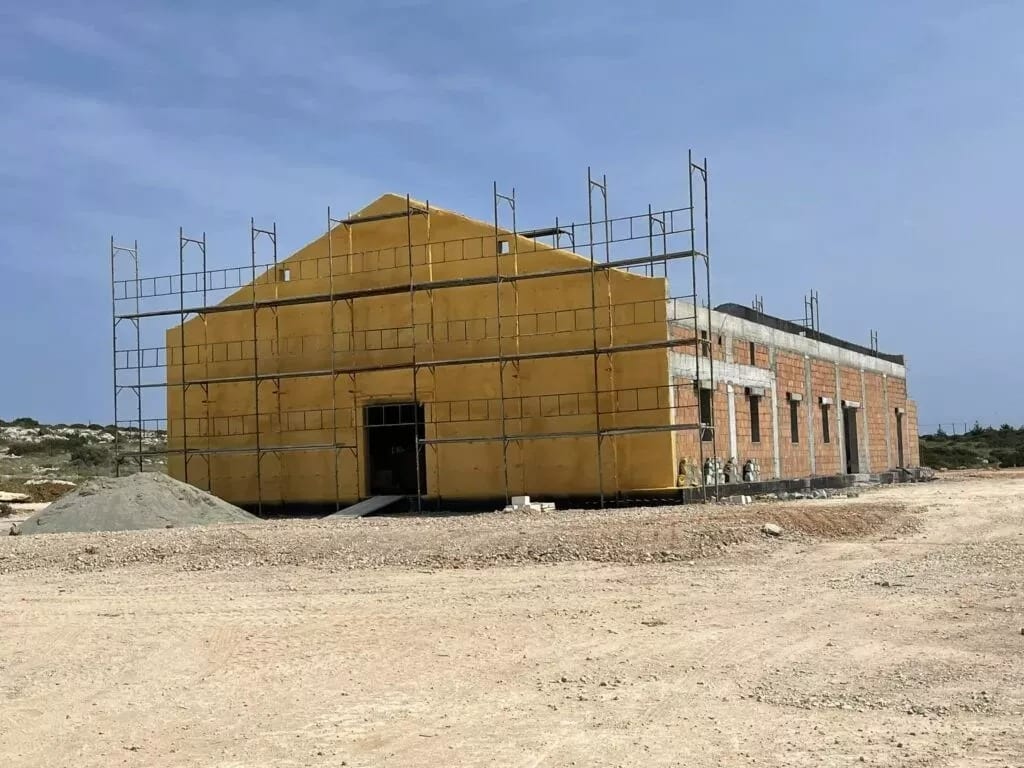
MPs clashed on Thursday over whether a monastery built without permits inside Cape Greco’s Natura 2000 area should be licensed, as the House interior committee heard that some 200 of 294 applications for planning exemptions over the past three years were approved.
The committee met to discuss the monastery of Saints Ephraim and Catherine, which the Famagusta bishopric began building at Mazeri tou Koukou in Ayia Napa municipality.
Both the environmental and town planning departments have advised that the exemption be refused, yet nonetheless the council that arbitrates over such cases (Symepa) decided last week to reopen the application after the bishopric assured it would scale back its earlier proposals for the monastery.
Committee chairman and Akel MP Aristos Damianou, said the practice of granting exemptions had “troubled society for years”, raising doubts about whether decisions “served the public good” or reflected “other vested interests and external pressures”.
He said “a large number of opinions” consider the edifices illegal, and that a court decision already exists on the matter.
Damianou also lambasted the absence of Ayia Napa municipality, which he called “the most responsible body”.
“You can’t demolish a pergola or a room in a refugee house, but you can swallow up whole plots in protected areas,” he remarked.
Disy MP Andreas Constantinou said members had agreed that “stricter procedures are needed” and that authorities must be given the tools to intervene in time.
He stressed that “the permit must precede the project”, to stop work starting before an application is lodged.
He said the committee would also examine how Symepa operates, and whether municipalities and communities are told in sufficient time about permits issued after licensing powers were transferred.
On the monastery itself, he insisted that the project “must be licensed”, remarking that under today’s bureaucratic procedures “not even the Apostolos Andreas monastery could be built”.
Elam MP Andreas Papacharalambous defended the project as “a spiritual institution” tied to a planned shelter for abused women and children.
“This is no ordinary structure at hand, we are talking about our church,” he exclaimed, urging that Symepa must examine the application “without any pressure or prejudice”.
The bishopric has assured it will scrap buildings making up more than half of the plot ratio, leaving only a monastery and the shelter.
The environment department wrote to Symepa on September 4 that required environmental procedures had not been followed and that the project was already well advanced, which “harmed the integrity of the Natura 2000 sites” and recommended rejection.
The town planning department said in February that the project breached nine provisions of the development plan.
The environmental group Terra Cypria informed the committee the plot lies within an important bird area and a migratory corridor, saying Symepa “appeared to have ignored” a 2024 administrative court ruling against the bishopric.
According to Terra Cypria, large earthworks took place in late 2023 and early 2024 without either environmental or building permits.
The bishopric applied for an exemption on March 20 after a complaint was filed and an enforcement notice ordering demolition within 15 days followed on March 28, yet the structures remain to this date.
Auditor-general Andreas Papaconstantinou wrote to the cabinet on October 27 regarding the development, as it is they alone who makes the final decision.
The committee will return to the issue in January.




Click here to change your cookie preferences