
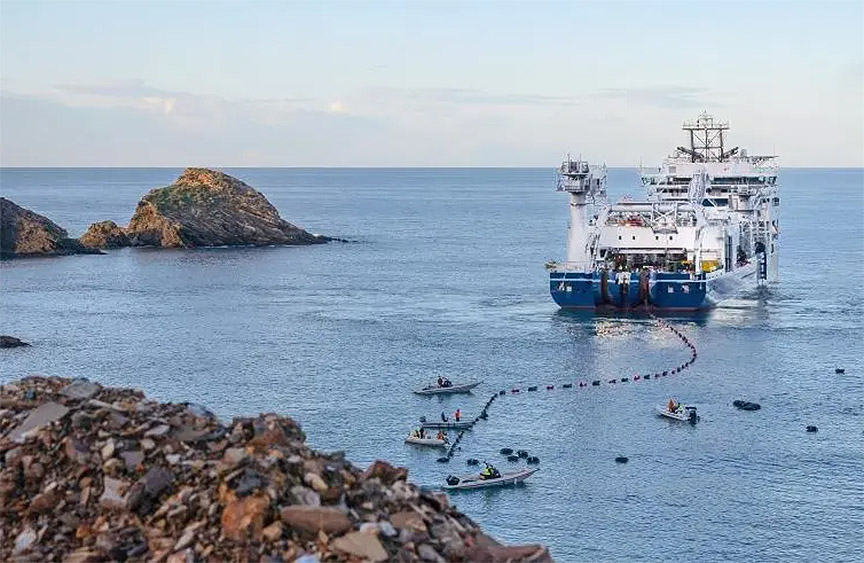
French telecoms company Nexans has reportedly withdrawn tenders linked to the Great Sea Interconnector (GSI), informing interested companies that the project is not moving forward on its existing timetable.
Sources close to the government on Tuesday informed the Cyprus Mail that the company’s reassessment was expected, given the numerous delays the project has faced.
The same source confirmed that subcontractors had already anticipated delays, as the overall construction schedule could not be sustained while the project was under review.
Speaking to reporters on Tuesday, President Christodoulides said he had not received any official briefings regarding reports about Nexans’ next steps.
He reiterated that public statements must be made responsibly and only once he is formally informed.
According to reports, Nexans had already sent written notices to subcontractors, confirming that the tenders were being cancelled because the project cannot proceed as originally intended.
Nexans has stopped short of declaring an outright withdrawal from the GSI, telling companies the project will be re-evaluated and that a revised programme will follow before any new tenders are issued.
French media outlet Les Echos said that on Tuesday Nexans’ share price on the Paris stock exchange dipped 8.5 per cent on news of a possible reassessment of the project.
Later in the day Nexans issued a press release affirming that it continues to “pursue the project’s execution, in line with its contractual obligations and in line with the steps defined with its client”.
It added: “In projects of this nature and scope, these steps may be adjusted over time.”
“Since the launch of the project, Nexans continues to support its client and has received substantial payments allowing for the fabrication of the cable for the Great Sea Interconnector. Thanks to this, the group has eliminated all financial risk in the event of adjustments to the project.”
Only a few weeks prior, Nexans’ CEO Julien Hueber insisted that work was progressing as planned and dismissed the notion of any ‘plan B’ being drafted, despite earlier company statements mentioning alternative uses for the cables if the project failed.
Up until August of this year, Nexans had received up to €250 million from Greece’s independent transmission system operator (Admie) to cover completed work, yet it remains unclear whether any further payments were made after that.
Admie is the project promoter for the GSI, and Nexans’ client.
The halt comes after President Nikos Christodoulides and Greek prime minister Kyriakos Mitsotakis agreed in Athens that the interconnector’s technical parameters must be updated to attract investors.
The leaders affirmed that the project remains of paramount strategic importance, both for regional security and for ending Cyprus’ energy isolation.
Meanwhile, the European Commission sent an unequivocal message of support regarding the GSI.
In a written response to MEP Michalis Hadjipantela, EU energy commissioner Dan Jorgensen stressed that completing the electricity interconnector remains an EU priority and that no new study is required.
The Commission underlined that the evaluation has already been finalised and confirmed that the project’s benefits outweigh its costs.
The newly appointed energy minister Michalis Damianos was also unavailable for comment.






Click here to change your cookie preferences