
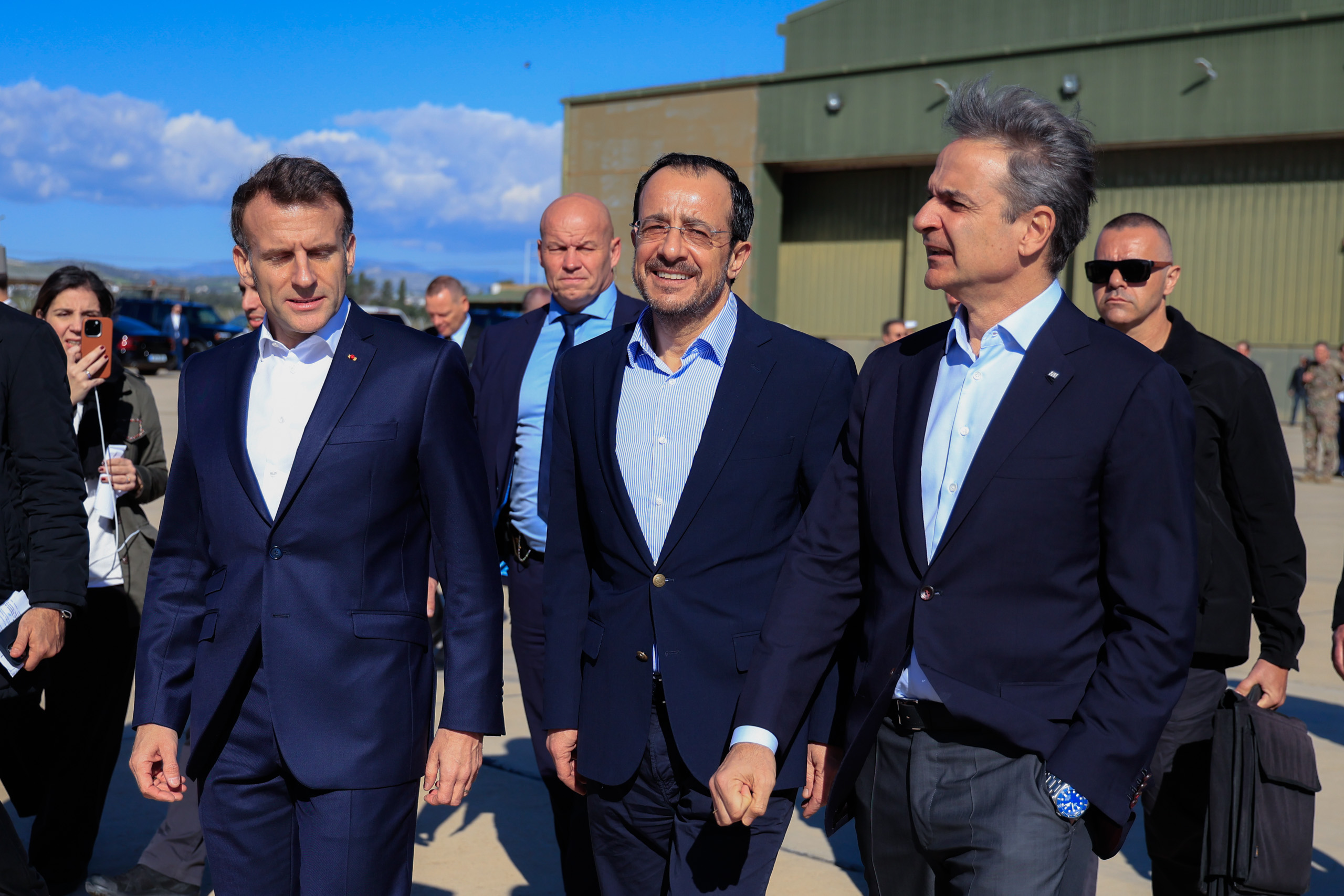
President Nikos Christodoulides could not hide his pride playing host to French President Emmanuel Macron and Greek Prime Minister Kyriakos Mitsotakis at the Paphos air base on Monday. He had every reason to feel personal pride about the way he had secured the support of two European countries whose leaders were here to show their solidarity in practice.
It was not just verbal support. Last week Greece deployed four F-16 fighters to the Paphos air base and sent two frigates to defend Cyprus. France, meanwhile, deployed a Mistral anti-aircraft unit and the Languedoc frigate last week and the Charles de Gaulle aircraft carrier is currently on its way to the region to contribute, in Macron’s words, “to the overall defence picture and to ensure it in the long term.”
We heard a lot of fine words at the joint news conference given by the three men in a helicopter hangar at the Andreas Papandreou base. Macron said that when someone “attacks Cyprus they are attacking Europe,” and last week the island had been “the target of several drones and missile fire.” The Cyprus government, understandably, did not make much of these attacks – it did not even report them publicly – but they must have been considered dangerous enough to persuade several EU countries to deploy naval assets in the vicinity of Cyprus.
Mitsotakis, apart from referring to the national bonds between Cyprus and Greece, also saw the bigger picture of EU unity. “If we cannot act together in such a crisis, how would we face possible, subsequent threats,” he asked, before concluding that “now is the time to make it clear that every bit of European territory is inviolable.”
Christodoulides, who has been agitating for greater EU involvement in what was happening in Middle East, appears to have got his way to an extent. He repeated his view that “Europe must become more actively and more coherently involved in the region with an approach that aims to strengthen security, stability and cooperation.” When Cyprus assumed the presidency of the EU council, Christodoulides had said he would bring the EU closer to Middle East and, in a way, he has done that.
Naval assets from several EU countries have arrived in the Middle East. Italy and Spain have sent frigates while others from different countries are accompanying the Charles de Gaulle. Macron said that France wishes to ensure the freedom of navigation in the Eastern Mediterranean and the Red Sea. In other words, there were also other reasons, apart from the defence of Cyprus, for the large presence of European warships in the region.
This, however, should take nothing away from the fact that EU member states came to the defence of Cyprus when there was a need. For this, all credit must go to Christodoulides.

Click here to change your cookie preferences