
A group of livestock farmers gathered on Wednesday outside a livestock unitin Yeri to protest the planned collection of animal samples by the veterinary services, amid rising tensions over containment measures for the spreading foot-and-mouth disease outbreak.
The protest followed the circulation of a document among livestock farmers calling on farm owners to refuse veterinary sampling, a move that has sparked sharp divisions within the agricultural community while authorities warn that cooperation is essential to contain the virus.
According to news website, Reporter, the document, circulated through social media groups used by livestock farmers, is titled “official objection and notification of invalidity of sampling”.
It urges farm owners to sign a declaration refusing access to veterinary services officials seeking to collect samples from animals for laboratory testing under disease monitoring protocols.
The development comes as Cyprus remains on high alert after the virus spread from Larnaca into the Nicosia district, including farms in Dhali and Yeri.
Farmers assembled outside the unit in Yeri after the owner was informed that Veterinary Services personnel would arrive to collect samples on Wednesday morning.
Supporters of the protest claim the sampling procedure is premature and inconsistent with official protocols following vaccination.
Livestock farmer, Theodoros Groutas, criticised the document publicly, expressing alarm that some producers are being encouraged to obstruct veterinary checks during a major disease outbreak.
Speaking on state broadcaster, CyBC, he questioned who had drafted the document and warned that its claims could undermine efforts to control the virus.
“I have a document in front of me which I do not know who drew up. It is titled ‘official objection and notification of invalidity of sampling’,” he said.
“It speaks about violations of official protocols and about the inaccuracy of the testing. It tells the owner to sign so that the veterinary services cannot carry out a check.”
Groutas instead called for stricter biosecurity measures in the Dhali–Yeri livestock area, where numerous farms operate in close proximity.
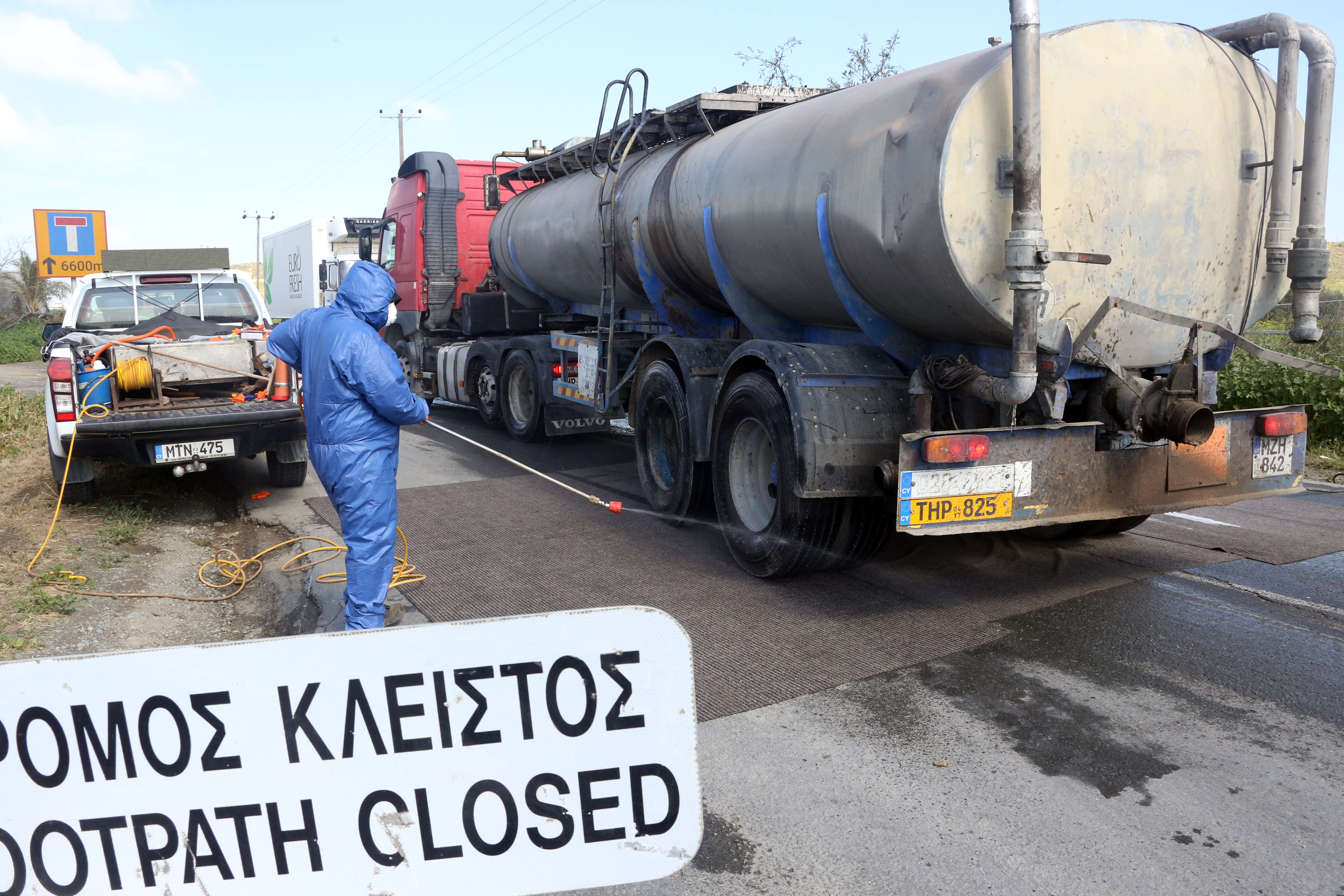
He argued that some existing disinfection precautions are insufficient, warning that vehicles moving between farms may not be properly sanitised.
“If a tractor passes over the carpets placed for disinfection it is not adequately disinfected,” he said, suggesting additional infrastructure such as mobile sanitation units to reduce the risk of spreading the virus between livestock facilities.
The farmer also raised concerns about illegal trade in agricultural products across the Green Line, arguing that weak enforcement contributes to the disease risk.
“It is not only hay bales that come from the occupied territories,” he said.
“Smugglers bring sugar, soft drinks, bread and yoghurt. Everyone knows who they are but nobody stops them. They have become completely brazen and move goods in broad daylight.”
Another farmer speaking on the same programme, Christodoulos Christodoulou, defended the document circulating among producers, arguing that veterinary sampling should not take place immediately after vaccination.
According to him, such testing could produce misleading results.
“The protocols say samples should be taken thirty days after the second vaccination,” he said.
“Why do they come to take samples as soon as the animals are vaccinated? Of course the animals will test positive.”
Authorities have not commented directly on the document but have repeatedly stressed that full compliance with veterinary protocols is essential to halt the outbreak.
Veterinary officials warn that delays or obstruction of inspections could worsen the situation as the highly contagious virus spreads between livestock units.
Foot-and-mouth disease has now been confirmed on dozens of farms across the island, with more than 15,000 animals already culled under European Union disease control rules.
Veterinary services have established three-kilometre protection zones and ten-kilometre surveillance zones around affected farms in Dhali and Yeri after infections were detected in the area earlier this week.
The spread beyond the original outbreak zone in Larnaca has heightened concern among authorities and the agricultural sector.
Cyprus’ dairy industry is heavily concentrated in the Idalion (Dhali) livestock region, making the containment of the virus there particularly urgent.
Government spokesman Konstantinos Letymbiotis warned that failure to follow scientific protocols could significantly increase the risk of further transmission.
“The surest way to overcome this major crisis is the complete and timely implementation of the procedures drawn up by scientists,” he said earlier this week.
The crisis is also raising wider economic concerns.
Halloumi, Cyprus’ flagship export product, generated approximately €356 million in exports in 2025, making the stability of milk production critical to the national economy.
While processed dairy products such as halloumi remain exempt from current export restrictions due to heat treatment during production, industry representatives warn that prolonged disruption to livestock farming could affect supply.
Meanwhile, public health concerns have been raised after two dead cows were discovered abandoned in a rural area along the Orounda–Ayia Marina road.
Residents reported that the carcasses had been left exposed near homes and businesses and had begun attracting stray dogs.
Local residents said similar incidents had occurred in the past and that complaints had previously been submitted to both police and veterinary authorities.
Government officials have also announced a €28 million support package for affected livestock farmers, including advance compensation payments and financial assistance to rebuild herds once the outbreak is contained.
Veterinary authorities insist that compliance with containment rules remains the only way to bring the outbreak under control and avoid deeper damage to Cyprus’ livestock sector and export markets.



Click here to change your cookie preferences