
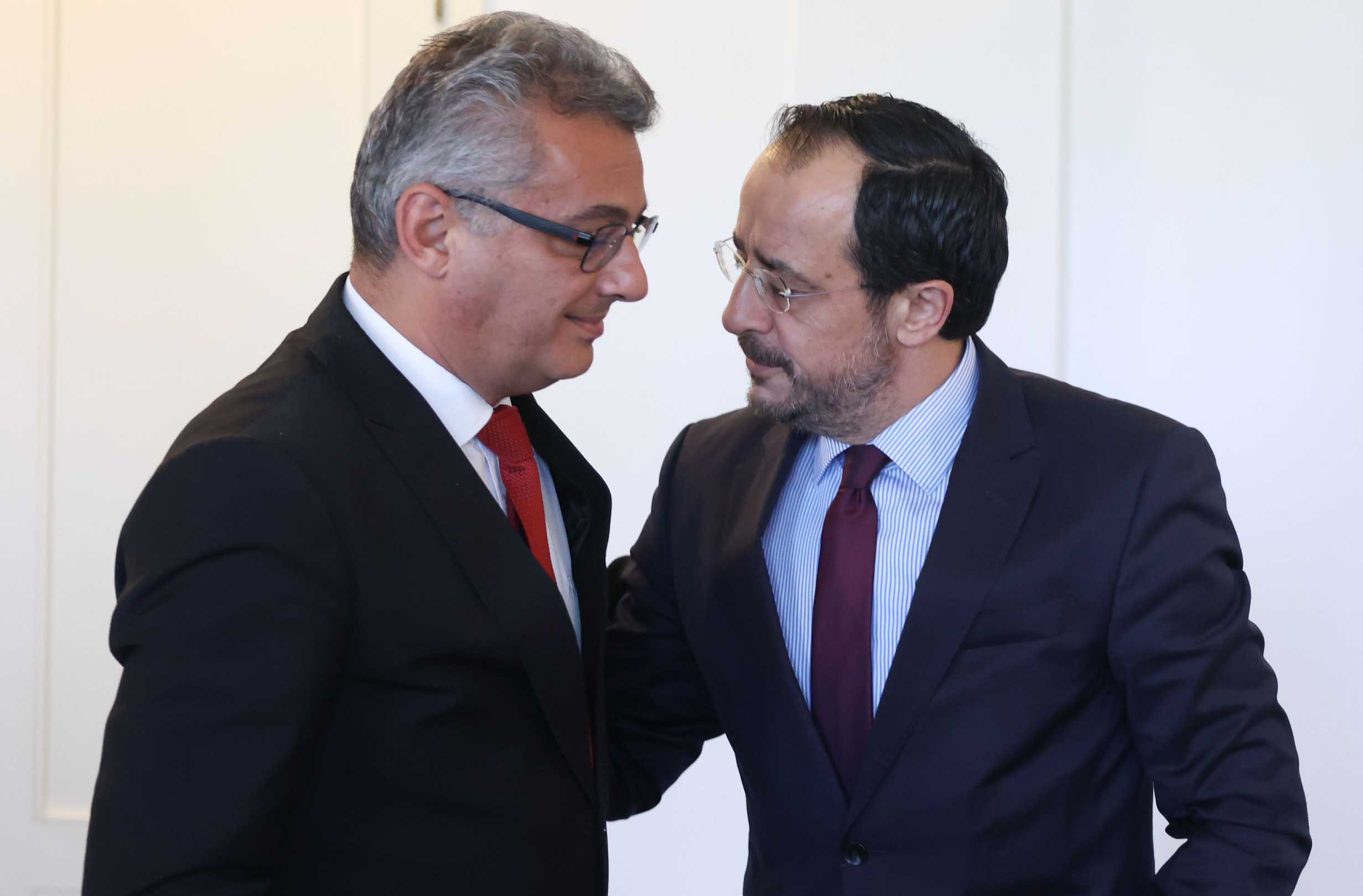
Christodoulides says he is ready – for what exactly?
By Nikolas Xenofontos
UN Secretary-General Antonio Guterres, after the last Christodoulides-Erhurman meeting on May 8, appears to be placing the new initiative on the Cyprus problem after the parliamentary elections and after the completion of the Cypriot presidency of the Council of the EU. And this is because the Cyprus problem does not move in a political vacuum.
In their last meeting, the two leaders agreed on certain low-political-intensity confidence building measures, such as the formulation of a framework for the participation of civil society, the preparation of a framework for the holding of religious services, the handling of foot-and-mouth disease, as well as the establishment of a new subcommittee within the framework of the Technical Committee on Economic and Commercial Matters.
These, of course, should not be underestimated, but they do not carry substantial weight regarding the Turkey factor. Christodoulides, immediately after the meeting, referred to an “informal expanded conference within the summer”. He himself declares that he is ready.
The critical question, however, is why Turkey should become substantively involved in such a process. At the same time, not even the Turkish Cypriot side declares itself ready for an immediate transition to a new conference, insisting on a step-by-step process.
Erdogan’s response to Guterres
When Erdogan and Guterres met, the latter asked for the Turkish President’s help on the Cyprus problem. But Erdogan told the SG that he has made great efforts without there being any result, noting that the problem lies elsewhere — and not with himself — implying the Greek Cypriot side. In conclusion, he left Guterres free to do whatever he thinks.
And so Guterres, with his immense Job-like patience, is trying to hand something over to the next SG, but why ask for Erdogan’s help at a time when Turkey is moving towards two states? An oxymoron, don’t you think?
Erdogan did not need to believe ideologically in two states in order to promote them. It was enough for him that this rhetoric served him as long as the Greek Cypriot side was giving Turkey no reason to return seriously to a federal framework.
Christodoulides
Christodoulides has stated that Turkey will move only when the interests of a solution are greater than those of non-solution. But not only does he offer nothing that could entice Turkey — such as a package of an upgraded customs union, natural gas with a pipeline to Turkey, SAFE, etc. — he is also trying, through his clumsy moves, to destroy anything positive that exists in the Cyprus problem.
Not only are we not trying to use energy through Turkey so that it has a reason to withdraw from our territories, but we are trying to eliminate them as the Republic of Cyprus through a commercial agreement towards Egypt, bypassing the Turkish Cypriots as well.
But that was not enough; we continue the criticism towards the UN, and we do not connect the Cypriot presidency at all with the national issue. Only with energy. But the energy developments proceeded without the consent of the Turkish Cypriots and not towards Turkey. What exactly is our President trying to do? Send a message to Turkey? To tell it what?
The backstage…
After, then, the Christodoulides-Erhurman meeting and the agreement on four low-political-intensity CBMs, Christodoulides did not speak only about a “summer expanded conference”, but also about a solution plan for the Cyprus problem before the end of 2026. He himself appears to base his optimism on the new mobility that emerged after the Guterres-Erdogan meeting, on the support of the EU and on contacts with the SG’s envoy.
The President spoke of backstage processes that began after the Guterres-Erdogan meeting, clarifying however that he himself has not met with the Turkish President. This in itself is not paradoxical; diplomacy often moves through third parties. The question is different: if the process needs low tones, why is Nicosia turning it publicly into an expectation of a solution plan before it has even become clear whether there is common ground with the Turkish Cypriot side and Turkey?
The European framework already points in this direction through the new EP resolution on the Cyprus problem, which, while condemning the Turkish stance on critical issues, at the same time recognises the need for cooperation with Turkey at a European level.
Nicosia, however, does not appear to be doing this. Instead of using the European discussion as a lever for a solution, it uses it mainly as a field for projecting the Republic of Cyprus.
The same applies to energy. If Turkey holds the key, then natural gas is one of the few practical tools that could change its calculation. But if this tool is disconnected from the solution and locked into a route that bypasses Turkey and the Turkish Cypriots, then Nicosia is not increasing the value of the solution. It is reducing it.
The Guterres initiative does not need only incentives towards Turkey. It also needs a climate of trust with the Turkish Cypriot side and the UN.
The new Guterres initiative, therefore, will not be judged by whether Christodoulides declares himself ready for a conference. It will be judged by whether Nicosia can create the conditions that will make a conference substantive.
If Turkey holds the key, as the President himself admits, then the policy of the Republic of Cyprus must answer one simple question: what is it doing so that the solution becomes more beneficial than non-solution?
So far, the answer is not convincing. Nicosia is not forming a European package of incentives, it is not turning energy into a common tool of solution, it is not cultivating sufficient trust with the Turkish Cypriot side, and it is not protecting the positive climate that the UN needs in order to move.
Guterres can open a window. Turkey can calculate interests. Europe can offer a framework. But Nicosia must have a strategy.
And here lies the problem. The Christodoulides obstacle is not that he does not speak of a solution. It is that he speaks of a solution without making the solution more likely. Without making it more beneficial. Without making it more credible.
If the new Guterres initiative is lost, it will not be only Turkey’s fault. It will also be the fault of a Nicosia that saw the window opening and, instead of filling it with strategy, treated it as yet another opportunity for communication management.




Click here to change your cookie preferences